

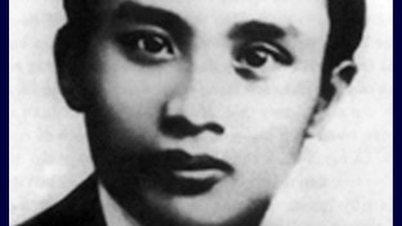
As a patriotic scholar, Hoàng Giáp Nguyễn Thượng Hiền left behind a vast literary legacy with over 600 poems. But above all, he was a prominent patriot of the late 19th and early 20th centuries, having a significant influence on patriotic scholars in Thanh Hóa .
Nguyen Thuong Hien (1868-1925) was from Lien Bat village, Ung Hoa district, Ha Dong (now part of Hanoi ). Born into a scholarly family, at the age of 16, he took the provincial examination for the first time and passed, earning a bachelor's degree in Thanh Hoa. In 1885, he topped the national examination but before his name could be announced, Hue fell, and he retreated to live in seclusion in Nua Mountain (Thanh Hoa). In 1892, at the age of 24, he passed the imperial examination again, earning a second-class doctorate (Hoang Giap), and was appointed as a compiler at the National History Institute. He was later promoted to Head of Education in Ninh Binh (1901), Ha Nam (1905), and Nam Dinh (1906).
Although educated in Confucian thought, he was fond of reading modern books and was one of the first Vietnamese to embrace and propagate the bourgeois democratic ideas of Kang and Liang (Kang Youwei and Liang Qichao - Chinese - who advocated regime change and comprehensive reform to revitalize the country). He enjoyed associating with patriotic intellectuals such as Tang Bat Ho, Phan Boi Chau, and Phan Chu Trinh...
In the early 20th century, patriotic movements such as the Duy Tan movement, the Duy Tan Society - Dong Du movement, and the Dong Kinh Nghia Thuc movement influenced patriotic intellectuals in Thanh Hoa. Specifically, in 1906, before going to Japan, Phan Boi Chau stopped in Thanh Hoa, met with a group of patriotic scholars from Thanh Hoa, and discussed the path to national salvation.
Here, the headmaster Nguyen Thuong Hien, a key figure in the Dong Kinh Nghia Thuc movement, actively propagated new ideas of cultural and social reform in Thanh Hoa, especially among the intellectual class, with famous works by Phan Boi Chau such as "History of Vietnam's National Loss" and "Blood Letter from Overseas"... Through this, those who shared the same ideology as Phan Boi Chau and Nguyen Thuong Hien not only learned about the bourgeois democratic revolution but also found a new path to national salvation, establishing a "New Party" and participating in the Dong Du movement. This led to the establishment of several schools and economic establishments modeled after the "Nghia Thuc" movement, such as Hac Thanh Bookstore and Phuong Lau Company. These were also secret bases for patriotic propaganda, nurturing revolutionary seeds among the people of Thanh Hoa, so that when the opportunity arose, they would become a driving force for the larger movement in Thanh Hoa, coordinating with the nationwide struggle.
Nguyen Thuong Hien was a patriotic Confucian scholar, leaning towards democratic ideals, advocating for reform, and abandoning the monarchical stance and outdated Confucian views. His fervent activities in the Dong Kinh Nghia Thuc movement, the Dong Du movement, the Vietnam Restoration Society, etc., made a positive contribution to the Vietnamese national liberation struggle in the early 20th century.
Life reflects life, and so does poetry. Among the literati of his time, Nguyen Thuong Hien was a talented poet. He left behind a diverse literary legacy with over 600 poems and essays in both Chinese and Vietnamese scripts, composed over 33 years, from 1885 to 1918. In the early period, disillusioned with officialdom, he poured his feelings into the country: “If we synthesize all of Nguyen Thuong Hien’s nature poems, we will have a rather perfect picture of the country” (Tran Le Sang). In the later period, Nguyen Thuong Hien’s works mainly aimed at political mobilization, encouraging struggle, serving the cause of national salvation, and calling on compatriots to unite and rise up for revolution and national independence. Lines like, “The cradle cries out in lament / The streets are filled with crowds of mournful people / What pen can describe this scene? / Let the gods of rain and wind in the sky hear it”; “The more I talk, the more sorrowful I become / My garment soaked with pearls in the late night / Who has done such a thing to the nation? / Where can I turn to the Mandate of Heaven? / My shoulders are burdened with heavy responsibilities / My steps are slow and difficult to quicken across vast distances / My anger at the sea and my sorrow at the mountains remain unmoved / This poem of national loyalty will be left for posterity”... shows the profound understanding and shared suffering and hardship of a people who have lost their country.
It can be affirmed that in Thanh Hoa, there are not many books related to Nguyen Thuong Hien left. However, he left a significant mark. In the preface to "Thanh Hoa's Glorious Achievements" (Vuong Duy Trinh, Thanh Hoa Publishing House, 2021), Nguyen Thuong Hien, a second-class doctor of philosophy, wrote (according to the translation, annotations, and introduction by Vu Ngoc Dinh - Nguyen Huy Khuyen): "The virtuous man has lived in Hac Thanh for more than 20 years, his footsteps have wandered far and wide, only regretting that he has not been able to travel much. He often wishes to visit the famous scenic spots of mountains and rivers, but to this day he has not been able to fulfill his longing"... Standing before the "beautiful mountains and rivers, the profound and sacred voice," he "hopes that this land will forever be ranked among the famous villages." Doctor Nguyen Thuong Hien left behind many poems about the nature and beauty of Thanh Hoa. Notably, the poems include: "Hac Thanh Xuan Vong" (Viewing the Spring Scenery in Hac Thanh), "Hac Thanh Lu Cam" (Feelings While in Hac Thanh)... Or in "Memoirs of Le Manh Trinh" (Thanh Hoa Publishing House, 2019), when mentioning the Dong Du movement, Le Manh Trinh mentions Nguyen Thuong Hien and his decision to shave his head and become a monk to preserve his integrity. Although Nguyen Thuong Hien died on Van Son Cu mountain in Hangzhou (China) on December 27, 1925, at the age of 57, "The fire of purity burned the bones of a man of integrity, living nobly and dying nobly; In this civilized era, weary eyes are drawn to his homeland, his fame is complete but his aspirations are not yet fulfilled" (Eulogy for Mai Son Nguyen Thuong Hien written by Phan Boi Chau).
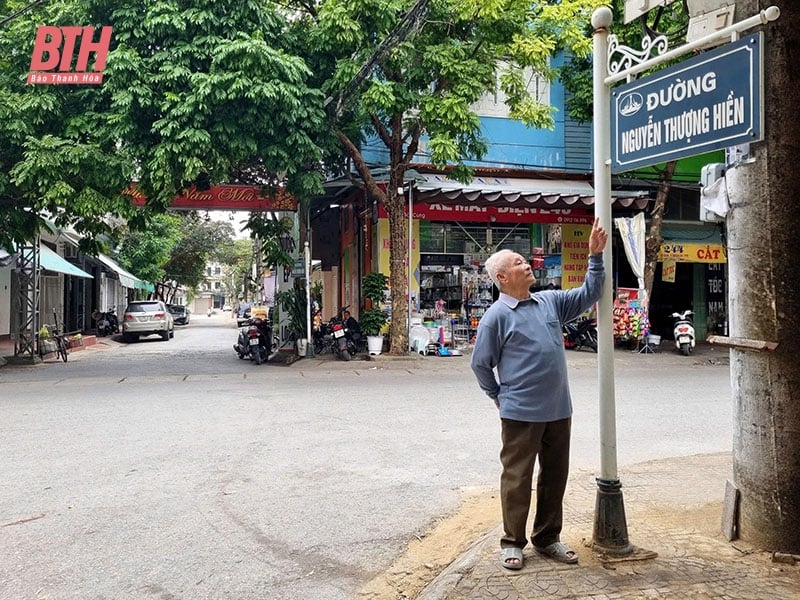
Coming from a Confucian background, willing to abandon officialdom and shun all fame and fortune to embrace reformist ideas with a democratic orientation, pursuing the cause of saving the country and its people, few people are like the scholar Nguyen Thuong Hien. Therefore, his name has been given to streets and many schools in Hanoi, Ho Chi Minh City, and other provinces and cities, including Thanh Hoa.
KIEU HUYEN
This article uses material from the books: Thanh Hoa Chronicle of Victory; Memoirs of Le Manh Trinh and the article: Intellectuals of Thanh Hoa in the patriotic movement against French colonialism in the first 30 years of the 20th century...
Source: https://baothanhhoa.vn/nguyen-thuong-hien-tu-tri-thuc-nho-hoc-den-chi-si-yeu-nuoc-231824.htm














![[INFOGRAPHICS] Phase 2 of the First Session of the 16th National Assembly: Considering and deciding on many important issues](https://vphoto.vietnam.vn/thumb/402x226/vietnam/resource/IMAGE/2026/04/20/1776678933182_20-4-anhquochoi2004.jpeg)
![[Infographic Series] Red Addresses of Dong Nai: Headquarters of the Southern Vietnam Liberation Army, Tan Hiep Prison Relic](https://vphoto.vietnam.vn/thumb/402x226/vietnam/resource/IMAGE/2025/9/26/1331532306fb4ad18e4a849e5c64202a)











































Comment (0)