 |
The price of Bitcoin has reversed to a level nearly two years ago. Photo: Decrypt . |
The price of Bitcoin has fallen below $60,000 for the first time since October 2024, marking a major turning point for the world's largest cryptocurrency after a period when it was considered the "star" of the global financial market thanks to the effect of Donald Trump's re-election as US President at the end of 2024.
According to Bloomberg , during the trading session on June 5th, the price of Bitcoin at one point dropped by as much as 7%, to $59,101 /BTC. Compared to its historical peak of over $126,000 set in October last year, the price of Bitcoin has lost more than half its value. The cryptocurrency is even trading at a lower level than when President Trump returned to the White House.
What's happening to Bitcoin?
The latest price drop stems from multiple factors simultaneously, including investors withdrawing capital from spot Bitcoin ETFs, escalating geopolitical tensions, and growing concerns about the sustainability of one of the most important sources of demand for Bitcoin.
One company that has garnered significant attention is Strategy, owned by billionaire Michael Saylor. This firm previously contributed to the bull market with its large-scale Bitcoin purchases. However, following this week's rare Bitcoin sale, Strategy has become the focus of scrutiny regarding its business model of holding digital assets on its balance sheet.
The overall landscape is also becoming less favorable for the cryptocurrency industry.
For much of the past decade, cryptocurrencies held a special place among risky assets favored by investors. However, the flow of money that once almost automatically went into the cryptocurrency market is now being dispersed to many other speculative assets, while artificial intelligence (AI) is emerging as the most attractive technological trend.
"For a long time, cryptocurrencies were the hot investment that Silicon Valley and financial institutions were obsessed with. But AI has taken that place," said Michael Antonelli, market strategist at Baird.
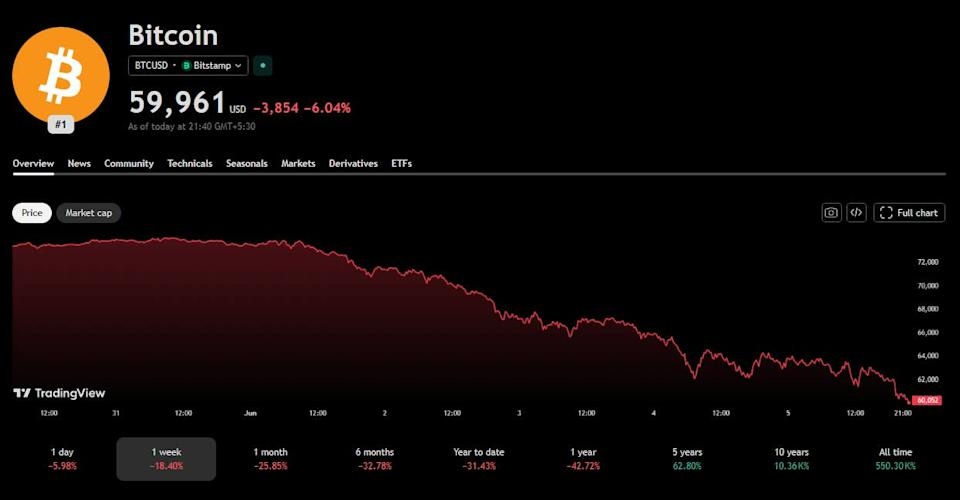 |
Bitcoin hit its lowest level in nearly two years. Photo: TradingView. |



AI stocks are now the focus of market growth, diminishing the appeal of Bitcoin. In addition, individual investors are also pouring money into short-term options contracts and the forecast market.
Even within the digital asset sector, stablecoins and perpetual futures contracts are attracting more attention, rather than the flow of money into Bitcoin as in previous cycles.
Not only did Bitcoin plummet, but many other major cryptocurrencies also fell sharply during the weekend's trading session.
Ether at one point lost as much as 13% of its value, falling to its lowest level since April 2025. Meanwhile, XRP, Solana, and Dogecoin all dropped by more than 5%.
The Trump effect is no longer strong enough to support the market.
Notably, the current downturn is occurring at what should ideally be the most favorable period for the cryptocurrency industry.
The Trump administration helped the sector achieve many of the goals the cryptocurrency community had pursued for nearly a decade, including a president with a pro-cryptocurrency stance, a more open regulatory environment, acceptance from major financial institutions, and a legal framework that increasingly recognizes digital assets as a permanent part of the financial system.
However, instead of generating a new wave of demand, those positive factors coincided with one of Bitcoin's sharpest corrections in years.
Bitcoin's all-time high was set just days before the market entered a prolonged sell-off. Billions of dollars in speculative positions were liquidated, making the market more vulnerable to shocks.
The conflict in Iran continues to weaken investor risk appetite. While the stock market benefits from the AI wave and continuously sets new records, Bitcoin is being left behind.
At the same time, renewed concerns about inflation are helping gold outperform Bitcoin, thereby undermining the "inflation hedge" role that the world's largest cryptocurrency once held.
Expectations of a wave of adoption from financial institutions are now giving way to the question of whether large investors can continue to expand their positions at the same pace as before.



"If gold is competing with the US dollar, then Bitcoin is essentially competing with global liquidity," said Dean Chen, an analyst at the cryptocurrency exchange Bitunix.
According to him, as the market increasingly believes that interest rates will remain high for longer and the cost of capital continues to be expensive, investors will tend to reduce their holdings in assets that do not generate cash flow, such as Bitcoin.
Source: https://znews.vn/tuan-dang-buon-cua-bitcoin-post1657498.html