

I was born and raised in the countryside of Tuy Hoa, a place less than 10 kilometers from the town, but as a child, it always seemed so far away. From the time I was old enough to understand until I finished primary school, I remember my mother taking me to the town about three times. Each time, we stopped at the town market to buy things like fabric for my New Year's clothes, and a few packets of tea from the Danh Thai tea shop near the market to give to my two uncles. Afterwards, my mother took me to the My Dung photo studio to have some pictures of mother and child taken. I later learned that these pictures were to be sent to my father, who was away fighting in the revolution. "Fighting in the revolution" was what the villagers called it, but according to the officials at the time, it was "following the communists."
 |
| Tuy Hoa in the 1960s. (Image from a collection) |
My house was in Nhon hamlet, a small village like an oasis in the middle of the fields, also known as Phuong hamlet. It had over a hundred houses, and most of them had children involved in the revolution, so the authorities at the time paid close attention to them. From my house to Provincial Road 5, I had to walk nearly two kilometers along a dirt road, which was very muddy during the rainy season. The primary school I attended was Phuoc Binh branch school. Before 1961, it had three classrooms with thatched roofs and mud walls. In 1962, two more rooms, single-story buildings with brick walls and tiled roofs, were added for the second and first grades (equivalent to grades 4 and 5 now). It was located very close to Provincial Road 5 and next to the village communal house. Every day, my elementary school friends and I walked from Nhon hamlet to school, traversing that bumpy two-kilometer dirt road.
To get to the town in the early 1960s, I would walk from my house to Provincial Road 5 and then take a motorized rickshaw from Phu Thu to Phu Lam to go to Tuy Hoa. But back then, motorized rickshaws from Phu Thu were very rare; when one did appear, it was mostly already full, so people usually chose to take a horse-drawn carriage to Phu Lam. It cost 1.5 dong for adults and 1 dong for children like me. From Phu Lam, taking a motorized rickshaw to Tuy Hoa market cost 3 dong per person.
 |
| The Tuy Hoa road sign on National Highway 1, north of Song Chua Bridge. (Image source: collected) |
At that time, the roads were very poor. Even the section of National Highway 1 from Phu Lam to Tuy Hoa was very narrow and full of potholes; when reaching the Da Rang iron bridge (often called the 21-span bridge), vehicles had to stop and wait for the signal from the bridge guard. The road bridge over the Da Rang River had been bombed by the French in 1953 and had not been rebuilt, so vehicles on National Highway 1 at that time shared the railway bridge, but because the bridge was narrow, only one-way traffic was allowed when there was no train. There were guard booths at both ends of the bridge to control one-way traffic. Back then, there wasn't much traffic on the road, so it wasn't too congested. The scariest thing was riding a bicycle or motorbike across the bridge because there were two railway tracks in the middle, and if you weren't careful, your wheels could get caught in the gap between the tracks.
I remember, around the beginning of July 1964, Uncle Bon Hue (my Uncle Chin's son, who later became a martyr in 1966) rode his bicycle past my house to give me a ride to Tuy Hoa to take the entrance exam for the 7th grade at Nguyen Hue High School. That was also the first time I had been to the town and stayed overnight. He took me to my lodging in an alley off Cao Thang Street, cooked lunch himself, then went down to the school to check my exam number, find and check the exam location beforehand. That evening, he took me for a walk to the Rang Dong ice cream shop on Phan Dinh Phung Street to treat me to a lucky ice cream before the exam, and then we strolled around the Nga Nam intersection.
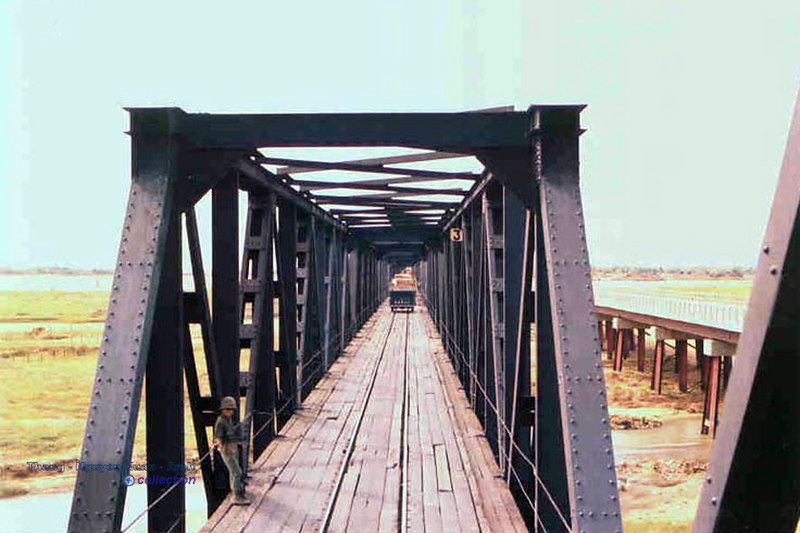 |
| The railway bridge with 21 spans over the Da Rang River south of the town was used by both trains and cars at the time. (Image from a collection) |
This was also the first time I'd walked at night under streetlights. Back then, the streets weren't as bustling as they are now, but for a country boy like me, it was already very lively. I did very well on that exam, so Uncle Bon even treated me to a cold dessert (a kind of milk tea today) at Dao Nguyen shop the following evening to celebrate. Perhaps passing the entrance exam to the seventh grade at Nguyen Hue High School was the beginning of how a country boy like me would become a city dweller for the rest of my life.
During my seven years of high school at Nguyen Hue High School, I moved six times. First, I lived in the neighborhood behind the Tan Hoa ice factory, about 70 meters from the Tuy Hoa power plant, where I could always hear the noise of the machinery from both facilities. Less than a year later, I moved to a house with a mezzanine on Tran Quy Cap Street, south of Bo De School. It was called Tran Quy Cap Street for show, but at that time it was just a narrow alley lined with bamboo, and in the rainy season, you had to wade through mud. I lived there for half a year before moving to the Duong neighborhood, north of what is now Ham Nghi Street. At that time, it was a low-lying rice paddy area where people dug ponds to irrigate their water spinach crops. It was less than 100 meters walk from there to the train station, near a depot for repairing locomotives and carriages. The section of Tran Phu Street (now Tran Phu Street), from the railway line to Le Thanh Phuong Street, was then a railway track used for turning around trains at Tuy Hoa station.
 |
| Nga Nam in those days. (Image from a collection) |
In the past, the Duong neighborhood was a poor rural area with unreliable electricity and mostly dirt roads. After my brother Bon Hue left for the mountains at the end of 1965, I had no one to rely on and, at only 12 years old, had to struggle to find a place to stay. Sometimes I stayed at Aunt Bay's house in a crowded alley near the old Nguyen Hue School, sometimes I stayed with a distant relative on Le Loi Street, and finally, in my senior year of high school, I stayed with my cousins in the Motolux alley between Le Loi and Nguyen Hue streets. Despite the hardships, perhaps because of these frequent changes of residence, I felt increasingly attached to my town, especially to the dusty, bumpy alleys in the dry season and the muddy ones in the rainy season. This is also why, 35 or 36 years later, when I was assigned to be the town's secretary, one of the things I was determined to implement as soon as possible was the program to pave sidewalks and alleys with concrete, and it was a success.
Sixty years ago, Tuy Hoa town was very small and didn't even have an official name; calling it a town was just a habit. The government at the time called it Chau Thanh commune, with its headquarters at the corner of Tran Hung Dao and Tran Binh Trong streets, diagonally opposite Bo De High School. The urban area at that time was defined by the east-west direction from National Highway 1 to Nguyen Hue School, and the north-south direction from Chua River to Road No. 6 (Nguyen Hue Street). If we could add to that, the area around Ga Hamlet and the 18-house neighborhood along National Highway 1 (now part of Ward 2) could also be considered part of the urban area.
The area under the sea at that time was very desolate, mainly containing the Provincial Administrative Building and mostly military restricted zones. At night, there were no streetlights, only a few searchlights from the military camps. The coastal road (now Doc Lap Street) was eroded by the waves, and many sections were covered with sand. The coastal casuarina forests were cut down for fear of Viet Cong infiltration and attacks. On Nguyen Hue Street (then commonly called Street No. 6), the area around the Children's House and the Tobacco Factory (then the Police Station) was heavily barbed wire fenced off, and few dared to pass by at night. From the beginning of 1966 onwards, when American troops poured into South Vietnam, military vehicles rumbled along Nguyen Hue Street every day, the road full of potholes, and dust billowed everywhere. And also from 1966, the war spread everywhere; at night, lying in the town, one could hear distant gunfire, interspersed with the rumbling of artillery fire from Nhan Mountain. People displaced from war zones poured into the town, crowding everywhere.
 |
| Tran Hung Dao Street, the section passing through Tuy Hoa market, is on the left. (Image from a collection) |
In 1964 and 1965, Tuy Hoa's streets were only bustling with activity around the Nga Nam intersection, north of Bao Tinh Pagoda, west of Dien Hong Flower Garden, east along Tran Hung Dao Street to the Information Department (opposite the current Agricultural and Rural Development Bank), and around Tuy Hoa Market. Other streets were deserted and had little traffic. The entire town at that time only had 12 or 13 streets, fewer than a single ward like Ward 7 or Ward 9 today. There was no water treatment plant; all households had to use well water. Electricity was supplied by a 6.7MW thermal power plant (located at the corner of Le Thanh Ton and Nguyen Thai Hoc streets), which only provided power to the inner city area. In the evenings, streetlights were mainly incandescent bulbs, emitting a dim, yellowish light; only the Nga Nam intersection and Tran Hung Dao Street had 1.2m fluorescent lights.
At the time when refugees flocked to the town, crowding into dilapidated houses with corrugated iron roofs in poor alleys and over densely packed cemeteries, the town center was only about 5 square kilometers. Back then, there were very few restaurants, mostly just small, inexpensive eateries. I remember restaurants with proper shops included My Chau Thanh restaurant at the intersection of Tran Hung Dao and Tran Quy Cap; Thanh Dam restaurant at the beginning of Tuy Hoa market, at the corner of Tran Hung Dao and Ngo Quyen; My An restaurant owned by a Chinese immigrant at Nga Nam; Thai Lai pho on Tran Hung Dao street below the market; Ninh Hoa spring roll shop and Ba Nam pho restaurant near Dai Nam theater; and Thien Huong chicken rice, which only opened in 1968, was located near the current Thien Huong restaurant.
Refreshment stalls included Rang Dong ice cream on Phan Dinh Phung Street; Dao Nguyen shop selling coffee and iced tea on Nga Nam; and Tuyet Hoa Vien shop selling iced tea and soft drinks in a kiosk right at the Tuy Hoa market gate facing Tran Hung Dao Street. The most famous coffee shop was Nho near Tuy Hoa train station; Vi Thuy (on Tran Hung Dao Street opposite Phu Thu today), Ha (Yersin Street), and Phuong (opposite Co.opmart today) only appeared after 1967. Also from 1967 onwards, a number of bars with waitresses selling alcohol and beer appeared in Tuy Hoa and Dong Tac, mainly serving American, Korean, and Saigon soldiers, lasting about 6-7 years. Accommodation at that time was very poor; apart from Vinh Dong A and Thanh Binh hotels (both on Le Thanh Ton Street), and later the somewhat decent Dai Lanh hotel, most were like Tan Hiep bedrooms (corner of Cao Thang and Le Thanh Ton), very dilapidated and low-class.
There were virtually no industrial production facilities, except for a power plant, a few ice factories like Phu Yen , Tan Xuan, Tan Hoa, and a handful of sawmills and carpentry workshops.
Regarding transportation, in 1964 and 1965, there were trains to Nha Trang, Saigon, and Quy Nhon. The Tuy Hoa train station, which was quite large during the French colonial period, now only remains as ruins – a few high walls. Next to it, there was a small, corrugated iron-roofed stationhouse that could accommodate 30-40 passengers waiting for trains. From 1967 onwards, train services were largely discontinued due to the destruction of many sections of the railway. Interprovincial travel was primarily by bus. The bus station was located west of the town market, occupying part of the southern section of the current provincial bus station and a portion of the provincial post office . At one point, the interprovincial bus station was located next to the Dien Hong Center, which included the current Nguyen Huu Tho Memorial House.
 |
| Ong Chu Bridge in those days. (Image from a collection) |
From the town center, traveling south towards the province by road was only possible via the 21-span bridge, and to the west, also only via the Ong Chu bridge. At that time, the Ong Chu bridge was a narrow, one-way bridge with iron girders and wooden decking. In late 1967, due to the escalating war, road travel to Saigon became impassable. Air Vietnam then launched the Saigon - Tuy Hoa - Saigon route, flying three times a week. A ticket agency and passenger pick-up/drop-off service was located near the corner of what is now Tran Hung Dao and Phan Boi Chau streets. The aircraft were Dakota propeller planes, redesigned for passenger transport, and were parked at Dong Tac airfield, which had a steel-paved runway. The town also had a military airfield, called Khu Chien airfield, with a runway of approximately 1,800 meters (in the area today from the interprovincial bus station to the Saigon Beer factory), exclusively for military aircraft. Within the province at that time, transportation was by bus, motorized tricycle, motorbike, and bicycle. In rural areas, horse-drawn carriages were still used. In urban areas, besides private vehicles, the only means of transportation was pedal rickshaws. From 1967 onwards, the large number of imported motorbikes led to the emergence of motorbike taxis, which offered relatively reasonable prices.
Regarding schools, there were very few back then, unlike now. At the secondary level, in the town, only Nguyen Hue High School was a public school, with 7 grades from 6th grade to 12th grade. Each year, only 250 students were admitted to the 7th grade through an entrance exam. In the 3rd grade, students ranked 1st to 5th from private schools were admitted, and in the 1st grade, additional students from private schools who passed the high school graduation exam with a passing grade of "Average" or higher, or passed with a "Good" grade but had high grades in the 11th grade, were also admitted. I studied at Nguyen Hue High School for 7 years (1964-1971), from 6th grade to 9th grade, at the old Nguyen Hue campus - now Hung Vuong Junior High School. I went on to study at the new high school campus at the current location. For those seven years, Mr. Nguyen Duc Giang served as the principal. At that time, the social standing of the principal of Nguyen Hue High School was quite high, equivalent to that of a provincial department head. At the end of 1971, Mr. Giang was transferred to Nha Trang. After 1975, his entire family emigrated to Denmark, but he frequently returned to visit his old school, his colleagues, and his former students.
Regarding private secondary schools, the town had Bodhi Secondary School and Dang Duc Tuan Secondary School, both established over 60 years ago, offering classes from grade 6 to grade 12. Their current location is occupied by Nguyen Van Troi Secondary School and the Provincial Continuing Education Center. St. Joseph's Girls' High School was located near the 18-room building on National Highway 1, only admitting female students from grade 6 to grade 9. Van Minh Secondary School, before 1965, was located near Phong Nien Market in Hoa Thang commune. Due to the spread of war, it moved to a rented facility belonging to the Cao Dai temple in the town to maintain its classes. Later, it invested in a new facility at the corner of Huynh Thuc Khang and Le Thanh Ton streets. Although the school's existence was not long, it produced many successful students. Semi-public Nguyen Hue High School and private schools Tan Dan and Minh Tan appeared later, from 1968 onwards.
Regarding primary schools, at that time there were many schools in the town, but the most famous were the Boys' Primary School (located at the current Trung Vuong Primary School) and the Girls' Primary School (located at the current Au Co Primary School). Back then, the town had absolutely no training facilities, not even at the secondary level; even primary school teacher training had to be done at the Quy Nhon Teacher Training College. In 1964, the entire town only had two bookstores: Van Kim (near the town market) and Nhan Da (on the Nga Nam intersection), in addition to a few small bookstores and stationery shops near the schools.
Regarding entertainment and sports, at that time the town only had two cinemas: the Dien Hong cinema with its rudimentary brick walls and corrugated iron roof (located at the current Dien Hong Cultural Center), with a capacity of about 300 seats, and the Dai Nam cinema, which also had about the same capacity. Normally, it showed films, but when there was a theater troupe or a large music festival, it was converted into a theater (the Hung Dao cinema was only opened after 1972).
The current provincial stadium had a cement archway at the time, but it was abandoned. Occasionally, football matches or festivals in the province were held on the clay court next to Nguyen Hue School. This court stretched from the fence of Nguyen Hue School to Tran Hung Dao Street, and from Le Quy Don Street to near Hung Vuong Street today. There was no surrounding fence, only a wooden grandstand next to the fence of Nguyen Hue School facing south. Normally, this was the football field for Nguyen Hue students. Above the power plant and below the Tan Xuan ice factory, before 1965, there was also a football field, which was later converted into a residential area. Most high schools had volleyball courts; some had basketball and table tennis courts.
Nguyen Hue School and Bodhi School had football fields. Younger students played foosball, while older students from wealthier families played billiards. Occasionally, when the teacher couldn't come to class, we would ride our bikes to Khanh Son Pagoda, Ho Son Pagoda, Long Thuy to drink coconut water, or take a ferry across to Ngoc Lang to eat sugarcane. Around 1964 and 1965, we would also go to Thap Nhan (a historical monument) to play. From 1966 onwards, Thap Nhan became a military base with artillery (at the location of the current Memorial) firing into revolutionary areas, so civilians were no longer allowed to visit. The trees around Nhan Mountain were cut down, and the top of the tower was partially destroyed by time and war; only a corner of the tower is visible.
Student life back then was very simple, lacking the audiovisual aids for learning and entertainment that we have today. There were no language centers or specialized language classes available for learning a foreign language. Teachers rarely offered private tutoring at home, and students who wanted to learn on their own had to buy cassette players and language learning tapes. Therefore, students in rural areas always lagged behind students in major cities in foreign language skills.
***
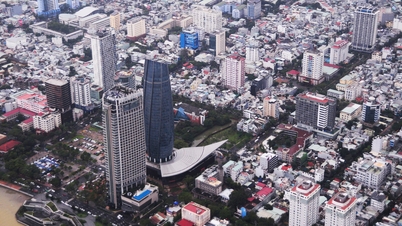
Sixty years have passed in the blink of an eye. 1964 and 1965 were the years of the Dragon and the Snake, and now 2024 and 2025 are also the years of the Dragon and the Snake. Time has completed a full cycle of a person's life. My memories from those years may be incomplete, but I only hope to recall the scene of that small, impoverished town of yesteryear to compare it with Tuy Hoa City today. The difference is immense. The urban space today is ten times larger; streets, roads, parks, lighting systems, schools at all levels, from university to university, are all far more modern and well-equipped. This gives us more faith in our homeland's progress towards becoming a first-class city within the province.
| Creating a green, clean, beautiful, smart, and friendly city is not something that can be achieved overnight. But with a city rich in natural landscapes: mountains, rivers, forests, and the sea, along with many cultural and historical relics and a heroic tradition in the resistance war, I believe that Tuy Hoa will certainly rise in the new era to become a prosperous, modern, and livable city in the not-too-distant future. |
DAO TAN LOC
Source: https://baophuyen.vn/94/324557/tuy-hoa-thuo-ay.html














![[Photo] Prime Minister Pham Minh Chinh receives the Chinese Ambassador to Vietnam](https://vphoto.vietnam.vn/thumb/1200x675/vietnam/resource/IMAGE/2026/04/05/1775397481797_ndo_br_dsc-5512-jpg.webp)









































Comment (0)