

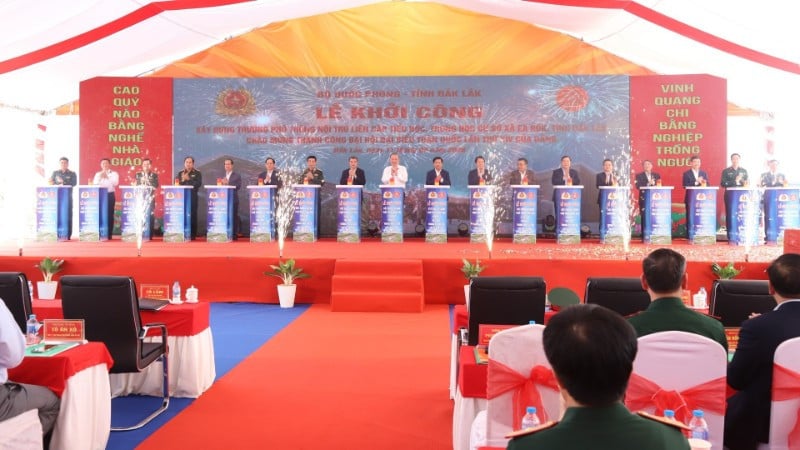
The policy of building 248 boarding schools at all levels in 248 border communes is not only about supplementing educational facilities, but also a step that demonstrates a vision for human development linked to strengthening national defense and security and building a solid foundation of public support in the "frontier" areas of the Fatherland.
Speaking at the groundbreaking ceremony, General Secretary To Lam emphasized that investing in a system of multi-level ethnic boarding schools in border communes is an important solution to raise the intellectual level of the people, develop local human resources, and strengthen the national defense posture in conjunction with the people's security posture and the people's trust. This approach shows that education in border areas needs to be viewed within the overall strategy of protecting and developing the country.
In many border communes, socio-economic conditions remain difficult, and access to quality education services is still limited. When the general level of education is further improved, legal awareness is strengthened, and the ability to apply science and technology is expanded, the community will have the internal strength to develop. Therefore, for border areas to be strong, it must begin with the knowledge of the people living there.
Another important focus is developing local human resources. This is a sustainable approach. When children of ethnic minorities receive a stable education and receive systematic training from primary to lower secondary school, they will become the next generation for their homeland. Local human resources understand the customs, language, and geographical area. They are well-positioned to implement policies and lead community development.
The construction of multi-level boarding schools is considered in relation to the national defense and people's security strategy. The border is the frontline of the Fatherland, a place where economic, cultural, and security interests intersect. A stable border region must be based on the people's trust. When people trust in the care of the Party and the State, and when their children are guaranteed educational opportunities, they will be more attached to their homeland, actively participating in maintaining security and order and protecting sovereignty. Education, therefore, becomes a factor in strengthening defense capabilities from within.
However, sound policies, if implemented irresponsibly, will erode public trust. The requirement for quality and efficient use is the measure of public service responsibility and a reminder of discipline in public investment. On the other hand, schools must become comprehensive educational environments; modern facilities need to be accompanied by a team of highly qualified, dedicated, and committed teachers in disadvantaged areas...
Building schools in border communes is not solely the responsibility of the education sector. Authorities at all levels need to coordinate closely to ensure progress and quality. Political and social organizations, village elders, and influential individuals should actively encourage families to send their children to school and maintain stable enrollment numbers. Businesses and individuals with the means can participate in supporting the provision of equipment, scholarships, and skills-building activities for students in border areas.
Education in border regions needs to be placed within the overall socio-economic development strategy. As the local workforce improves, there must be an environment for them to develop their abilities. This requires a close connection between education planning and planning for production, services, and infrastructure development.
From this specific groundbreaking event, the message becomes clear: Sowing the seeds of literacy in border areas is a sustainable way to safeguard the border. When the people's education level is raised, the local workforce is nurtured, and the people's support is strengthened, the border will be secure from within. This is the profound meaning of the decision to build a system of multi-level ethnic boarding schools in border communes. When a solid educational foundation is built, the future of border communes will open up with many new opportunities, contributing to the sustainable development of the country and maintaining sovereignty in all circumstances.
Source: https://nhandan.vn/uom-mam-tri-thuc-noi-phen-dau-to-quoc-post944245.html


![[Photo] Speaker of the National Assembly meets with the Vietnamese community in Türkiye](https://vphoto.vietnam.vn/thumb/1200x675/vietnam/resource/IMAGE/2026/04/18/1776483346102_1-8136-jpg.webp)

















![[Video] Key tasks assigned by the Head of the Central Propaganda and Mass Mobilization Department to 5 key national media agencies](https://vphoto.vietnam.vn/thumb/402x226/vietnam/resource/IMAGE/2026/04/18/1776487380386_tuyen-giao-jpg.webp)



















































Comment (0)