

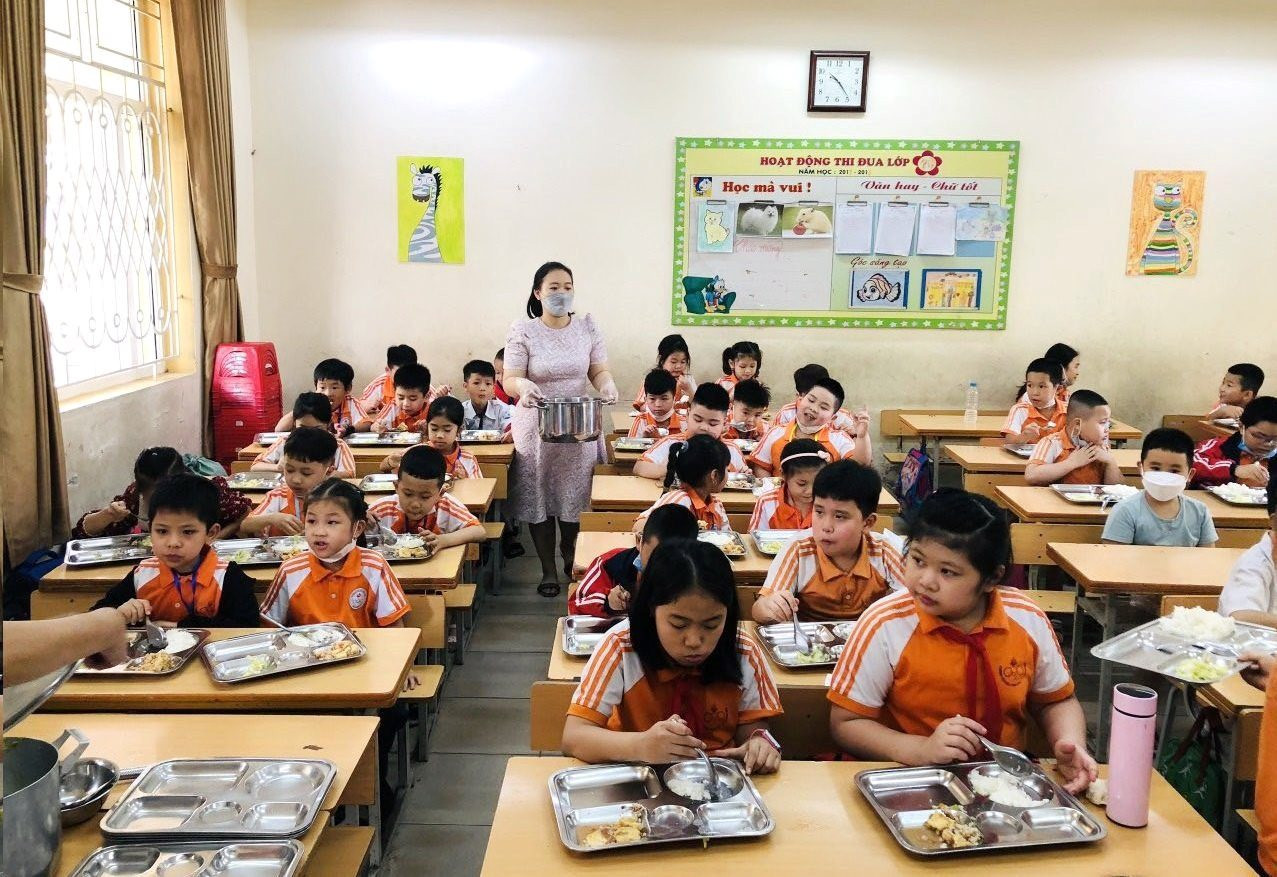
According to information from the Thanh Hoa Provincial Department of Education and Training, the Department recently conducted an inspection at eight ethnic boarding schools and junior high schools in the districts of Cam Thuy, Lang Chanh, Ba Thuoc, Quan Hoa, Thuong Xuan, Nhu Thanh, Ngoc Lac, and Nhu Xuan. During the inspection, provincial authorities discovered numerous violations related to the organization of meals for boarding students. Specifically, the school's kitchen staff had only received training in food safety but lacked training in child nutrition; a dedicated childcare and nutrition department had not been established, and daily menus for students had not been developed. Some schools lacked regulations boards in their dining areas; food storage was disorganized; and at the time of inspection, the schools could not provide veterinary hygiene registration certificates or food quarantine certificates for newly imported food; and some cooking staff did not wear the required protective clothing.
This is not the first time localities have reviewed school lunch programs. At the end of 2023, Prime Minister Pham Minh Chinh requested the Ministry of Education and Training to lead a review of school lunch programs for students in mountainous areas and ethnic minority communities following reports in the press that students at Hoang Thu Pho 1 Ethnic Boarding Primary School in Bac Ha district, Lao Cai province, were eating rice mixed with instant noodles.
Regarding meal quality, reports from many localities indicate that the meal allowances for students, agreed upon by schools and parent representatives, are low, ranging from only 5,000 to 8,000 VND per breakfast and 16,000 to 20,000 VND per main meal, making it difficult to ensure adequate nutrition. For students in public schools, especially in mountainous areas, many families face financial difficulties and cannot propose higher fees, while the cost of living is constantly rising. Cooking ingredients must be sourced from reputable suppliers with complete documentation, resulting in higher prices compared to traditional markets. With such low fees, achieving high nutritional quality in meals is also challenging.
Therefore, according to experts, there is a need for preferential policies for units providing school lunch services for students. Recently, the Ho Chi Minh City Department of Education and Training submitted a document to the Ho Chi Minh City Tax Department requesting a review of tax policies for public service units in the field of education and training, due to concerns that tax costs would affect the quality of school lunch services for students.
According to Associate Professor Bui Thi Nhung, Head of the School Nutrition Department (Institute of Nutrition), attention should be paid to school nutrition activities. This includes relevant ministries and agencies advising the Government to issue a school health program, which should include establishing standards for school meals; guidelines on organizing, managing, and supervising school meal programs; policies and regulations on facilities and equipment for educational institutions and schools; and human resources for food processing. Pilot school meal models should be implemented, from small to large scale, to draw lessons and propose school nutrition policies suitable for each locality.
Ms. Nhung also emphasized that improving the nutritional status of school-aged children requires collaboration between families and schools. Specifically, school meals, school nutrition education, and the cooperation between families and schools to help children develop healthy eating habits and an active lifestyle are crucial.
Associate Professor Tran Thanh Nam, Vice Rector of the University of Education, Vietnam National University, Hanoi, believes that health education programs should be integrated into the curriculum of schools. This would help children better understand health and nutrition. Simultaneously, educating students could also, to some extent, educate parents about health science, thereby contributing to improving the physical stature of Vietnamese people.
Source

![[Photo] General Secretary and President To Lam meets with National Assembly delegates from ethnic minorities.](https://vphoto.vietnam.vn/thumb/1200x675/vietnam/resource/IMAGE/2026/04/20/1776696701056_a1-bnd-8331-3342-jpg.webp)
![[Image] National Assembly discusses the implementation of the socio-economic development plan.](https://vphoto.vietnam.vn/thumb/1200x675/vietnam/resource/IMAGE/2026/04/20/1776696707422_ndo_br_img-20260420-185419-jpg.webp)











































































Comment (0)