

The idea for the bookstore was nurtured since childhood, when Ngan and her younger sister wandered the city renting books. The dream of "growing up to open a bookstore so I can read to my heart's content" was once uttered as a childish promise, but over time it took shape. In 2011, the first bookshelf, worth 5 million VND, a gift from her parents when the family built a new house and bought furniture, marked the beginning of her journey of accumulating books.
By 2016, when they had enough books to fill several shelves, the two sisters started thinking about reselling them. Customers were invited up to their room to choose books. Then, they started advertising on Facebook. In the early days, the simple sign hanging in front of the yard made many neighbors smile skeptically. However, in the first month alone, revenue reached 8 million VND. As the supply expanded thanks to connections from scrap collectors, old libraries, or dissolved organizations, some months' revenue exceeded 17 million VND.
In Ms. Ngan's memory, the first book sale was an unforgettable experience. Long lines of students flocked to choose books, creating a festive atmosphere, and nearly two tons of books were almost completely sold out. From then on, the relationship between the shop and its readers became closer. On one occasion, she even spent two gold bars from her wedding to stock up on books, expand her warehouse, and access more valuable book sources.
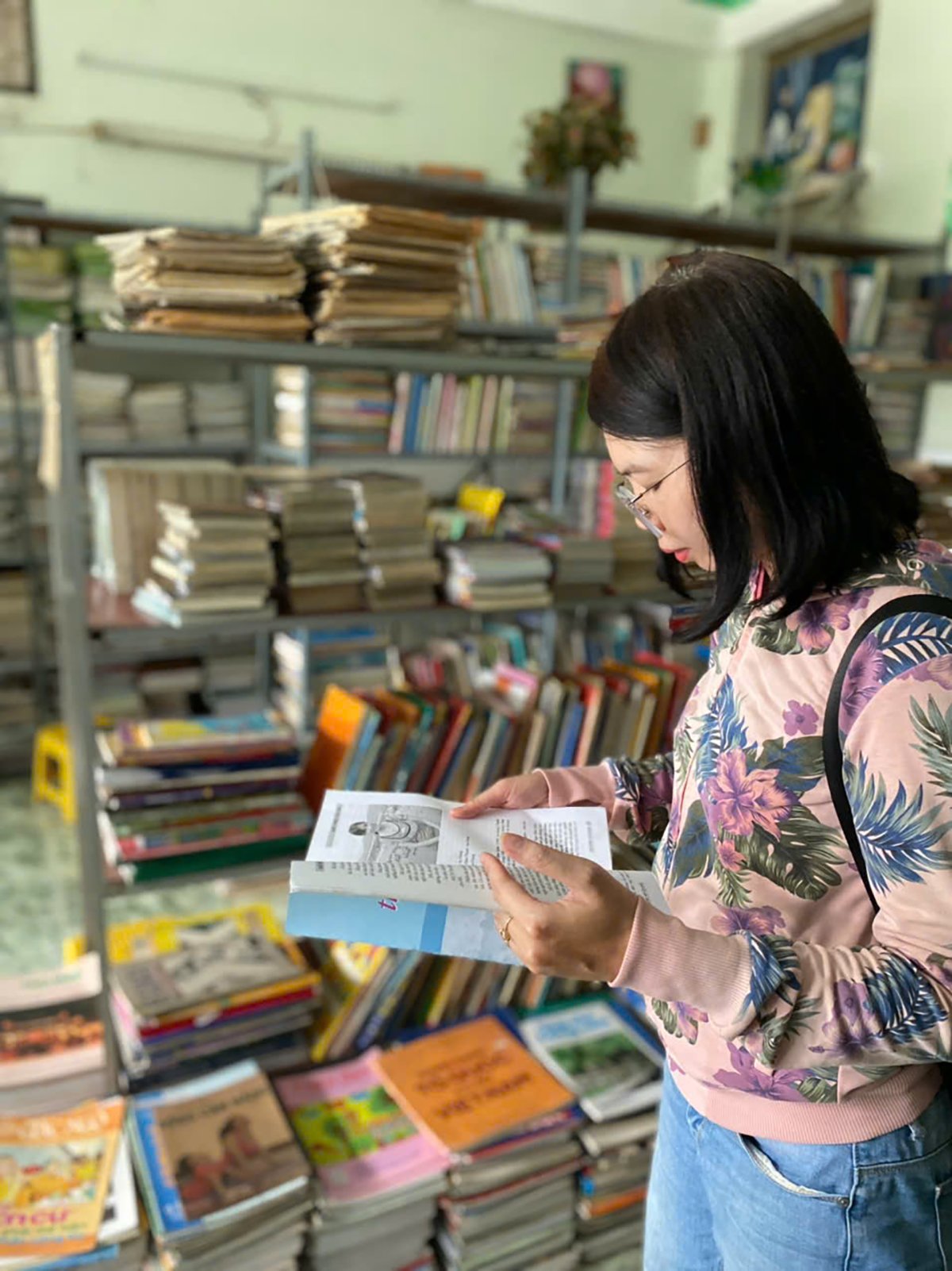
Buying books isn't just about transactions. For those who donate books, she finds suitable recipients to return them to. If a book is no longer usable, she considers reusing it or sending it to someone who needs it. According to her, old books have their own value, depending on the reader, not on the condition of the paper.
The bookstore gradually grew, not only thanks to the number of books, but also to the support from her family. Having been in business herself, her father always emphasized the spirit of independence and supported his two daughters both materially and with experience. Besides books, Ms. Ngan also tried her hand at other products: ornamental plants, materials for making flowers, and statue painting, creating a diverse and welcoming space for a wide range of customers.
Customers come to the shop ranging from students to housewives, parents, and office workers. Books on skills, children's comics, reference books, foreign languages, and textbooks always make up the majority of the search volume. Among these, many people are particularly interested in books on parenting, early childhood education , or books that are no longer being reprinted.
Ms. Nguyen Thi Huynh Nhu (residing in Binh Khanh ward, Long Xuyen city) said that she often visits the shop in her free time to look for books on child psychology and family education. She appreciates the convenience; she can text in advance when needed and then come to pick up the books, saving her a lot of time.
The used book market, especially in the textbook segment, increasingly demands that sellers be flexible and have a thorough understanding of the curriculum in each locality and school. According to Ms. Ngan, each area may use a different set of textbooks. To meet the right needs, sellers must constantly monitor trends and feedback from customers.
In the digital age, traditional bookstores still find ways to survive. Buyers can directly examine, hold, and feel each book before deciding to take it home. Many customers also enjoy chatting and exchanging information with the seller, an experience unavailable when shopping online. Nevertheless, sales channels through social media, such as Fanpages, personal Facebook profiles, or Zalo groups, are still maintained to reach customers located far away.
According to Ms. Ngan, old books are a part of reading culture. Books that have been passed down through many hands, that have sat quietly on family bookshelves or in libraries, can still find new readers if placed in the right place. Although no longer new, those pages still contain knowledge, cultural values, and emotions of the era in which they were printed.
Vietnam's Book and Reading Culture Day on April 21st is an opportunity to reflect on the relationship between people and books, especially in the context of technology increasingly changing the habits of acquiring knowledge. Small bookstores, used book sellers, and readers who still choose physical books are part of this quiet cultural flow. Reading is not just an individual act, but also contributes to maintaining a sustainable value in the community: the habit of accessing knowledge through the pages of books, passed down from generation to generation.
Source: https://baoangiang.com.vn/van-hoa-doc-qua-nhung-trang-sach-cu-a419248.html
![[Photo] Urgent efforts to mitigate the consequences of the barge colliding with the Ghenh Bridge.](https://vphoto.vietnam.vn/thumb/1200x675/vietnam/resource/IMAGE/2026/03/08/1772956866931_ndo_br_dji-20260308105506-0016-d-resize-5169-jpg.webp)
![[Image] 20 islands in the Spratly Islands special administrative region hold early elections.](https://vphoto.vietnam.vn/thumb/1200x675/vietnam/resource/IMAGE/2026/03/08/1772949669607_img-20260308-112026-90-jpg.webp)










































































Comment (0)