

Stepping into the airport waiting area, amidst the bustling crowds returning from business trips, Ho Minh Duc paused for a few seconds when he heard a gentle, familiar female voice reading an announcement on the system.
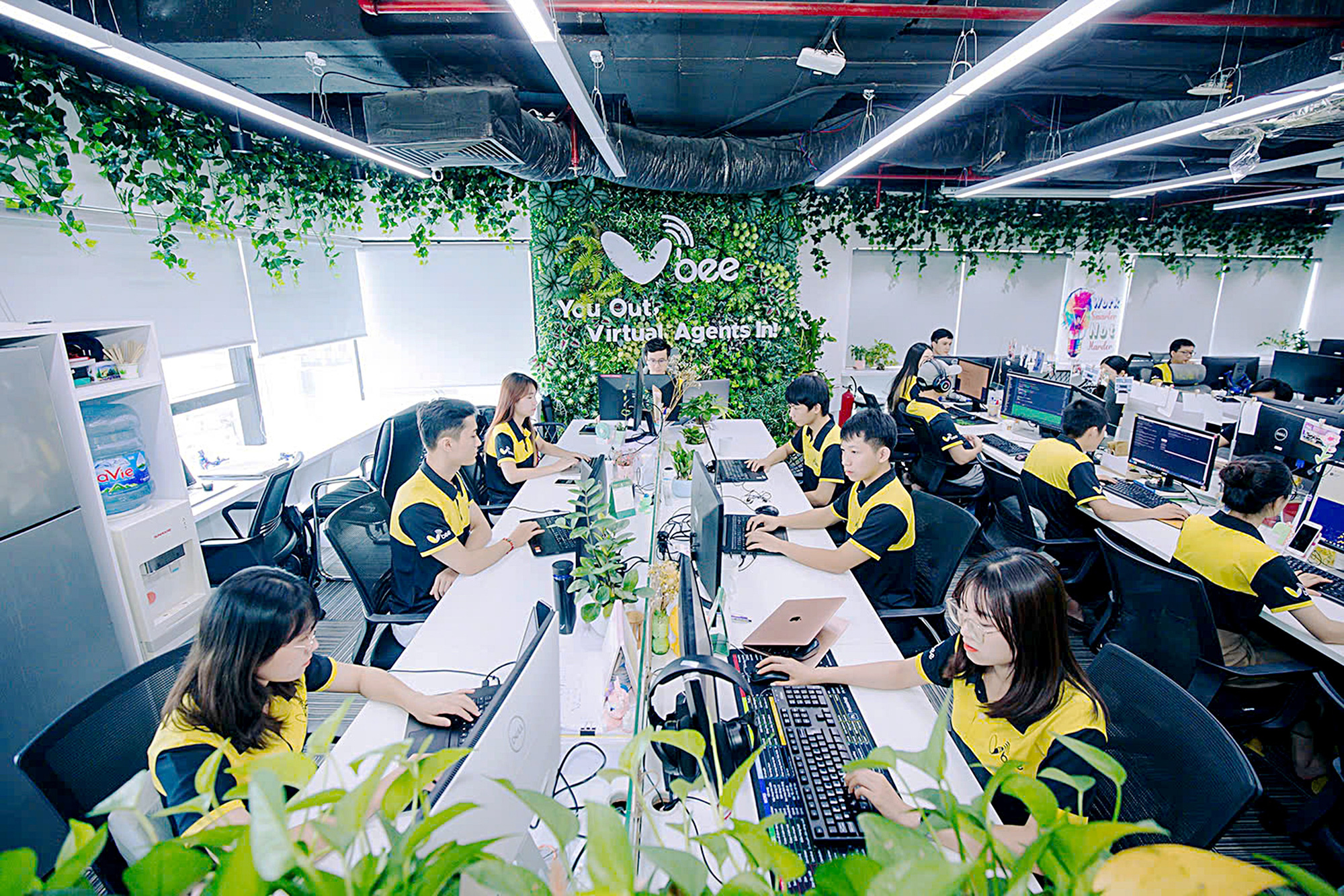
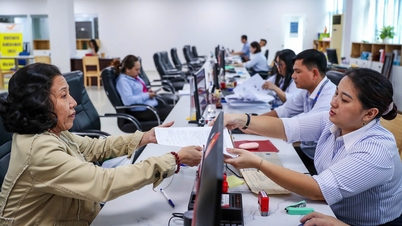
Vbee's staff are working at the company headquarters in Hanoi - Photo: Provided by the company.
He smiled, feeling relieved and happy, like he was reuniting with a loved one. That "loved one" was one of the 20 AI voice actors that Duc and the Vbee team had spent countless days and months working with, pouring their hearts into every nuance of sound and carefully crafting each nuance to make them increasingly natural and human-like.
The bumpy road of start-ups
It's hard to say how many times CEO Ho Minh Duc and CTO Nguyen Thi Thu Trang – the two founders of Vbee Data Services and Solutions Joint Stock Company – have experienced such joy and pride.
They encountered these "special acquaintances" again in various circumstances: the clear voices on school loudspeakers, the warm tones in buildings, or the professional voices from the automated telephone systems of many businesses.
Vbee's creations are no longer just the result of algorithms and code; they are truly entering real life, making quiet but powerful contributions to many fields.
From book reviews and movie dubbing to automated call center announcements, Vbee has breathed new life into voice technology.
As the "mother" of that core TTS technology, Dr. Nguyen Thi Thu Trang has always aspired to bring products derived from Vietnamese speech synthesis technology – a technology she has poured much passion into since her doctoral dissertation at Paris 11 University – to real users.
Vbee's early days were full of challenges. Despite being free for the first two years, their text-to-speech (TTS) tool only attracted a small group of users. But then COVID-19 unexpectedly became a turning point.
Faced with strict social distancing regulations, businesses like FE Credit, Momo, Viet Credit, Sacombank , etc., had to find ways to reach thousands of customers. That's when Vbee was given an opportunity: from debt reminders to automated responses, their product quickly became the optimal solution. At that time, virtual assistants and virtual call center agents brought in up to 80% of Vbee's revenue.
As the pandemic subsided and the global economy declined, Vbee faced a new challenge. The wave of generative AI (GenAI) and the digital content trend revived the TTS tool. Today, from TikTok to YouTube and Facebook, Vbee's AI voices are everywhere.
"Much of the current TTS content is provided by us," Ho Minh Duc proudly shared. Currently, Vbee's active user base has exceeded 2 million, and this number continues to steadily increase by 20% each month.
Vbee has trained over 20 high-quality company voices, and if you include custom-ordered voices, they have created over 200 different AI voices.
With the new voice transcription technology recently researched and launched for testing, a new voice now only requires 3 minutes of data recording for training, instead of 4 to 10 hours of recording as it did two years ago.
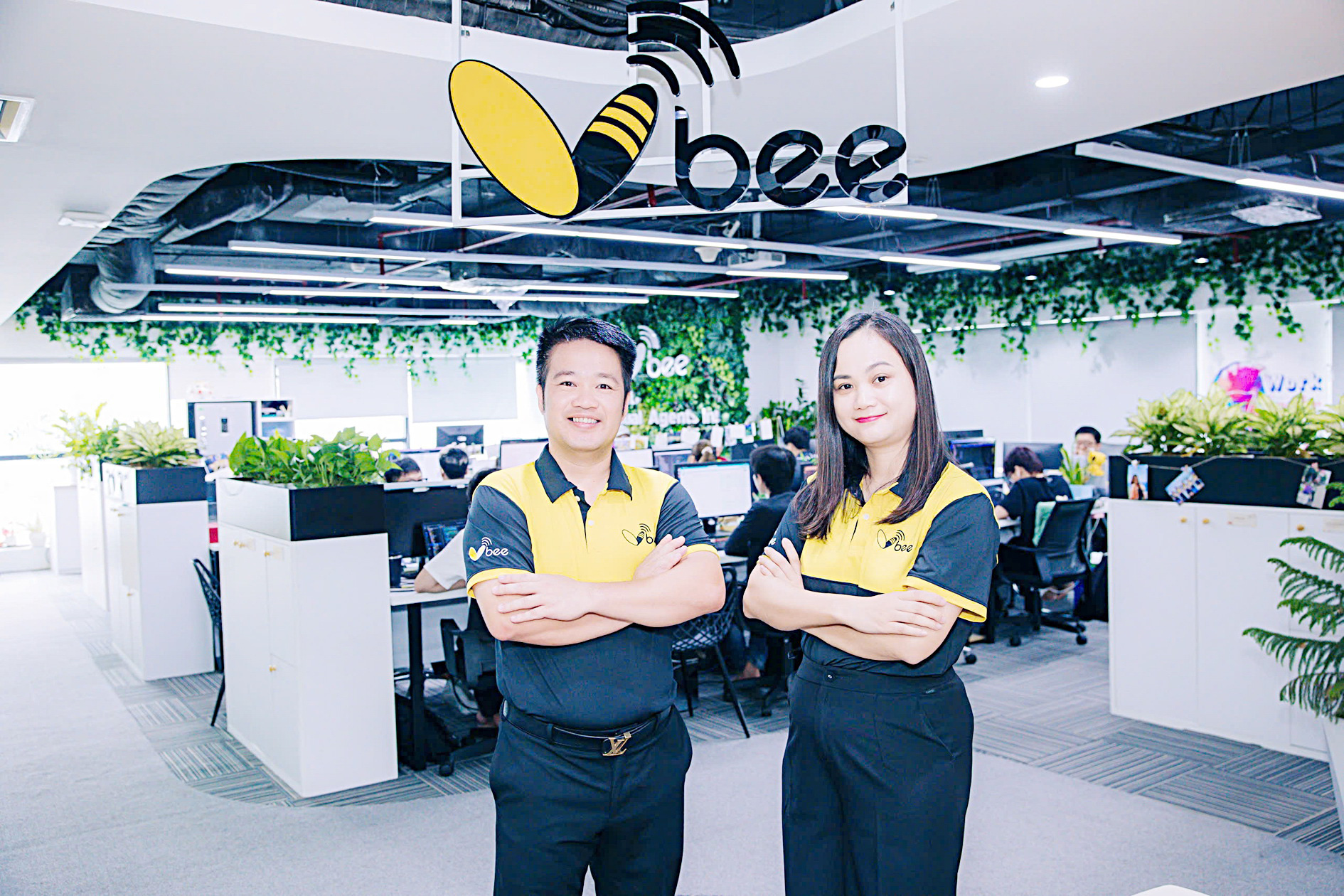
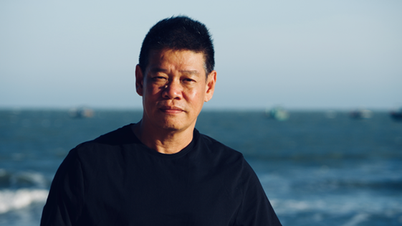
CEO Ho Minh Duc and CTO Nguyen Thi Thu Trang - the two founders of Vbee Data Services and Solutions Joint Stock Company - Photo: Provided by the company.
"We have an advantage in our understanding of the Vietnamese language."
In the race for speech synthesis technology, CEO Ho Minh Duc sees a point where efforts to innovate technology will gradually reach their limits.
According to him, Vbee is not only developing core Vietnamese speech processing technology, but is also building a technology system capable of deeply understanding the Vietnamese language – with all its subtleties, tones, and unique culture that only true Vietnamese people can fully comprehend.
As a leading company in the TTS market in Vietnam, Vbee's two leaders believe that their tool has become the benchmark for AI voiceovers in Vietnamese. Users not only appreciate the accuracy but also sense the "emotion" in each voice developed by Vbee.
In Vietnamese, for example, even a single word like "ngõ" (alley) has many different names depending on the region, such as "hẻm," "kiệt," and "xẹc"—each word carrying a distinct nuance that AI needs to understand.
To achieve this, Vbee has invested heavily in collecting sample datasets as well as investing in a robust server system for training the AI.
"To enable AI to understand and correctly process information with such regional nuances, we had to build countless sample sets, and the cost of the processing servers was also very high," CEO Ho Minh Duc shared.
Dr. Nguyen Thi Thu Trang has dedicated over 15 years to researching Vbee's core TTS technology to decipher the distinctive tones and grammar of the Vietnamese language. For her, her mother tongue is a subtle world full of expressive nuances.
"Vietnamese is a very complex and interesting language; the tones are the most difficult aspect and different from many other common languages in the world. The more I understand the language, the more accurate my model will be," she explained.
Vbee is gradually establishing itself as an indispensable part of tools and devices that integrate Vietnamese language processing software in the technological era.
In every word and every voice, the Vbee team not only explores and develops technology but also strives to create a genuine "Vietnamese emotion" in their AI voices.
The name Vbee is an abbreviation of "Vietnamese BE your Eyes," stemming from my initial desire to create a tool that would serve as "eyes" for the visually impaired. However, in today's developing world, where many people prioritize hearing over sight, we believe Vbee will also become "eyes" for everyone.
Dr. Nguyen Thi Thu Trang (Senior Lecturer at the School of Information Technology and Communications, Hanoi University of Science and Technology, Founder and Chief Technology Officer of Vbee Company)
A gathering of audiobook enthusiasts
Vbee was born from Dr. Nguyen Thi Thu Trang's deep connection with the visually impaired community. Since her student days, she has been involved in recording audiobooks and developing Vietnamese text-to-speech systems to support the visually impaired.
These experiences inspired her to develop Vietnamese text-to-speech software – the precursor to Vbee. In 2018, she and her classmate Ho Minh Duc – a fellow student at Hanoi University of Science and Technology with experience from the Socbay.com project and the digitization of audiobooks – founded Vbee, a pioneer in the field of text-to-speech in Vietnam.
Vbee's outstanding achievements
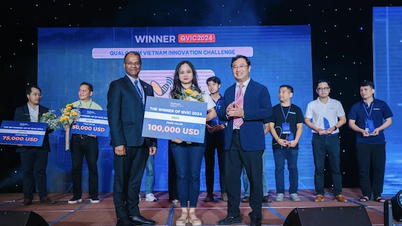
- First prize winner of the Qualcomm Vietnam Innovation Challenge 2024
- Special Prize at the Youth Start-up Award 2023
- Startup wins the Grab Venture Ignite 2020 acceleration program.
- Top prize at the 2018 Vietnam Talent Awards, second prize at the 2020 Vietnam Talent Awards.
- Certified as a Vietnamese core technology in the National Digital Transformation Program 2025-2030 of the Ministry of Information and Communications.
- The project won the Vietnam Digital Media Award 2018 and the Vingroup Funding Award 2019.
Regional vision
Having established itself in the Vietnamese market, Vbee is aiming to expand into Southeast Asia, with plans to bring its TTS technology to countries such as Laos, Thailand, Cambodia, and the Philippines by 2026.
According to Dr. Nguyen Thi Thu Trang, the rapid advancement of technology today, with the emergence of multilingual models, will make it easier to develop TTS tools for other languages.
Currently, she is researching voice technologies for Thai, Chinese, and English, opening up new avenues for Vbee in the international market.
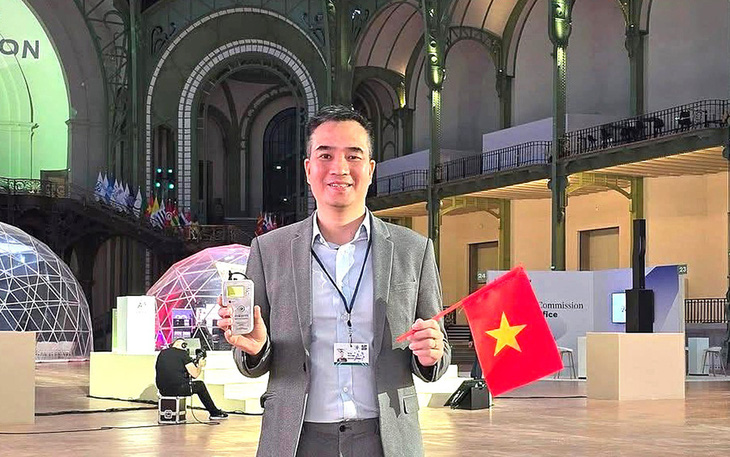 Vietnamese start-up honored at the Paris AI Summit
Source: https://tuoitre.vn/vbee-va-no-luc-chap-canh-cho-tieng-viet-20250217102146767.htm
![[Photo] General Secretary and President To Lam meets with National Assembly delegates from ethnic minorities.](https://vphoto.vietnam.vn/thumb/1200x675/vietnam/resource/IMAGE/2026/04/20/1776696701056_a1-bnd-8331-3342-jpg.webp)




![[Image] National Assembly discusses the implementation of the socio-economic development plan.](https://vphoto.vietnam.vn/thumb/1200x675/vietnam/resource/IMAGE/2026/04/20/1776696707422_ndo_br_img-20260420-185419-jpg.webp)













































































Comment (0)