

Nestled amidst vast mountains and forests, the Ton Son Mo Xuan Base historical site in Xuan An commune, Yen Lap district, is a place that commemorates revolutionary activities and preserves many historical stories of General Ngo Quang Bich, the initiator of the Can Vuong movement against the French in the late 19th century.

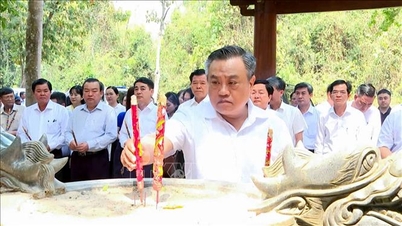
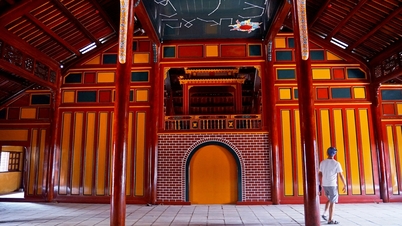
The shrine dedicated to General Ngo Quang Bich at the Ton Son Mo Xuan Base historical site.
General Ngo Quang Bich, also known as Ngu Phong, was born on April 8th, 1832 (the year of the Water Dragon) in Trinh Pho village, An Ninh commune, Tien Hai district, Thai Binh province. In 1861, he passed the imperial examination, but submitted a petition to stay home and open a school... Seeing his hometown suffering from floods and crop failures, he organized the digging of the Su River and the construction of the Tam Dong sluice gate, bringing water in for irrigation, resulting in two bountiful harvests (the people praised him and offered the village's fields as sacrifices after his death).
In 1869, during the Kỷ Tỵ examination, he passed with flying colors and held the title of Đình Nguyên Hoàng Giáp (First-ranked Imperial Scholar). He successively held the following positions: Cabinet Secretary in the capital, Prefect of Diên Khánh ( Khánh Hòa ), Prefect of Lâm Thao (Hưng Hóa), Judge of Bình Định, Judge of Sơn Tây, Chancellor of the National Academy, and was entrusted by the King with reviewing the "Comprehensive History of Vietnam," serving as Chief Envoy of the Mountain Defense and concurrently Governor of Hưng Hóa. He was instrumental in recruiting the Black Flag General Lưu Vĩnh Phúc to suppress bandits, and later fought against the French, twice killing enemy generals at Cầu Giấy. Throughout his career, he was praised by the King as an "honest official," and the people called him "Living Buddha."

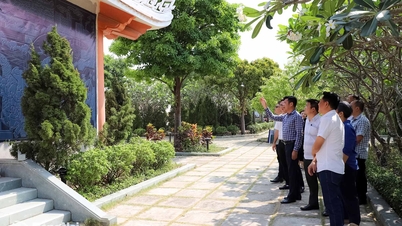
Mr. Dinh Hong Quan, a member of the Management Board of the historical site, introduced the bust of General Ngo Quang Bich, made from a single block of green stone.
In 1883, the imperial court signed a treaty with France, recalling him to the capital to assume his post. He returned his seal of office and vowed to fight to the death to defend Hung Hoa citadel. The enemy sent two legions with over 7,000 soldiers, along with warships and cannons, to attack. The citadel fell, and he intended to commit suicide, but his soldiers fought their way through, allowing him to retreat to Tien Dong and Cam Khe, where he raised the banner of rebellion. Heroes and valiant men from all over flocked to join the cause. More than a year later, when Emperor Ham Nghi ascended the throne, he sent envoys to confer upon him the titles of Grand Academician, Minister of Rites, Grand Minister of Military Affairs of Northern Vietnam, and Marquis Thuan Trung, granting him the authority of a civil advisor and a military commander, and sent him on two diplomatic missions to seek assistance. Although these missions were unsuccessful because the Qing dynasty had already compromised with France, his diplomatic efforts garnered the sympathy and support of the literati of Southern China.
In November 1886, he decided to move the headquarters to Nghia Lo to expand the territory, with the intention of welcoming King Ham Nghi to the North. The enemy launched several attacks on Nghia Lo, all of which ended in disastrous defeats. In 1888, he withdrew his troops to Que Son, Yen Lap district, establishing a base at Ton Son mountain in Mo Xuan. He organized the battle of Ky Suu year when the enemy advanced deep into the base, eliminating over 500 enemy soldiers and establishing a base to consolidate the long-term resistance movement.
For seven years (1883-1890) as the leader of the Can Vuong movement in Northern Vietnam, he rallied and united people of various ethnic groups, skillfully utilizing the mountains and forests, combining guerrilla warfare with "mobile warfare," employing the vast and intricate network of people's war tactics, and supported by many talented generals such as Tong Duy Tan, Tan Thuat, Bo Giap, De Kieu, Doc Ngu... which caused the French army to suffer many defeats...

The temple dedicated to General Ngo Quang Bich is located in Khe Chau, Xuan An commune, Yen Lap district.
Although the Ton Son Mo Xuan base only operated in Yen Lap for two years (1889-1890), it marked a turning point and provided valuable lessons in building defensive bases for military training, consolidating the garrison system, and preparing weapons and provisions for a long-term plan to fight the French. Therefore, the Ton Son Mo Xuan base is one of the typical relics associated with the Can Vuong movement against the French in the Northwest highlands at the end of the 19th century, led by General Ngo Quang Bich. Due to its historical and cultural value, in 2012 the Provincial People's Committee decided to classify the Ton Son Mo Xuan base as a provincial-level historical and cultural relic.
In recent years, to meet the needs of local people and tourists from all over who wish to visit and offer incense to General Ngo Quang Bich, the Ton Son Mo Xuan historical site has been renovated and beautified with various features such as: the shrine area dedicated to General Ngo Quang Bich; a bust of him made of solid green stone donated by Dr. Ngo Quang Nam - former Head of the Vinh Phuc Department of Culture, a 5th-generation descendant of the General; and the temple dedicated to General Nguyen Quang Bich on the summit of Ton Son mountain, Khe Chau. A particularly noteworthy detail is the 58 stone steps leading from the shrine to the bust, symbolizing his age.
In remembrance of the contributions of General Ngo Quang Bich - a key figure in the Can Vuong movement against the French - the local government and people not only regularly care for and protect the historical site, but also strive to effectively implement emulation movements, building Xuan An commune into an increasingly prosperous and developed area.
Vinh Ha
Source: https://baophutho.vn/ve-di-tich-can-cu-ton-son-mo-xuan-213574.htm
![[Photo] National Assembly Chairman Tran Thanh Man attends the policy seminar to promote Vietnam-Türkiye cooperation.](https://vphoto.vietnam.vn/thumb/1200x675/vietnam/resource/IMAGE/2026/04/16/1776351415367_vna-potal-chu-tich-quoc-hoi-tran-thanh-man-du-toa-dam-chinh-sach-thuc-day-hop-tac-viet-nam-tho-nhi-ky-8705791-jpg.webp)
























































Comment (0)