


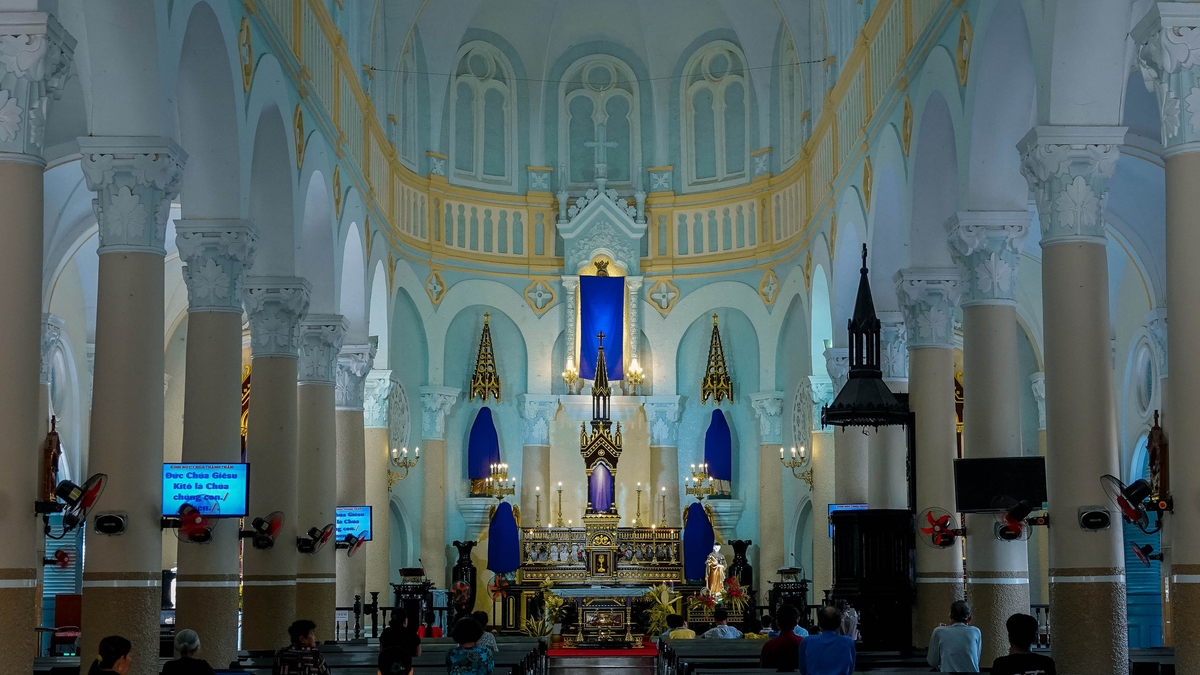
Hanshan Temple attracts many tourists who come to visit and worship.
When visiting Tong Son, tourists cannot miss the Han Son scenic complex (Han Son Temple, Nga Ba Bong Temple, Ngoc Son Pagoda, and related scenic spots), with Han Son Temple considered the "soul" of the complex. This is where the Third Holy Mother is worshipped, along with the Holy Mother Lieu Hanh and Lord Le Tho Vuc. According to encyclopedias, historical documents, inscriptions, and folk legends: During the Later Le Dynasty, around the early years of Hong Duc, under King Le Thanh Tong (1470), Grand Marshal Le Tho Vuc was assigned by the court to lead troops against the Champa invaders. Before setting out, he received guidance from the Third Holy Mother on how to use troops to attack the enemy. In the battle at Cha Ban, Le Tho Vuc's army captured the Champa king alive, without suffering any casualties. In the year of Ky Hoi (1479), Cau Cong, the leader of Bon Man, plotted rebellion, inciting Lao Qua (Laos) to cause trouble in the western part of our country. Grand Marshal Le Tho Vuc was given command along with four generals to lead the army to suppress the rebels. Once again, he received advice from the Holy Mother, resulting in victories in all battles, and he was granted the title of Sung Quoc Cong by the king.
In gratitude for the help of the Third Mother Goddess, Grand Marshal Lê Thọ Vực petitioned the king to build a temple dedicated to her. Recognizing this as a meaningful act, King Lê ordered the construction of the Hàn Sơn Temple for the people to worship. Later, after Lê Thọ Vực's death, the people built a temple near the Hàn Sơn Temple in his honor. This temple is commonly known as the Temple of the Great Lord or the Temple of the Virtuous Lord.
In 1992, the Han Son scenic area was recognized as a provincial-level historical site. Over the years, thanks to the attention of the State, philanthropists, the people, and tourists from all over, the Han Son temple in particular and the Han Son scenic area in general have been renovated and beautified, becoming a famous cultural and spiritual tourism destination in Thanh Hoa province.
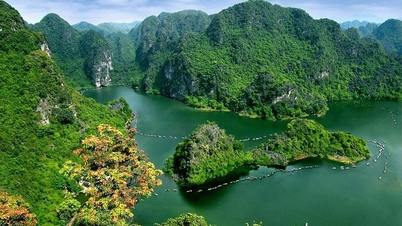
Visiting Han Son Temple, tourists can explore, worship, and enjoy the majestic and poetic natural scenery. Seen from afar, Han Son Temple resembles a picturesque landscape painting, its reflection shimmering in the Len River. Every year, from the 1st to the 12th of June (lunar calendar), the Han Son Temple Festival takes place to commemorate those who pioneered the Tong Son region and the national heroes who fought against foreign invaders during the national liberation wars. Besides the solemn ceremonial part, there is also a festival with many vibrant cultural activities that attract a large number of people and tourists from all over.
With its beautiful location, unique architectural and decorative patterns, picturesque natural landscape, and sacred atmosphere, Han Son Temple attracts a large number of tourists from within and outside the province. In the first 11 months of 2025, Han Son Temple welcomed approximately 100,000 visitors for sightseeing and worship.
Ms. Duong Thi Thuy, a resident of Hong Ha ward, Hanoi , a tourist visiting Han Son Temple, said: "Han Son Temple has a beautiful location, with a river in front and mountains behind. Coming here, I feel at peace, and all the worries of life seem to disappear. All members of the group are satisfied with this trip. Next spring, my family will definitely return to Han Son Temple to visit, worship, and pray for blessings and peace."
On their journey to explore the Tống Sơn region, visitors will have the opportunity to visit and discover the historical revolutionary site of the Bãi Sậy War Zone, located in Bái Sơn village. The Bãi Sậy War Zone was established in 1944 by the Thanh Hóa Provincial Viet Minh Committee, following the directives of Military Region 3. Under the leadership and guidance of the Party organization, the Bãi Sậy area quickly became a military training ground for core self-defense forces. By the end of May 1944, guerrilla and self-defense units were quickly formed in all neighboring villages, and personnel were sent to the base for training. The Bãi Sậy War Zone is considered a solid revolutionary base of the province and the former Hà Trung district, and one of the important bases of the Quang Trung War Zone during the period of urgent preparation for the August 1945 General Uprising.
With its historical significance, the Bai Say revolutionary base has been recognized as a provincial-level historical revolutionary site. Currently, it has become a "red address" for educating the younger generation about historical and revolutionary traditions. During national and local holidays and important events, cadres, Party members, and the people return here to offer incense and express their gratitude to those who sacrificed for the independence and freedom of the Fatherland. This inspires pride, willpower, and a desire to contribute to building the homeland and the country among the younger generations of the Tong Son region.

The Bai Say revolutionary historical site has become a place for educating the younger generation about revolutionary traditions.
Currently, the commune has 18 historical sites, including 1 national-level historical site and 17 provincial-level historical, cultural, architectural, and scenic sites. Proud of its homeland rich in historical and cultural traditions, Tong Son commune always pays attention to the management and protection of these sites against damage. The locality mobilizes all resources to restore and preserve the sites in order to promote the values of historical and cultural relics in conjunction with the development of spiritual tourism.
In fact, it has been observed that in recent years, many historical and cultural relics in Tong Son commune have received attention for restoration and preservation, meeting the needs of the local people, such as the Do My village communal house, the historical relic of the Bai Say revolutionary base... Currently, Tong Son commune has reviewed and reported to the province a proposal for the preservation, restoration, and promotion of the value of relics in the commune for the period 2026-2030; and has developed a plan for the preservation, restoration, and preservation of the Co Bo temple historical and cultural relic in the Han Son scenic area. At the same time, the commune has proposed to the Provincial People's Committee to consider and approve the plan for the preservation, restoration, and preservation of village communal houses, prioritizing the two key revolutionary relics: Bai Son communal house and Dong Bong communal house.
Mr. Le The Manh, Head of the Culture and Social Affairs Department of Tong Son Commune People's Committee, said: “Tong Son Commune focuses on mobilizing all resources to restore and preserve historical and cultural relics, linking them with the development of spiritual tourism. We connect the relic sites within the commune with those in neighboring localities, such as Gia Mieu communal house, Trieu Tuong Mausoleum, Nguyen Huu family church (Ha Long commune), Song Son temple (Quang Trung ward), Tran Hung Dao temple (Hoat Giang commune), Kim Son mountain national scenic area (Bien Thuong commune)... to form tourist tours that attract visitors. We apply science and technology in the management, preservation, and promotion of relic values to promote heritage values on technological platforms. Through this, we build a tourism brand for Tong Son based on cultural and historical values, creating sustainable livelihoods for people in the areas around the relic sites.”
Source: https://baoangiang.com.vn/ve-mien-di-tich-tong-son-a471582.html












































Comment (0)