

Based on national financial capacity, technical factors, and the country's actual needs, investment in high-speed rail should be implemented soon.
Part 1: Solving the "thirst" for passenger transport supply
While freight transport is well-served by sea and coastal waterways, passenger transport is facing an imbalance between modes and overcrowding if a new, modern mode of transport is not invested in soon.
Even with airplanes and trains available, people still choose to travel by bus.
One weekend evening in September 2024, after saying goodbye to his elderly mother in Vinh City, Pham Hong Phuong, an employee of a transportation construction company, hurriedly left with his wife to catch a bus back to the capital to be on time for work the next day.
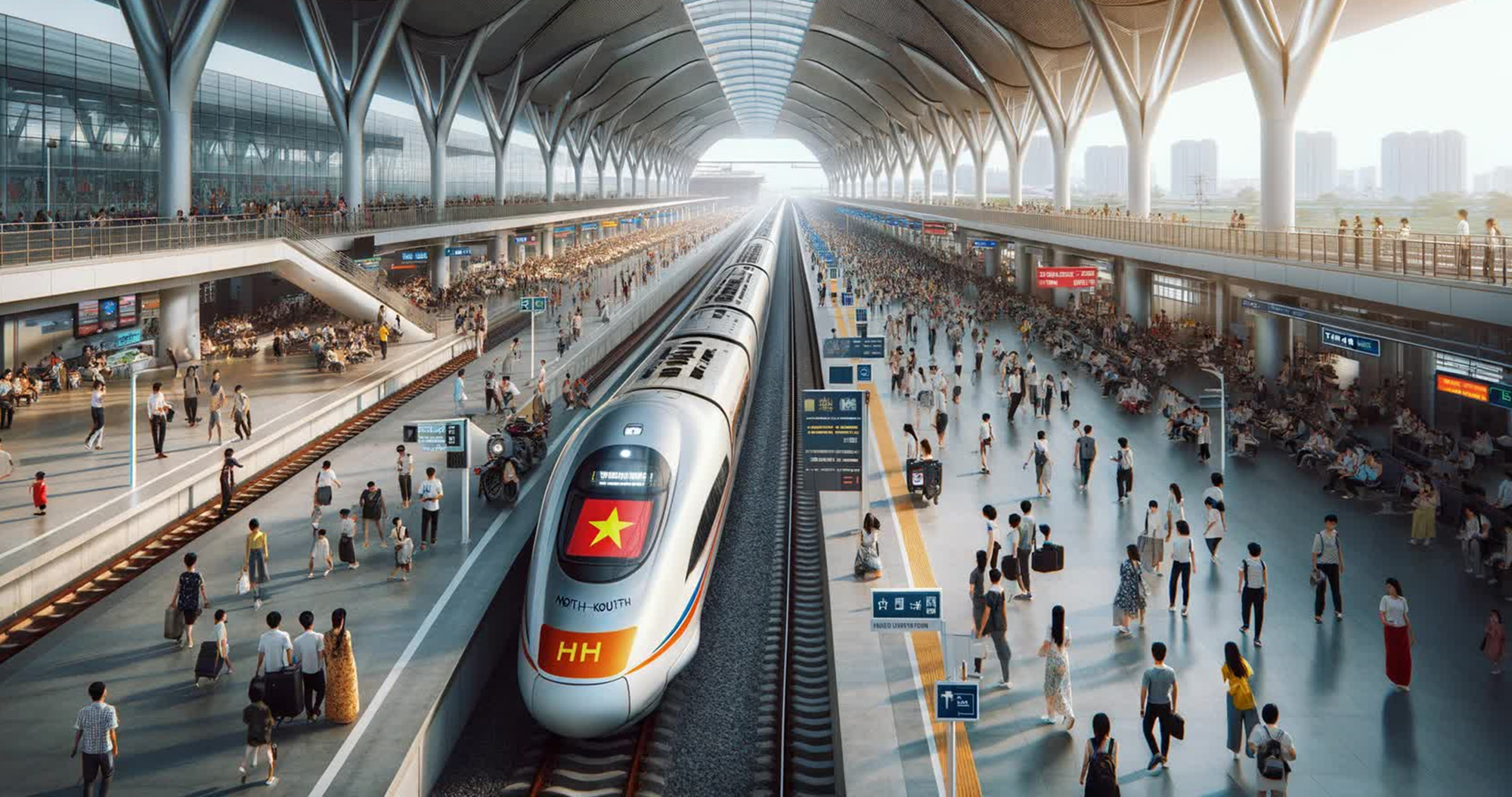
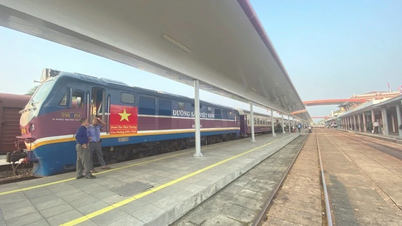
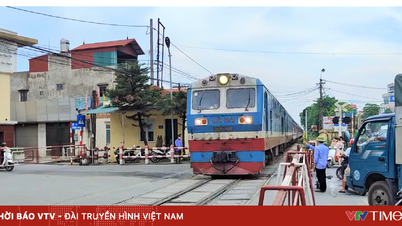
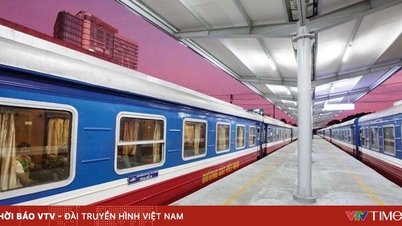
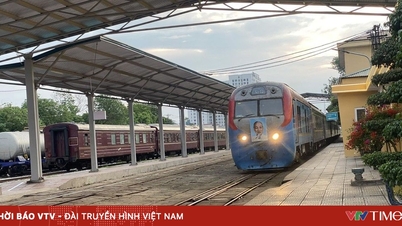
The benefits of high-speed rail are evident as many countries have invested in it very successfully (illustrative image).
Even after many years away from his hometown in the city, sleeper buses remain his preferred mode of transportation for his journey back home.
According to Mr. Phuong, Hanoi and Vinh City can also be connected by train and plane. Train travel is highly safe but the journey time is quite long, taking 8 hours.
For air travel, the flight time from Vinh to Noi Bai is only about 35 minutes, but the total travel time and check-in procedures take about 2.5 - 3 hours, which is the same as traveling by private car, and the total travel cost is three times more expensive than by bus.
Mr. Tran Thien Canh, Director of the Vietnam Railway Department:
Stimulating tourism and developing the economy.
Vietnam's railway network currently has 7 lines, with the Hanoi - Ho Chi Minh City line accounting for approximately 50% of the total transport volume, but the infrastructure was built more than 140 years ago.
The current situation shows that there is a need for new, modern, high-volume, high-speed, and safe railway lines to meet the ever-increasing transportation demand.
Investing in high-speed rail will both meet transportation needs and contribute to population decentralization, avoiding concentration in large cities like Hanoi and Ho Chi Minh City, stimulating tourism , and promoting socio-economic development.
"Traveling by sleeper bus, the ticket price is only about 300,000 VND per person, passengers are picked up and dropped off at their destination, and the travel time is only about 5 hours," Mr. Phuong said, adding that in reality, while there are diverse transportation methods, they are not truly convenient.
In the near future, he hopes that the central region of Vietnam will have faster modes of transportation than buses and trains, and that air travel will be more accessible and convenient.
Having been involved in the railway transport sector for approximately 30 years, Mr. Huynh The Son, Deputy Head of the Business Department of Hanoi Railway Transport Joint Stock Company, said: Ticket price is an important factor, but the key to the attractiveness of the railway is the speed of travel and the travel time.
As an example, Mr. Son stated that on the Hanoi - Vinh route, the average price for a sleeper bus ticket is approximately 300,000 - 350,000 VND.
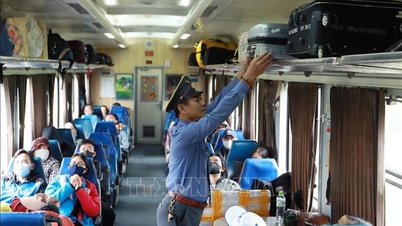
While the price of a train ticket for a full journey is only around 400,000 VND per sleeper berth, the number of passengers traveling by train is very low because the travel time is twice as long as by bus.
On the 300-400km route, the railway is losing many passengers to road transport. After the Dien Chau - Bai Vot expressway came into operation, the number of passengers on the Hanoi - Vinh train route has decreased noticeably.
During the summer of 2023, in addition to the regularly scheduled passenger trains (NA1/NA2), the transport company did not operate any extra trains as in previous years due to a lack of demand.
"Even if there's a surge in passenger demand, we can't add more trains because the route's capacity has reached its limit," Mr. Son said.
Imbalance between methods
The Ministry of Transport's assessment of the current overall transport landscape is that there is an imbalance in the market share of passenger transport among different modes of transport.
According to the Ministry of Transport, airlines are currently struggling to maintain flights under 500km (which are often unprofitable), using profits from longer routes to offset losses on shorter ones. Meanwhile, passenger transport services between Hanoi and Ho Chi Minh City still operate continuously by road.
"The planning process for the various sectors of the transportation industry has considered the potential and advantages of each mode of transport to develop development scenarios."
Accordingly, for passenger transport, road transport is dominant over short distances (under 150km). High-speed rail completely dominates medium-distance transport (150-800km). For long distances (over 800km), the market share is mainly held by air transport and partly by high-speed rail.
"Investing in the construction of high-speed rail will make a significant contribution to restructuring the passenger transport market share among different modes of transport in a sustainable direction," a leader of the Ministry of Transport stated.
We need a large-scale, high-speed mode of transport.
According to Mr. Chu Van Tuan, Deputy Director of the Railway Project Management Board (Ministry of Transport), on the North-South corridor, the transport system includes: Road transport, which has the largest market share (in 2019, it accounted for nearly 63% of passenger transport and over 50% of freight transport).
The railway system has outdated infrastructure and service quality that does not meet demand, resulting in a very low market share (in 2019, it accounted for 3.2% of passengers and 0.5-1% of goods).
Waterways and maritime transport have the capacity to transport large volumes at low cost, handling the majority of freight transport needs on the North-South axis (in 2019, the volume was 133 million tons/year, accounting for over 48%).
In recent years, the aviation industry has experienced rapid growth, at approximately 18% per year, accounting for about 36.6% of passenger transport market share.
"Frequency transport basically meets demand at low cost. However, passenger transport is experiencing an imbalance," Mr. Tuan observed.
According to him, the North-South economic corridor accounts for 54% of the population, 63% of economic zones, 72% of major seaports, 40% of industrial parks, and contributes over 51% of the country's GDP.
By 2050, the demand for freight transport on the North-South corridor is expected to reach 1.4 - 1.7 billion tons/year, and passenger demand will reach 1.1 - 1.3 billion passengers/year.
This projected volume will be handled by all modes of transport. Of these, sea and river transport, with their advantages in transporting large volumes of goods at low cost, will account for the majority of the transport market share.
Passenger transport will be allocated to rail, road, and air depending on the distance each mode of transport has an advantage over. Specifically, transport on the railway corridor is projected to reach approximately 18.2 million tons/year and 122.7 million passengers/year by 2050.
"The demand for passenger transport will be severely short if there is no high-capacity, high-speed transport method like high-speed rail," Mr. Tuan said.
Prioritize passenger transport.
According to leaders of the Ministry of Transport, the current average cost per ton/km for maritime and inland waterway transport is about 450 VND, for rail transport about 680 VND, and for air transport it is more expensive.
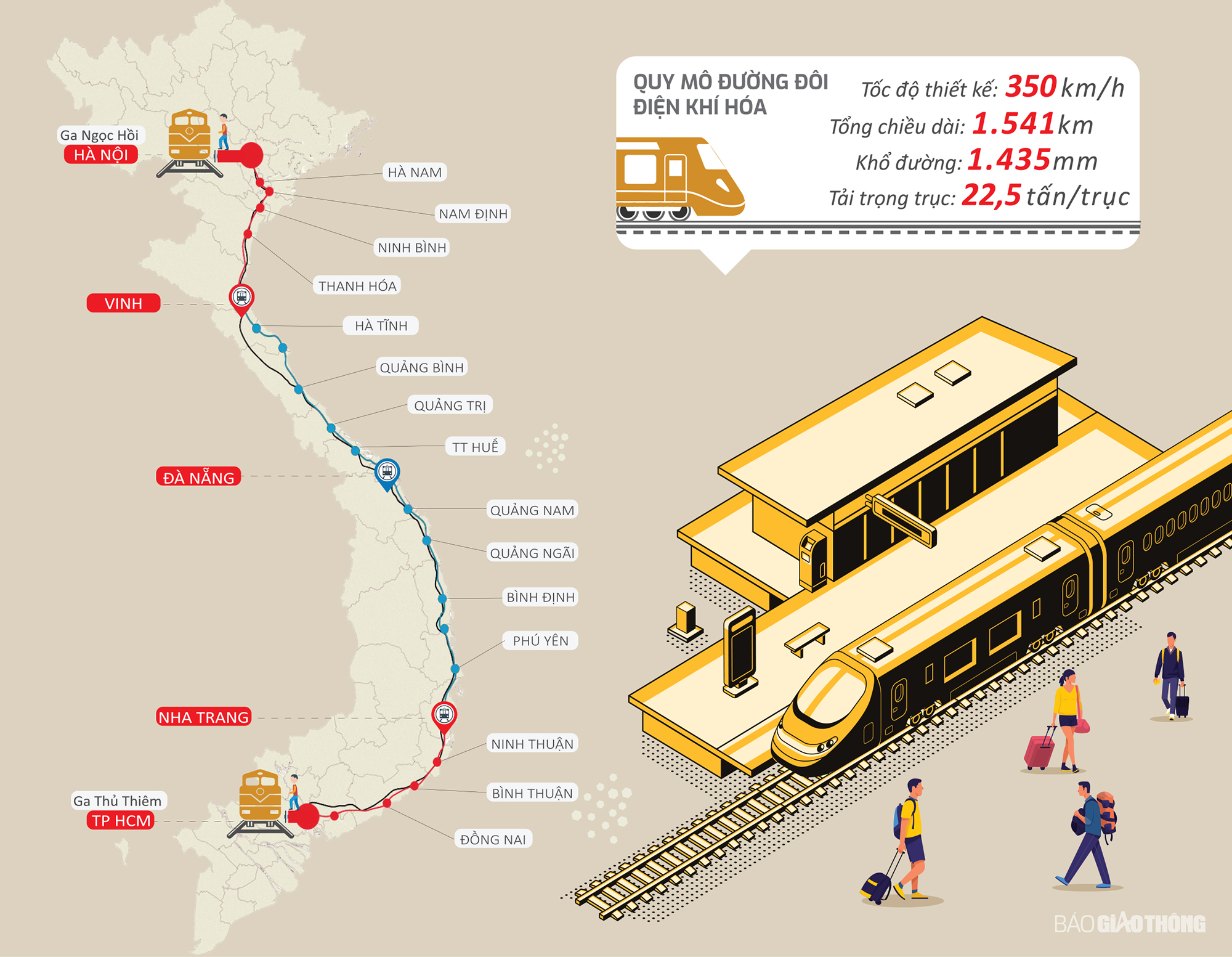
The high-speed railway project passes through the territory of 20 provinces and cities, starting in Hanoi (Ngoc Hoi station complex) and ending in Ho Chi Minh City (Thu Thiem station). Graphic: Nguyen Tuong.
Coastal countries with similar long, sprawling landscapes to Vietnam, such as Japan, Italy, and Indonesia, primarily choose sea and inland waterway transport for their cargo due to cost advantages.
"China has a developed railway system, but when deciding to build a freight transport line from Nanning to the sea, it invested in the 134km Pinglu Canal for 5,000-ton ships, with a total cost of over 10 billion USD," a leader of the Ministry of Transport cited as an example, adding that most countries with developed railway networks use existing railways for freight transport, while high-speed rail is primarily used for passenger transport.
Having been involved in the development of the transportation sector for many years, Mr. Nguyen Ngoc Dong, former Deputy Minister of Transport, assessed that the North-South corridor is the most important of the country's 38 transportation corridors, with very high transportation demand and an average growth rate of about 10% per year.
Forecasts indicate that by 2030, without developing a new mode of transport, meeting transportation needs will be very difficult. This reality necessitates Vietnam's early development of new high-speed rail lines to supplement existing ones, primarily focusing on passenger transport.
"Vietnam is an open economy, and most of the goods produced are for export. Along the North-South route, there are many seaports, and goods will be collected by road to the seaports. Sea transport remains the optimal choice," Mr. Dong explained.
According to Mr. Dong, the Vietnam Tourism Development Strategy sets a target of achieving total revenue from tourists of approximately 130-135 billion USD by 2030, contributing directly to GDP at 15-17%.
"Based on global experience, high-speed rail has a positive and reciprocal relationship with the tourism and service industries. Developing high-speed rail is a crucial factor in promoting the development of services and tourism," Mr. Dong analyzed.
The sooner it's done, the better.
According to National Assembly Deputy Pham Van Thinh (National Assembly's Economic Committee), the railway's transport capacity is very good and highly effective.
However, for many years, railways in general and the North-South line in particular have not received adequate investment resources. Therefore, the sooner the high-speed railway is built, the better.
"The high-speed rail project is large-scale, technically complex, and requires significant investment. Therefore, how to mobilize resources needs to be carefully considered to ensure feasibility," Mr. Thinh said.
National Assembly Deputy Tran Van Tien (National Assembly's Economic Committee) acknowledged that for a country with a length of over 2,000km like Vietnam, developing high-speed rail is essential.
"The benefits of high-speed rail have been proven by the successful investments made in many countries. With technology that runs entirely on electricity, high-speed rail also contributes to the development of a green economy – a goal we are striving for. At this point, investing in it is something that 'needs to be done immediately'," Mr. Tien said.
Economist and Associate Professor Dr. Nguyen Thuong Lang also stated: "We should have done this a long time ago. Having a safe, high-volume transportation method is an urgent requirement."
Mr. Lang analyzed that setting high targets naturally leads to high investment capital. However, we can mobilize resources from many sources, not just relying on the budget. "Capital is not the issue; the most important thing is to plan effectively and realistically," Mr. Lang suggested.
The right time
Research by the Ministry of Transport and consultants shows that Japan decided to invest in its first railway line in 1950, when its GDP per capita was only about $250.
China invested in 2005, when its GDP per capita reached $1,753; Uzbekistan invested in 2011, when its GDP per capita reached $1,926. Indonesia invested in 2015, when its GDP per capita was approximately $3,322.
In Vietnam, according to research by the World Bank, this is the right time to build a high-speed rail line when the GDP per capita in 2023 reached approximately US$4,282 and is estimated to reach approximately US$7,500 in 2030.
The size of the economy in 2023 was approximately $430 billion, nearly three times larger than in 2010; public debt was at a low level, only about 37% of GDP.
With the high-speed rail project expected to begin construction in 2027, the economy is projected to reach approximately $564 billion, so securing investment resources will no longer be a major obstacle.
Make the high-speed railway as straight as possible.
On the morning of September 25th, Deputy Prime Minister Tran Hong Ha chaired a meeting to hear reports on the progress of the North-South high-speed rail project.
At the meeting, Deputy Minister of Transport Nguyen Danh Huy reported that the goal is to approve the investment policy before 2025; complete land clearance and commence construction before 2030; and complete the entire route before 2045.
The project's investment scope starts in Hanoi (Ngoc Hoi Station Complex) and ends in Ho Chi Minh City at Thu Thiem Station. The project passes through the territory of 20 provinces and cities.
Concluding the meeting, Deputy Prime Minister Tran Hong Ha requested the Ministry of Transport to pay attention to the following during the consultation process: in addition to the investment scope from the starting point of the project in Hanoi to the end point in Ho Chi Minh City, it is necessary to consider and study the option of extending the high-speed railway line from Mong Cai to Ca Mau.
In addition, the pre-feasibility report needs to demonstrate the investment perspective of constructing a railway line with a design speed of 350 km/h as straight as possible, crossing mountains and building bridges over rivers.
At the same time, it is proposed that specific mechanisms and policies be developed regarding phased investment, allocation of central and local government funds either once or in five-year periods, utilization of bonds, ODA, and other legitimate sources, and leveraging the remaining capacity of the public debt ceiling.
The Ministry of Transport needs to propose solutions to strengthen decentralization and delegation of authority, assigning responsibility to localities for land preparation, construction of technical infrastructure, railway stations, etc.
Source: https://www.baogiaothong.vn/vi-sao-can-som-lam-duong-sat-toc-do-cao-192240930235436264.htm
![[Photo] General Secretary To Lam attends the ceremony commemorating the 75th anniversary of the founding of the Central Military Hospital 108.](https://vphoto.vietnam.vn/thumb/1200x675/vietnam/resource/IMAGE/2026/03/30/1774866343623_a1-bnd-5435-7415-jpg.webp)

![[Photo] The moment of seasonal change at Thong Nhat Park](https://vphoto.vietnam.vn/thumb/1200x675/vietnam/resource/IMAGE/2026/03/30/1774870546141_ndo_br_b773e4e7b1a230fc69b313-jpg.webp)







































































Comment (0)