While Northern Vietnam boasts its soft, flat pho noodles and Southern Vietnam is characterized by its chewy hu tieu noodles, the South Central coastal region (especially Binh Dinh and Phu Yen) celebrates banh hoi. These tiny, pristine white rice noodles, interwoven like threads of silk, are topped with a glossy layer of fried shallots or vibrant green chives, creating an unforgettable visual and taste experience.
However, unlike banh xeo or banh cuon, the name "banh hoi" carries a rather questionable connotation. Ultimately, why does this dish have such a strange name? To answer this, we need to delve into the pages of folklore, share knowledge, and consider it from various perspectives.
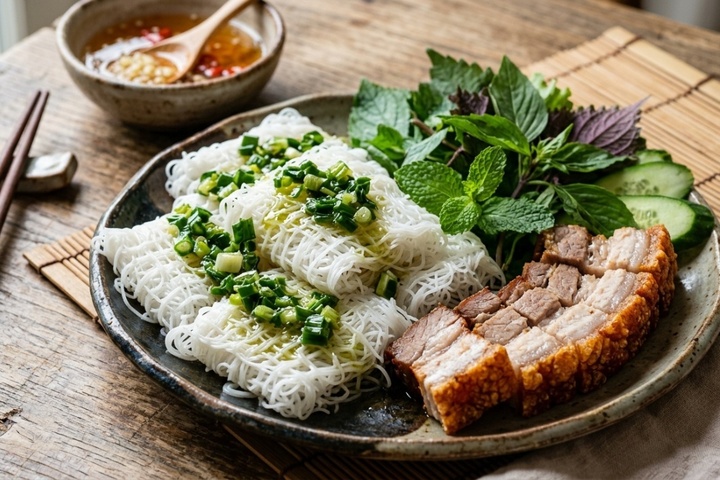
From a cultural and linguistic perspective, the name "banh hoi" (rice vermicelli) is a unique embodiment of everyday life. (Photo: CT)
Why is it called "banh hoi" (rice noodle cake)?
The most common and straightforward explanation from ancient Vietnamese people stems from the curiosity of diners. Legend has it that bánh hỏi (rice vermicelli) originated in the martial arts land of Binh Dinh hundreds of years ago. When this dish was first created by artisans, its structure caused great astonishment.
At that time, people were only familiar with thick, round rice noodles or whole sheets of rice paper. Seeing a sheet of cake made up of thousands of tiny, delicate strands of dough, everyone was surprised and kept asking: "What kind of cake is this?", "How can they make such small strands?". Because this cake constantly aroused curiosity and questions from diners wherever they went, the locals decided to use the verb "to ask" (to inquire) to name it. Originating from curiosity, the name "bánh hỏi" (inquiry cake) was born naturally, reflecting the simple linguistic thinking of the Vietnamese people, who use events associated with objects to name things.
The connection with fertility beliefs and engagement ceremonies.
From a deeper cultural research perspective, many scholars and elders in Central Vietnam believe that the name "banh hoi" (rice noodle cake) originates from its role in important rituals of the human life cycle, especially marriage ceremonies.



In Binh Dinh and many Southern provinces, banh hoi (rice noodle cake) is an indispensable offering in ancestral worship ceremonies, religious rituals, and especially in engagement ceremonies. Symbolically, the image of delicate rice noodle strands interwoven and tightly bound together into inseparable layers of cake is an allegory for the enduring fidelity and bond between a couple. Because this cake is a must-have on the offering tray for the engagement ceremony, people have shortened its name to "banh hoi" (engagement cake).
This hypothesis is considered to have a solid cultural basis, reflecting the positive philosophies of our ancestors embedded in each dish.
Beyond folklore, when analyzed from a culinary science perspective, banh hoi is essentially a technical and mechanical advancement of the traditional fresh rice noodle dish. Both rice noodles and banh hoi undergo the process of soaking rice, grinding flour, kneading, and pressing. However, while rice noodles use molds with large holes, the molds used to press banh hoi (usually made of copper or aluminum) are a masterpiece of craftsmanship with tiny pinholes.
For the rice flour to pass through these tiny, stick-like holes without breaking, it must be extremely refined, undergoing a stirring (flour mixing) process over fire to create a semi-rigid consistency.
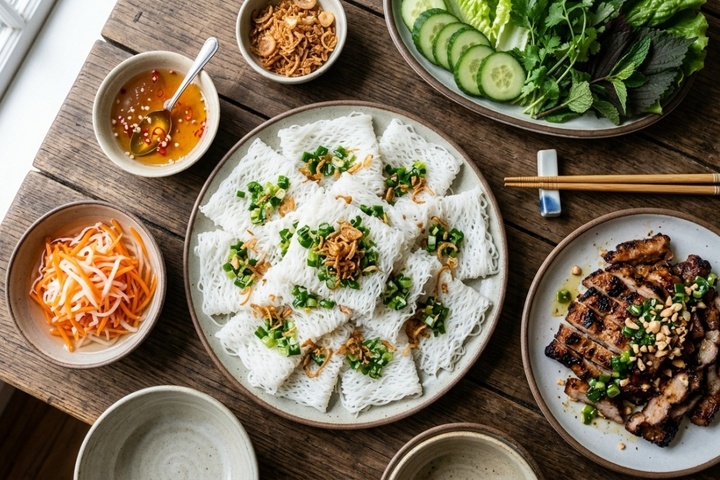
The rice vermicelli noodles are thin, white, and interwoven like a net. They are usually brushed with scallion oil and served with roasted pork, pork offal, grilled meat, and a sweet and sour fish sauce.
When the cook applies strong pressure, hundreds of ultra-fine strands of dough are released. The cook must skillfully catch and continuously move the strands with their hands to stack and interweave them into thin rectangles, which are then steamed. This meticulous, patient, and labor-intensive process is what makes banh hoi a dish requiring a much higher level of skill than other types of rice noodles.
A fusion of regional cuisines
Over time, banh hoi (rice vermicelli) has expanded beyond Central Vietnam, undergoing wonderful variations as it travels south. The dish's ingenuity lies in its ability to absorb flavors. With its porous, hollow texture thanks to countless interwoven strands of rice vermicelli, it acts like a biological sponge, easily retaining the richness of fried shallots or chives in Binh Dinh, and the aroma of roasted pork, pork offal, or shrimp paste.



When eating, diners roll up the rice vermicelli with fresh herbs and dip it generously into a bowl of sweet and sour fish sauce or rich fermented fish sauce. The sauce seeps into every small groove of the vermicelli, creating an explosion of flavors in the mouth: the chewiness of the rice, the crispness of the roasted pork, the richness of the fried onions, and the refreshing coolness of the raw vegetables.
The question "Why is it called 'Banh Hoi'?" holds an open answer. Whether it originated from the curious whispers around traditional feasts or served as a witness to the vows exchanged during engagement ceremonies, this name has perfectly fulfilled its purpose.
According to Vtcnews.vn
Source: https://baoangiang.com.vn/vi-sao-goi-la-banh-hoi-a490995.html



![[Image] National conference summarizing one year of operation of the overall organizational model of the political system, the three-tiered government model.](https://vphoto.vietnam.vn/thumb/1200x675/vietnam/resource/IMAGE/2026/07/01/1782882811691_ndo_br_1-jpg.webp)