

A flood of products for nightlife...
"Where to go tonight? Let's go to Phu Quoc's VUI-Fest night market!" This catchy, memorable catchphrase from Vui Phet - VUI-Fest Bazaar, a newly launched night market in Sunset Town, has become a trending topic on social media in recent days. Attracting up to 10 international visitors per square meter, Phu Quoc's first seaside night market has been dubbed a "Western Quarter" just a few months after opening. Previously, the Phu Quoc night market in Duong Dong town was one of the most popular after-6 PM entertainment spots on the island. However, despite being invested in on a fairly large and well-organized scale, the Duong Dong night market still resembled typical night markets in other tourist destinations. Visitors would simply stroll around, browse goods, eat, and at most return to their hotels by 10 PM. Therefore, VUI-Fest Bazaar breathes new life into Phu Quoc's nightlife scene. Not only does it offer a diverse range of food stalls from Vietnamese to Asian and European cuisine, and stalls selling local souvenirs, but Vui Phet Night Market also captivates visitors with unique art performances and entertainment shows from 7 PM to 9 PM. Afterward, it "doesn't let visitors leave" with dazzling fireworks displays every night from the stage of the Kiss of the Sea show. Thanks to these diverse and attractive activities, since its opening, Vui Phet Night Market has welcomed tens of thousands of visitors every night. In the first few days of its opening, the investor recorded over 20,000 visitors.
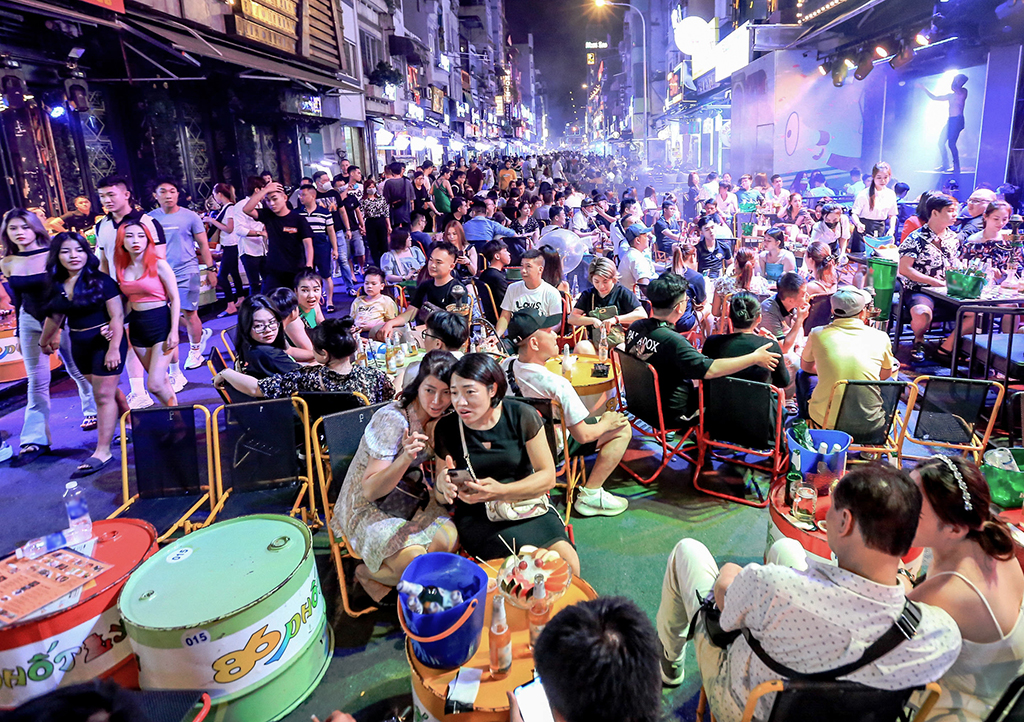
Bui Vien Street (District 1, Ho Chi Minh City), often frequented by tourists, needs to be lit up even later to encourage them to spend money.
"The market is one of the projects we expect to breathe new life into Phu Quoc, adding another nightlife option for tourists alongside the traditional Duong Dong night market. The island's night economy will be awakened, thanks to a space where local tourism professionals can unleash their creativity through a series of street art festivals, shopping, and attractive local culinary experiences…," a representative from Sun Group told Thanh Nien newspaper.
For its part, Ho Chi Minh City is also determined not to fall behind in the "City That Never Sleeps" race. Ahead of 2024, Ho Chi Minh City is launching its first night tour, allowing visitors to explore historical sites, enjoy art, cuisine, shopping, and wellness in District 1. For approximately 1.6 million VND, visitors can learn about Saigon's history at the 140-year-old Continental Hotel, enjoy the À Ố Show , dine on Dong Khoi Street, visit, shop, and have a late-night meal at Ben Thanh Market, and then relax at a spa at the end of the day. Alongside this, the double-decker bus tour, themed "Saigon Never Sleeps," has officially launched, making Ho Chi Minh City the only city in the world offering a 24/7 open-top double-decker bus city tour. This is a night tour from 11 PM to 7 AM the following morning.
Following this trend, Ho Chi Minh City recently launched a pilot project for Thao Dien Night Street, operating from 7 PM to 2 AM the following morning on Friday and Saturday nights. Thao Dien Night Street is expected to contribute to the development of culture, tourism, and commerce in the city, meeting the entertainment, shopping, and leisure needs of residents and tourists. This area is particularly attractive to foreigners who work, live, and study there. Districts 7, 1, 3, Phu Nhuan, and others are also actively implementing projects to develop the night-time economy in their respective districts, working together to illuminate the city at night.
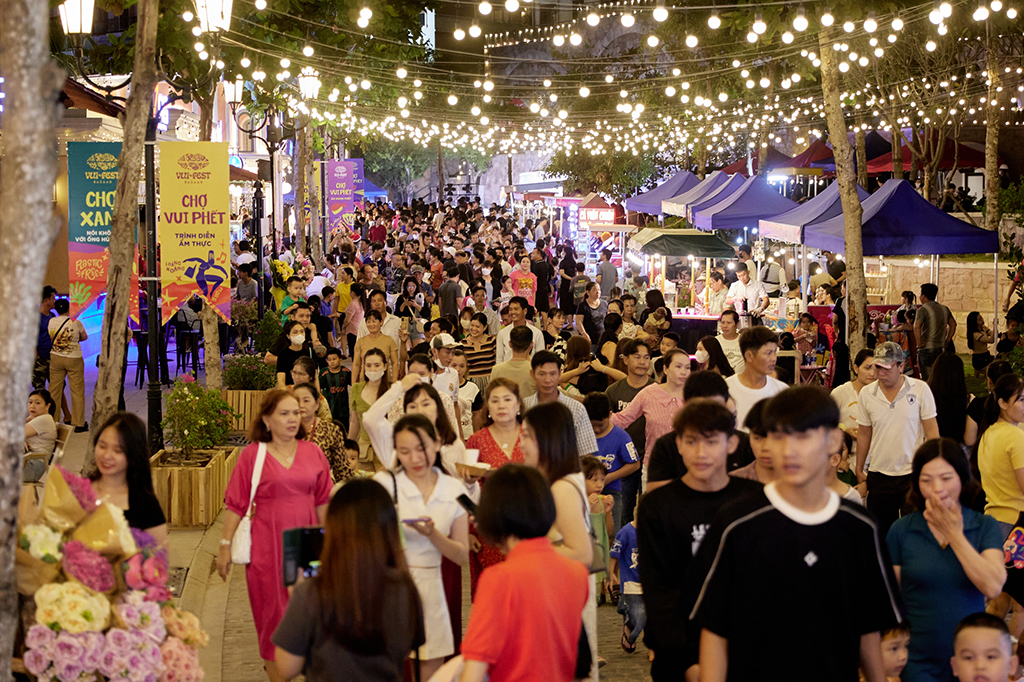
VUI-Fest Bazaar - an attractive new night tourism product in Phu Quoc.
The excitement surrounding the night-time economy isn't limited to major tourist cities; it has spread to suburban areas as well. Since the Covid-19 pandemic, Son Tay Town (Hanoi) has continuously launched numerous initiatives aimed at boosting tourism, starting with a night-time pedestrian street. On weekends, the area around Son Tay ancient citadel comes alive with vibrant cultural, artistic, and sporting activities. From 8 PM every Saturday, cultural and artistic events take place with high frequency. The town's People's Committee has arranged eight stages around the citadel for performances, art exhibitions, and sporting events. Younger tourists can enjoy sports dances, street guitar performances, hip-hop dancing, etc.; while those who appreciate traditional culture can listen to traditional folk songs, visit stalls displaying antiques, and more.
In addition, Quang Ninh, Hai Phong, Thua Thien-Hue, Da Lat, and other provinces have also taken decisive actions at various levels through decisions and action programs, aiming for breakthroughs in the night-time economy to activate the "money-making machine" of the tourism industry.
...but then at midnight they demanded to "turn off the lights".
Products and services are constantly emerging and innovating, but a common feature of most of these "nightlife" options is that they close at midnight. For example, the VUI-Fest night market in Phu Quoc is "extremely fun" but only operates from 4 PM to midnight daily. A vendor in the night market said that according to regulations, it must close at midnight, but at some restaurants, customers are still enjoying themselves. According to current regulations, karaoke and bar/dance hall services, if soundproofed, are allowed to operate until 2 AM. For mini-bars/bars/restaurants with sound located in or near residential areas, the sound must cease by 10 PM. Restaurants, bars, and entertainment venues without sound have no opening hours but are required to ensure security, order, and other standards. "That regulation is actually quite restrictive because most of the customers here are Westerners. When they travel, they don't have a concept of time. Sometimes they watch the fireworks and then excitedly go out for beer, dancing, and late-night meals... And you need music to have fun; if the music is off, you can't just sit around chatting all night or drinking in silence," this small business owner shared.
Similarly, the Thao Dien night market in Thu Duc City, located right in the heart of Ho Chi Minh City's "Western Quarter," only stays open until 10 PM. Tourists who don't want to return to their hotels can take a taxi to District 1 to continue spending money in Bui Vien. However, Ho Chi Minh City's nightclubs are currently only open until 2 AM the following morning. For those who are "passionate" about nightclubs, especially young people, 10 PM or 11 PM is when they start dressing up, and by 2 AM, the music is barely playing before they have to head home.
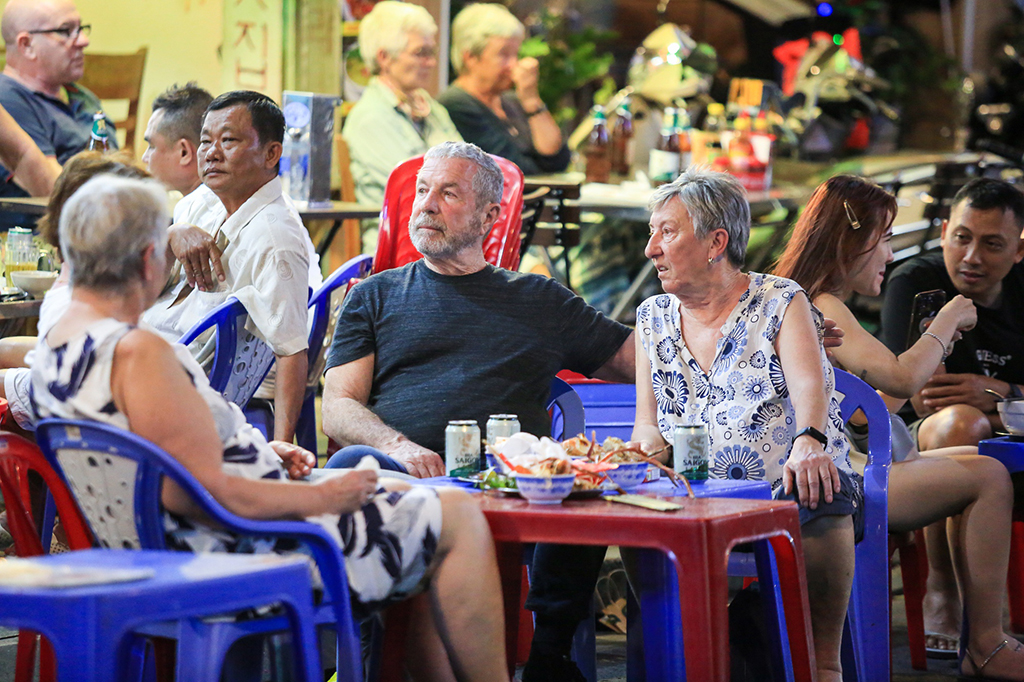
Bui Vien Street, often frequented by tourists, is packed with people on weekends...
"Last Saturday night, I went to Bui Vien with some friends to have a few beers. It's been years since I've been back to Bui Vien in Saigon, and it's really different. Restaurants and bars have tables and chairs spilling onto the street. Many bars even have outdoor dance floors, as lively as the pedestrian street in Pattaya, Thailand. It was packed with people, both locals and foreigners. We were having fun when, around 1 AM, authorities started going from bar to bar, reminding people to remove their tables and chairs and turn off the music. At that time, our bar still had about 100 customers. Most of the foreigners were bewildered, not understanding what was happening. Around 2 AM, the barriers at both ends of the street opened, and cars started pouring in again. When the music stopped, the fun ended, and everyone went home," recounted Mr. Tran Hieu (a resident of District 4, Ho Chi Minh City) about his recent experience on the city's most bustling "Western Street."
Karaoke, arguably the most popular form of nighttime entertainment, is only permitted to operate until midnight. Meanwhile, movie theaters are constantly threatened with fines if they open after midnight, and a proposal to extend the operating hours to 2 AM has yet to be approved after nearly two years. Nevertheless, many theaters still offer screenings as late as 11:30 PM, catering to a significant number of customers who want to watch movies at night.
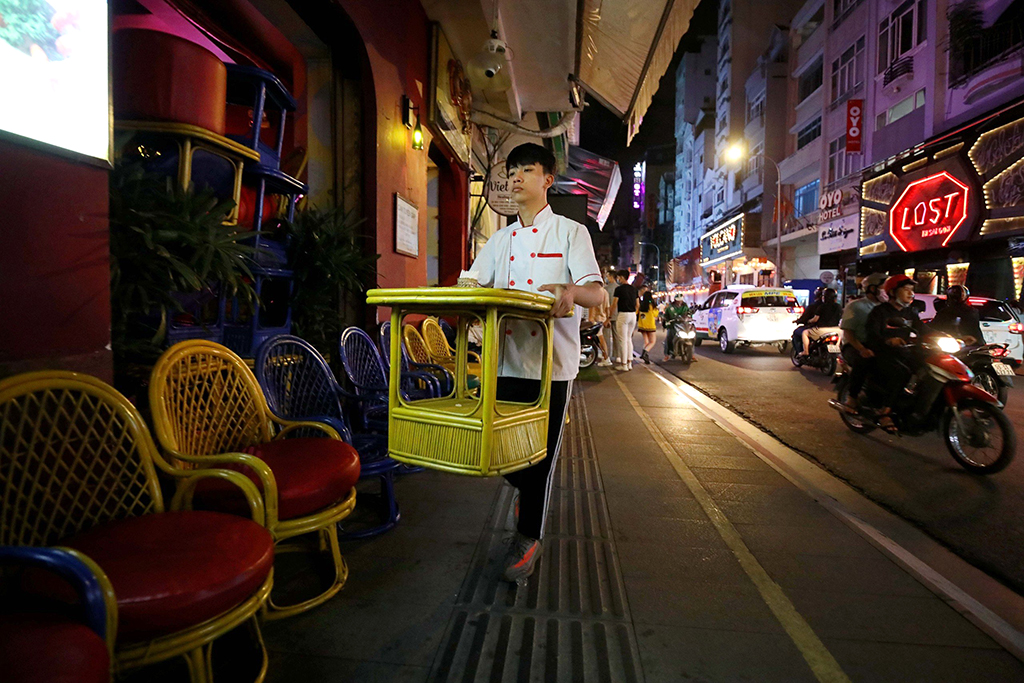
...however, it needs to be cleaned up soon.
Is it a lack of a legal framework or a lack of breakthroughs?
When discussing the night-time economy, before even considering what to do or where to go, lifting the curfew for entertainment and recreational services is considered a crucial factor.
In Asia, China is a prime example of nighttime economic development. From around 2010, shopping malls and night-time commercial streets in major cities were bustling, but until early 2019, Beijing, compared to cities in southern and eastern China, still had few nighttime shopping and entertainment venues, with most closing after 10 PM. However, in a short time, the city has taken the lead in "lighting up" its nighttime economy through various measures such as optimizing public transportation, promoting night-time restaurants, and encouraging extended business hours. Some famous tourist attractions in Beijing have extended their opening hours by a few hours. The first and second subway lines have extended their operating hours on Fridays and Saturdays, with the last train departing after midnight. Some districts are developing late-night canteens along key subway lines and encouraging convenience stores to operate 24/7… A series of measures have been aggressively implemented by the city's leaders to extend the sleepless hours for both tourists and residents.
Thailand is known as Asia's "party capital" because there are so many places to have fun day and night, but when it comes to attracting more international tourists and encouraging them to spend more, extending nighttime entertainment hours is among the first solutions being implemented. Just two hours of extended nighttime entertainment hours helped Thailand generate 54.5 billion baht (US$1.6 billion) in tourism revenue in December 2023 alone, a 44% increase compared to the same period the previous year. In Pattaya alone, extending opening hours boosted revenue at bars and entertainment venues by 50% during the year-end period.
In Vietnam, in July 2023, the Ministry of Culture, Sports and Tourism issued a plan outlining several models for developing night-time tourism products with various solutions, including a proposal to research and consider adjusting regulations on service hours, allowing night-time service activities to operate until 6 AM the following day (the current regulation is 2 AM). In reality, this is not a groundbreaking regulation, as the Government's Decision approving the plan for developing the night-time economy in Vietnam, issued in July 2020, already allowed for pilot programs extending night-time service activities until 6 AM the following day in several attractive tourist destinations and areas with favorable conditions for managing risks in night-time service activities in major cities/centers with high tourist traffic, such as Hanoi, Quang Ninh, Hai Phong, Ho Chi Minh City, Da Nang, Hoi An, Thua Thien-Hue, Can Tho, Da Lat, and Phu Quoc. However, to date, no locality has boldly proposed a pilot program.
Associate Professor Pham Trung Luong, former Deputy Director of the Institute for Tourism Development Research (Vietnam National Administration of Tourism)
Associate Professor Pham Trung Luong, former Deputy Director of the Institute for Tourism Development Research (Vietnam National Administration of Tourism), calls these "shackles" that localities lack the determination to break free from. According to him, the night-time economy is a component that can easily be boosted, attracting tourists' money immediately to drive tourism breakthroughs and economic development. Besides potential advantages such as diverse and abundant tourism resources; unique culture, art, and cuisine; and relatively pleasant nighttime weather, there are also existing types of services and entertainment that don't need new construction; simply "loosening regulations" can immediately boost their growth. For example, if tourists want to watch movies, go to karaoke, bars, pubs, or nightclubs later in the day, simply extending the operating hours will naturally generate more revenue. However, despite being given the autonomy, localities remain hesitant… In general, the idea of developing the night-time economy is still half-hearted; it ends as soon as it reaches "midnight."
On the other hand, according to Associate Professor Pham Trung Luong, simply extending business hours does not automatically create a night economy. A night economy model needs to fully meet three components: entertainment, dining, and shopping. A night economy complex should include a culinary paradise; an entertainment space that not only offers gambling but can also host world-renowned artists and celebrities for high-class artistic performances, utilizing special effects and technology; and a shopping area that can sell souvenirs, traditional Vietnamese goods, or outlet stores, branded goods, and duty-free items with guaranteed quality and quality control. The night economy area must be separately planned and located far from residential areas so that it can operate bustlingly 24/7 without affecting the lives of residents. Therefore, the central government still needs to open up more policies for localities to build entertainment complexes such as casinos, duty-free shopping areas, and tax refund policies for tourists... "The most important thing is consistency. If you allow visitors to stay until morning, you must also build a system of diverse products and experiences that are attractive enough to keep visitors coming until dawn. Investing in products and then forcing visitors to leave early is wasteful, but if visitors can play freely without places to spend their money, then the open policy loses its meaning," Associate Professor Pham Trung Luong emphasized.
Overall, the night-time economy still needs a boost in mindset and policy to achieve breakthroughs and contribute to the overall growth momentum of the economy.
Vietnam was a favorite tourist destination for Chinese visitors in early 2024.
Newly released search data from Agoda shows that search volume from China to Vietnam during the recent Lunar New Year holiday has almost returned to pre-pandemic levels. Specifically, Chinese tourists interested in traveling to Vietnam in 2024 reached 95% of the 2020 level – before travel restrictions due to the Covid-19 pandemic were implemented. Ho Chi Minh City, Hanoi, Nha Trang, Da Nang, and Phu Quoc are the top 5 choices for Chinese tourists, compared to the top 5 in 2020 which were Ho Chi Minh City, Nha Trang, Hanoi, Da Nang, and Phan Thiet.
Source link



















































































Comment (0)