 |
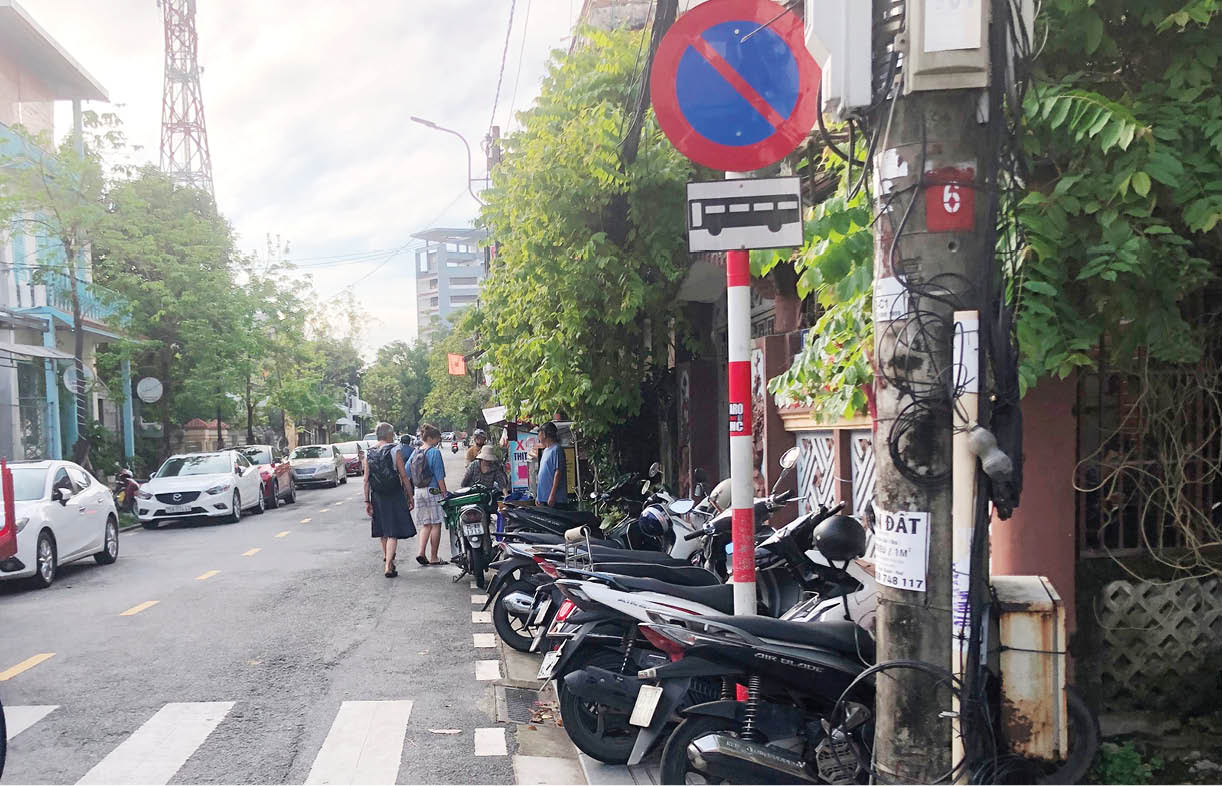
| The sidewalks of many streets are not intended for pedestrians. |
More than just a pathway
In recent days, along many central streets in the city's wards, authorities have simultaneously launched campaigns to address the encroachment on sidewalks and roads. Each campaign results in the removal of shops, the relocation of street vendors, and the dismantling of advertising signs… However, after a while, when the situation temporarily calms down, everything returns to how it was before.
It's easy to see that sidewalks have long ceased to be simply spaces reserved for pedestrians. They've become places for small businesses, where people set up tables and chairs to sell drinks, breakfast, snacks, and more. In urban life, every square meter of sidewalk has become part of a livelihood, especially for low-income earners. Therefore, each campaign to restore order, while necessary, still comes with certain disruptions. Some vendors have to move, and small shops have to close or downsize. This highlights the reality that simply addressing violations will not create sustainable change in sidewalk management.


Another problem with sidewalks that reveals inadequacies is the overlapping of management responsibilities. While sidewalks are part of the transportation infrastructure, they are also linked to business activities, urban order, and the environment. When multiple forces are involved but lack a unified coordination mechanism, the effectiveness of enforcement is easily fragmented.
Flexibility and humanity are needed.
Experience from many cities shows that effective sidewalk management cannot rely on a single solution. The challenge lies in a flexible approach that harmonizes management requirements with the needs of people earning a living. This is particularly relevant to Hue City, a city that is both a tourist center and possesses traditional urban characteristics. Returning sidewalks to pedestrians is necessary to ensure aesthetics and traffic safety, especially in central areas and tourist destinations. However, without supporting solutions, stricter management could create significant pressure on people who make their living on the sidewalks.
One possible approach is to reclassify and replan sidewalk space. Not all streets are subject to the same regulations. Areas with absolute priority for pedestrians can be identified, while also studying the possibility of designating streets where businesses are permitted under controlled hours or by product category.
Simultaneously, creating alternative livelihoods is a key factor. Models such as night markets, food streets, and concentrated trading areas, if properly planned, will both meet the business needs of the people and contribute to creating a unique urban landscape. This is also a way to shift trading activities from spontaneous to organized and more manageable.



In addition, it is necessary to strengthen public awareness campaigns to encourage people to better comply with government policies, ensuring that sidewalks are used for their intended purpose and reducing encroachment.
Source: https://huengaynay.vn/kinh-te/via-he-bai-toan-quan-tri-do-thi-165009.html




























![[Photo] Thousands of people participate in a run to show their support for the campaign "Sharing a common determination to build drug-free communes, wards, and special zones".](https://vphoto.vietnam.vn/thumb/1200x675/vietnam/resource/IMAGE/2026/06/27/1782554475933_0673e2a3df7b5e25076a-8283-jpg.webp)