

| EDITOR'S NOTE October 13, 2024 marks the 20th anniversary of Vietnamese Entrepreneurs' Day. Over the past 20 years, the private business sector has grown into a vibrant, energetic force, full of ambition and energy to contribute even more to the nation's prosperity. From being stigmatized as an exploiting class in the past, entrepreneurs have officially been given a day to be celebrated like many other professions. The majority of entrepreneurs today started from nothing and have now become business owners, creating wealth for society and generating numerous jobs. However, that spirit has diminished in recent years, due to lockdowns caused by the Covid-19 pandemic and the "fear of making mistakes, fear of responsibility" within the system. The entrepreneurial spirit needs to be revitalized, the desire to get rich needs to be spread, and fear needs to be eradicated. Above all, over the past decades, Vietnamese entrepreneurs have consistently demonstrated adaptability, flexibility, and resilience, becoming a vital force in the economy . They are undoubtedly pillars in the process of achieving the country's prosperity goals by 2045. On the occasion of October 13th, VietNamNet publishes a series of articles to encourage the entrepreneurial spirit and share with entrepreneurs the current difficulties and obstacles, aiming towards a rapid and sustainable "era of national resurgence." |
Vietnam Weekly presents the first part of a conversation with Mr. Tran Si Chuong, an economic expert with nearly three decades of experience working with the private sector, on entrepreneurship in Vietnam.
How do you view the development of the private sector in Vietnam over the past several years?
Mr. Tran Si Chuong : When I first returned to Vietnam in 1997, I collaborated with American Professor James Riedel from Johns Hopkins University to research and write the first report for the World Bank on the private sector of Vietnam.
One of the main goals of the report was to find out whether Vietnamese people have an entrepreneurial spirit. We conducted surveys in many localities. After only about two weeks, we were surprised to find that wherever Vietnamese people sat, they were talking about business and making money.
Once, while traveling to Can Tho by ferry, a foreign member of our group ordered a cold beer, but the ferry sped away while a young girl selling ice was waiting. However, when the ferry docked, the girl somehow managed to bring the cold beer back. The foreign researcher was astonished and said, "With this kind of entrepreneurial spirit, this country will surely develop."
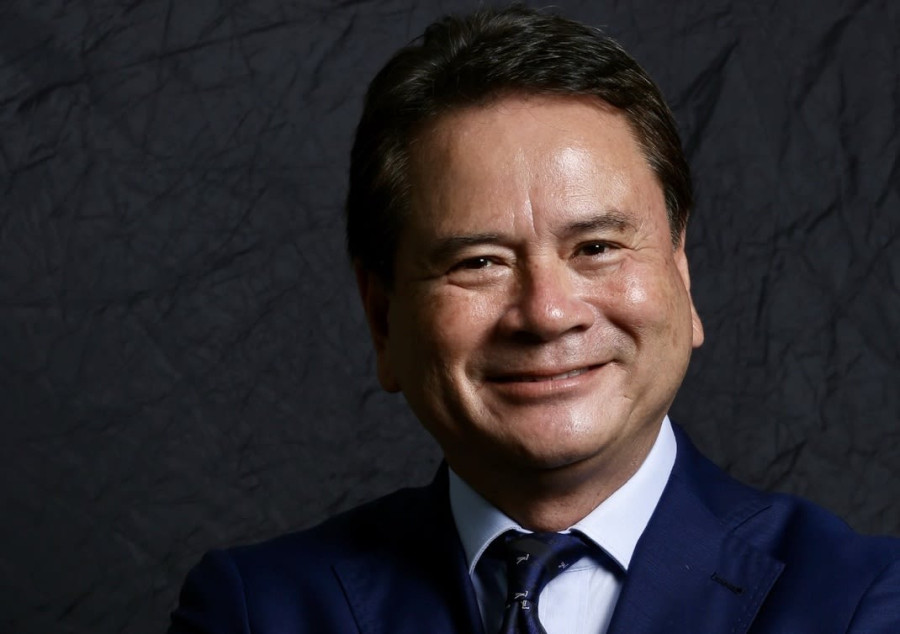
Mr. Tran Si Chuong: The entrepreneurial spirit of Vietnamese people once flourished. Photo: VietNamNet
Over 20 years ago, I helped many young entrepreneurs start their businesses. Most of them started from scratch, with the most having only a few hundred million dong as capital to import raw materials for production. Yet now, many of them have assets worth tens of millions of dollars. And the number of people with assets worth tens of millions of dollars is now very large.
Many female entrepreneurs in their sixties are now tycoons in the pharmaceutical and garment industries. These women previously had to ride bicycles to remote areas to sell individual items like shirts and pills, something that the younger generation can hardly imagine.
The entrepreneurial spirit of the Vietnamese people has developed very strongly. In absolute terms, the development of the private business sector is significant, but in relative terms, it could have developed even more.
However, the entrepreneurial spirit has declined significantly, seemingly hitting rock bottom. According to a recent VCCI survey, only 27% of businesses indicated they plan to expand production and business in 2024 and 2025, lower than the low point in 2012-2013. Do you see this in practice?
Businesspeople are very perceptive; they are the best at reading economic risks…
It's true that in recent years, the situation has become very difficult. From an international perspective, many economic and political axes are shaken, such as the Russia-Ukraine war and conflicts in the Middle East, with no end in sight. Global value chains have been disrupted, globalization has fractured, inflation is high, and high interest rates persist.
Domestically, Vietnamese businesses consistently face very high interest rates and numerous business barriers. In addition to the difficulties from the Covid-19 pandemic, there is now the added burden of bureaucratic inefficiency. Yet, entrepreneurs continue to work diligently. It must be acknowledged that Vietnamese businesses possess a truly remarkable resilience.
The total assets of the 12 largest private corporations in Vietnam are estimated at around $70 billion. What are your thoughts on this figure?
This $70 billion figure is equivalent to the assets of just one foreign corporation. Consider Elon Musk's personal wealth, which is double Vietnam's GDP. This illustrates that Vietnamese private businesses are still relatively "poor" compared to the rest of the world.
On the other hand, I think Vietnam now has about 20 billionaires; they just don't announce it. Having millions or billions of dollars is commonplace now because the digital economy will create financial billionaires, and these people can get rich overnight. It wouldn't be surprising if there were even more billionaires in the age of AI. But the question is, while some people will get rich quickly, will the country become strong?
I would like to reiterate that, in absolute terms, the development of the private sector is significant, but in relative terms, it could have developed even more.

Prime Minister Pham Minh Chinh holds discussions with representatives of private corporations. Photo: VGP
The land story
The frozen real estate market is a major problem for the economy. Many businesses are selling houses to people before completing the necessary legal procedures, leaving people's assets unsold, businesses at risk, and banks also affected. How do you think this issue should be addressed?
The fact that businesses built and sold houses to people without proper legal permits isn't solely their fault. The State also bears responsibility. People have already moved into those houses; how can you force them to leave? I believe the State needs to legalize this situation in some way because it has to be resolved for the people anyway. Resolving it now is much better than waiting 10-20 years. This backlog needs to be addressed as soon as possible to break the deadlock.
Another issue is that the Land Law is a crucial law, so it must have a philosophy that prioritizes optimal solutions to benefit all stakeholders, ensuring the rights of people whose land is expropriated while also encouraging investors. Fair protection of all parties' rights is essential for a harmonious and successful market development. As for those who violate the law, swift sanctions must be imposed to ensure fairness and trust in society.
Access to land is also a very difficult issue for businesses, especially since land prices are determined by market value under the new Land Law. How do you view this?
To acquire land, investors need to demonstrate that if residents relocate, the land they move to must have a higher or equivalent value. Importantly, efforts should be made to avoid touching the state budget, as this is very complex. Even for public projects, the government should minimize the use of the budget to mobilize capital from the private sector. Unfortunately, despite the existence of the PPP Law, private businesses do not feel comfortable or attracted to participate. This is the problem.
Regarding high land prices, I think the market will adjust. For example, right now on Dong Khoi Street, District 1 in Ho Chi Minh City, people are demanding 1.5 billion VND/m2, claiming that a few years ago the land price was already 1 billion VND/m2 and they can't sell it for less. They keep demanding that price, but nobody buys it. Therefore, the market will adjust itself.
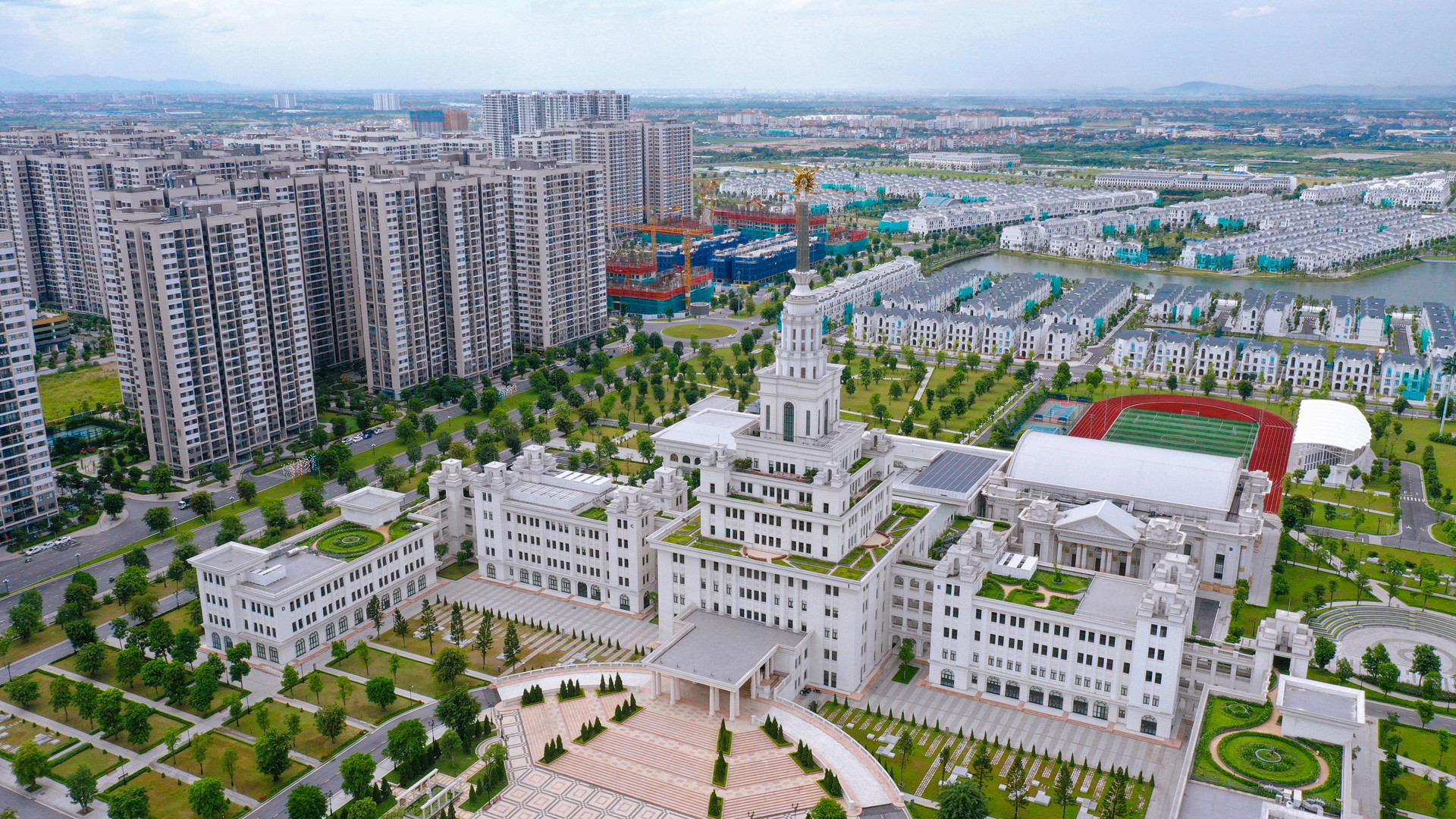
The VinUni University campus and residential buildings belonging to Vingroup, Gia Lam, Hanoi. Photo: Hoang Ha
Trust is social capital.
While the number of bankruptcies has increased significantly, many businesses have also managed to survive after extremely painful restructuring processes. What are your thoughts on this situation?
Restructuring means changing the operating model. Firstly, businesses must sell off areas that are not generating revenue to reduce cost burdens and generate cash flow, as the duration of this crisis is uncertain. Most fundamentally, businesses need to maintain the lowest possible cash flow and costs.
Secondly, think about the long term. Many businesses still lack a long-term vision for sustainable development. "Sustainable development" is talked about a lot, but what actually needs to be done to achieve it is often overlooked. Sustainable development requires discipline and good governance.
Many businesses thrive thanks to management, not governance. Many entrepreneurs are risk-takers, very successful, and quick to seize opportunities, but that's management, not governance. They see their business doing well, so they assume they've managed it well.
I've known a businessman since he had 20 employees. Now, he has over 200. I asked him how his system is doing. He replied, in essence, that he still controls every step of the process, knows everything, and nothing escapes his notice.
I don't think so. I believe that person is just managing things haphazardly and superficially; how could they possibly know everything that goes on in the business? Anyone who's good at business thinks they're a brilliant strategist because they grasp market trends and buy low and sell high, but that's not strategy, that's management.
Therefore, good governance and strategic direction are essential, especially in this rapidly changing AI era.

The InterContinental Danang Sun Peninsula Resort, owned by Sungroup, is located in Da Nang. Photo: VietNamNet
The story he told is very relevant today because nowadays, almost the second generation in Vietnamese business families is starting to take on management roles. There are many cases of failure because even though the businesses have grown large, they are still managed according to the family model. What advice does he have?
It is true that the generation of successful entrepreneurs after the Doi Moi (Renovation) period is facing this problem, although it is not new to the world.
Many of the world's biggest names started as family businesses, but they had good management systems and management culture. Therefore, even their grandchildren and great-grandchildren have money, and they still have money in retirement because the company's management structure is not dependent on any individual in the family.
For example, the Rockefeller family is in its eighth generation, yet they remain incredibly wealthy, possessing billions of dollars even though they now only hold 5% of the company. They have members on the board of directors and a team of advisors ranging from lawyers to economists and financial experts. They don't train one child to do all of that because how could one person possess all those skills?
But Vietnamese people often do everything themselves. It's ingrained in Vietnamese blood that they don't trust anyone. Everyone thinks, "It's my property, so I have to manage it myself. How can I entrust it to an outside system?" Thinking like that is definitely a recipe for disaster.
Firstly, the probability of training a child to inherit the business is zero, because even if the child is very talented, well-behaved, and educated abroad, how can they run this system in Vietnam? Their fathers did things that the child cannot do because things are very different here.
I know of families who send their sons, especially the eldest, to study in the US and then force them to become CEOs, resulting in the business declining significantly within one or two years. Therefore, the older generation of entrepreneurs should believe that businesses must operate through management and systems. Of course, some capable children can still become CEOs, but their authority should be limited.
McKinsey research shows that the probability of a company being successfully passed down from the first generation to the second is 30%; and from the second to the third is 10%. Therefore, the probability of success from the first to the third generation is only 3%. If the model dictates that the company must be passed down through generations, the risk of the grandson ending up selling lottery tickets on the streets is high.
Of course, that model doesn't work in Vietnam because many entrepreneurs end up in jail. I feel sorry and sad because businesses are assets of society; they create jobs for many people.
This also explains why domestic businesses haven't grown stronger. Domestic businesses should be increasing their opportunities for cooperation with FDI companies. If FDI companies see large-scale businesses with good management systems, they will be more willing to do business with us.
Furthermore, domestic businesses do not yet have management systems that meet international standards, so cooperation between FDI and domestic businesses is merely outsourcing.
| Mr. Tran Si Chuong is currently a Senior Partner and Strategic Development and Corporate Governance Consultant at 3 Horizons (UK), a strategic consulting firm. He previously served as an economic and banking advisor to the Banking Committee of the U.S. Congress. Since 1995, he has regularly worked in Vietnam and several countries in the region, advising international financial institutions and domestic and foreign businesses on macroeconomics, governance, and corporate development strategies. |
Vietnamnet.vn
Source: https://vietnamnet.vn/viet-nam-uoc-tinh-co-20-ty-phu-2329779.html#


































































Comment (0)