

Quick view:
- What is offside?
- What is the difference between offside positioning and offside fouls?
- How to calculate offside in football
- Exceptions do not count as offside.
- The tactical significance of offside
- The complexity and controversy surrounding the determination of offside.
- The role of VAR and SAOT (semi-automatic offside detection) technology
What is offside?
The term "offside" originates from Chinese characters, where "viet" means to surpass and "vi" means position, i.e., exceeding the permitted position.
According to the rules, a player is considered offside if, at the moment a teammate passes or touches the ball, that player is closer to the opponent's goal than both the ball and the last second of the opposing team's defenders (including the goalkeeper). In other words, it's when the player receives the ball near the opponent's goal, directly facing the goalkeeper, or with only a single defender in front of them.

What is the difference between offside positioning and offside fouls?
In football, there is a common confusion between offside position and offside foul.
Being in an offside position does not automatically result in a foul being called; it only creates a condition for a player to be penalized if they participate in the play. A player can be in an offside position without being penalized if they do not actively participate in the game or interfere with the actions of opposing players.
A player is only penalized for an offside foul if they are in an offside position and then actively participate in the play or affect an opponent.
How to calculate offside in football
A player in an offside position is only penalized for offside if both the position and the action at the moment a teammate passes or touches the ball are simultaneously met.
Offside conditions include the player being in the opponent's half (excluding the halfway line), having fewer than two opposing players between him and the opponent's end line relative to the ball (i.e., being behind the second-to-last defender), and being in front of the ball (in the direction of attack).
The conditions for committing a foul (only occurring while in an offside position) include directly touching a ball passed by a teammate, obstructing an opponent, affecting an opponent's vision or ability to play, preventing an opponent from playing the ball, or contesting the ball with an opponent, and gaining an advantage from an offside position (involvement in a situation where the ball bounces off the post, crossbar, or from an opposing player).
When an offside is committed, the referee will stop the game and award an indirect free kick to the defending team from the position where the offending player entered the game.
Exceptions do not count as offside.
A player in an offside position will not be penalized if they receive the ball directly from a goal kick, throw-in, or corner kick.
The tactical significance of offside
The offside rule requires forwards to be in an offside position when the ball is passed toward them, limiting their ability to receive the ball behind the opposing defense. This forces the attacking team to have a clear movement and passing strategy, with well-timed passes and quick runs to move into advantageous positions after the ball has been kicked.
Defensive teams often employ the "offside trap" tactic by pushing their defensive line high in a coordinated manner to force opposing players into offside positions. However, this tactic is described as a "double-edged sword" because it requires seamless coordination and high concentration; even a small mistake can create dangerous gaps.
The complexity and controversy surrounding the determination of offside.
The offside rule is considered one of the most difficult rules to enforce correctly in football.
Determining offside depends on the observational and judgmental abilities of the referee and his assistants. Decisions are often only a matter of centimeters or millimeters, but they are crucial as they determine whether an attack can continue or a goal can be awarded. The fast pace of the game and the movement of players can obscure vision, making it difficult for the linesman to detect the foul.
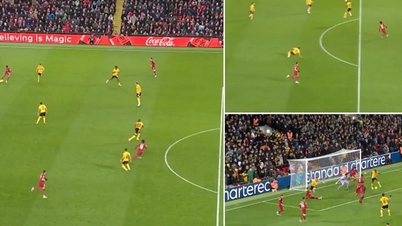
Tight offside situations like those involving Raheem Sterling (Premier League 2021) or Lautaro Martinez (World Cup 2022) demonstrate the complexity and controversy of this rule, even with the aid of technology.
The role of VAR and SAOT (semi-automatic offside detection) technology
Video Assistant Referee (VAR) technology was developed to analyze offside situations more accurately. VAR referees use 3D graphics to draw precise virtual lines on the field, comparing the position of a legitimate body part of an attacking player (excluding hands and arms) with the last defensive player to determine the offside position with millimeter precision. While VAR helps minimize errors, it has also been controversial due to its offside decisions being based on millimeters of accuracy.

Referee checks VAR
To address this issue and speed up decision-making, Semi-Automated Offside Technology (SAOT) was introduced. This technology uses 12 specialized cameras mounted under the stadium roof to track the ball and monitor 29 data points per player, updating 50 times per second. When an offside situation occurs, the data is quickly sent to the VAR room for confirmation, reducing waiting time and increasing accuracy. SAOT was successfully implemented at the 2022 World Cup and the 2023 Asian Cup.
To put it simply, the offside rule is like an invisible firewall on the football field; it's not a foul when you're standing next to that wall (offside position), but it becomes a foul (offside) if you try to get past that wall to touch the ball or affect the defender at the very moment the ball is passed. The current support of VAR and SAOT is like adding super-fast cameras and laser systems to accurately determine whether the attacking player's "legitimate part" actually touched that invisible firewall, even if only by a few millimeters.
Source: https://vietnamnet.vn/viet-vi-offside-la-gi-2466602.html



![[Photo] Meeting of the Standing Committee of the National Assembly Party Committee with the Standing Committee of the Government Party Committee on the First Session of the 16th National Assembly](https://vphoto.vietnam.vn/thumb/1200x675/vietnam/resource/IMAGE/2026/03/10/1773107502031_ndo_br_thu-tuong-pham-minh-chinh-va-chu-tich-qh-tran-thanh-man-dong-chu-tri-hoi-nghijpg-jpg.webp)
![[Photo] Da Nang: Mountainous commune adorned with flags and flowers, ready for election day.](https://vphoto.vietnam.vn/thumb/1200x675/vietnam/resource/IMAGE/2026/03/10/1773113803384_ndo_br_9-jpg.webp)




























![[Image] 20 islands in the Spratly Islands special administrative region hold early elections.](https://vphoto.vietnam.vn/thumb/1200x675/vietnam/resource/IMAGE/2026/03/08/1772949669607_img-20260308-112026-90-jpg.webp)







































































Comment (0)