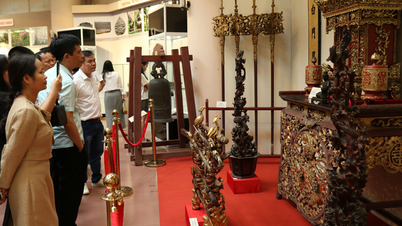
The greatest scholar of Vietnam in the 18th century.
Le Quy Don's childhood name was Le Danh Phuong, his courtesy name was Doan Hau, and his pen name was Que Duong. He was originally from Dien Ha village, Dien Ha district, Son Nam province (now Doc Lap commune, Hung Ha district, Thai Binh province). He was born on August 2, 1726, in Bich Cau ward, Thang Long capital, and lived and started a family there. His father was Doctor Le Trong Thu, pen name Truc Anh, who served as an official in the Le-Trinh dynasty for over 50 years. He was renowned as an honest and upright official and had a great influence on Le Quy Don's life.
For a long time, many people have praised the rare talent of Le Quy Don: he knew how to read and write at the age of 2, could read many classical texts at the age of 5, composed the famous poem "Snake Head, Snake Face" at the age of 8, had read all 5 Classics, 4 Books, history, and stories by the age of 14, even Zhu Xi, and could compose 10 poems in a day without needing a draft...
At the age of 17, Le Quy Don took the provincial examination at Son Nam school and passed with the highest rank (Giai Nguyen). That year, he officially changed his name from Le Danh Phuong to Le Quy Don. At the age of 26, he participated in the national examination of the year Nham Dan (1752) and achieved a brilliant gold medal: he came first in both the provincial and imperial examinations. From here, he began his career as an official.
The renowned cultural figure Lê Quý Đôn, dubbed the "wisdom of the era," was the greatest scholar of Vietnam in the 18th century. With his intelligence and profound knowledge, he left behind approximately 50 valuable books covering almost all contemporary knowledge, including philosophy, sociology, history, economics, political science, literature, and art. Some notable works include: in philosophy, "Thư kinh diễn nghĩa" (Interpretation of the Book of Documents), "Dịch kinh phu thuyết" (Explanation of the Book of Changes), "Xuân Thu lược luận" (Summary of the Spring and Autumn Annals), and "Quần thư khảo biện" (A Comprehensive Study of the Encyclopedia); in history, "Đại Việt thông sử" (Comprehensive History of Đại Việt), "Kiến văn tiểu lục" (Small Records of Observations), "Bắc sứ thông lục" (Comprehensive Records of the Northern Envoys), and "Lê triều công thần liệt truyện" (Biographies of Meritorious Officials of the Lê Dynasty); in literature, "Toàn Việt thi lục" (Complete Collection of Vietnamese Poetry), "Hoàng Việt văn hải" (Hoang Viet Literary Sea), "Quế Đường thi tập" (Quế Đường Poetry Collection), and "Quế Đường văn tập" (Quế Đường Prose Collection); and, notably, the encyclopedic "Vân Đài loại ngữ" (Classification of Vân Đài's Sayings).
In 1784, he fell ill and requested to return to his maternal hometown of Duy Tien for treatment. He passed away on June 2nd of that year and was posthumously awarded the title of Minister of Public Works.
You may also like
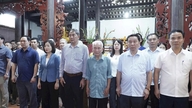
Thuong Tin commune offers incense to commemorate national hero Nguyen Trai.On October 7th, the Party Committee, People's Council, People's Committee, and Fatherland Front of Thuong Tin commune solemnly organized a ceremony to offer incense in commemoration of the 645th anniversary of the birth and the 583rd anniversary of the death of National Hero and Cultural Figure Nguyen Trai (1380-1442). 
Inauguration of the Nguyen Dinh Chieu Memorial House in My Loc commune.On July 1st, the Party Committee, People's Council, People's Committee, and Vietnam Fatherland Front Committee of My Loc commune, Tay Ninh province, held the inauguration ceremony for the Memorial House of Cultural Figure Nguyen Dinh Chieu - a project implementing the Resolution of the 1st Party Congress of the commune, term 2025-2030. UNESCO approves recommendation for designation.
At the international scientific conference "Le Quy Don: Life and Work" held in Thai Binh, Associate Professor Nina V. Grigoreva from HSE University, St. Petersburg, Russian Federation, stated that, through his contributions and works, the scholar Le Quy Don is a leading pioneer of Vietnam.
“Le Quy Don was a great official, intellectual, and scholar during the Le Trung Hung era. He lived, worked, and wrote during the mid-18th century, which in world history is known as the Enlightenment. He was a contemporary of great cultural and scientific figures such as Montesquieu (France), Voltaire (France), Hume (England), Lomonosov (Russia), Rousseau ( Switzerland -France), Diderot (France)...”, analyzed Nina V. Grigoreva.
Professor Shimizu Masaaki of Osaka University, Japan, made a very interesting comparison between the scholar Le Quy Don and the famous 18th-century Japanese linguist and national scholar Motoori Norinaga (1730-1801).
“Compared to the research methods of a Japanese scholar, Motoori Norinaga, in identifying the similarities and differences between two contemporary scholars in Vietnam and Japan, Le Quy Don was the first Vietnamese person to consider language and writing as objects of thought and understanding. He was the first to propose a method for studying the Vietnamese language in the history of Vietnamese science,” emphasized Professor Shimizu Masaaki.
Over the past few years, the Vietnam Institute of Culture and Arts Research and the Department of Culture, Sports and Tourism of Thai Binh province have been preparing the dossier on the cultural figure Le Quy Don to propose to UNESCO to co-organize the 300th anniversary of his birth in 2026.
On the night of April 10, 2025 (local time), at the 221st session of the Executive Board of the United Nations Educational, Scientific and Cultural Organization (UNESCO) held in Paris, member states adopted a decision recommending that the UNESCO General Assembly, scheduled to meet in November 2025, approve the honoring and joint commemoration of the birthdays of several world-renowned figures, including honoring and jointly commemorating with Vietnam the 300th anniversary of the birth of the renowned figure Le Quy Don (1726 - 2026).

Vietnam encourages US businesses to expand investment in high technology.On the morning of June 26th, at the Government Headquarters, Deputy Prime Minister Ho Quoc Dung received Mr. Jeff Place, Supply Chain Director of Coherent Group (USA). During the meeting, the Deputy Prime Minister affirmed that Vietnam encourages US businesses to expand investment, especially in high-tech, innovation, and semiconductor industries.
The delegation from Thai Binh province, in coordination with the Vietnamese Embassy in France, the Vietnamese Delegation to UNESCO, and the Vietnamese Cultural Center in France, successfully organized the conference "Introducing the cultural figure Le Quy Don and promoting the culture and tourism of Thai Binh province". The conference was part of efforts to lobby UNESCO to cooperate in commemorating the 300th anniversary of the birth of the renowned figure Le Quy Don (1726 - 2026).
Bao Chau
Source: https://baophapluat.vn/vinh-danh-nha-bac-hoc-le-quy-don-post545518.html






![[Image] National conference summarizing one year of operation of the overall organizational model of the political system, the three-tiered government model.](https://vphoto.vietnam.vn/thumb/1200x675/vietnam/resource/IMAGE/2026/07/01/1782882811691_ndo_br_1-jpg.webp)