


In terms of absolute points, this was the sharpest drop in trading history.
The stock market opened the week with strong selling pressure early on, at one point losing more than 17 points due to news about the results of bond audits at several listed companies.
NVL opened at the floor price, ACB, VIB, andSHB fell by around 1%, and MSN also reversed its upward trend from the end of last week, continuing its decline after a near-ceiling price drop to red.
Last weekend, the Government Inspectorate announced the conclusions of its inspection regarding compliance with policies and laws in the issuance and use of funds from privately placed corporate bonds.
Among the entities found to have violated the intended use of funds raised from bonds are several commercial banks, Novaland Group, and Masan Group.
The Government Inspectorate concluded that Masan Group and its two subsidiaries, Masan Consumer and Wincommerce, misused funds from corporate bonds, totaling nearly 2,000 billion VND, for purposes other than those for which they were issued.
Selling pressure from stocks undergoing inspections, coupled with corrections in large-cap Vingroup stocks, plunged the market into the red.
Today's highlight came from the Viettel group of stocks, with CTR and VTP hitting their upper limits, while VGI also rose nearly 9%. This group of stocks has also been outside the overall market's price surge over the past five months.

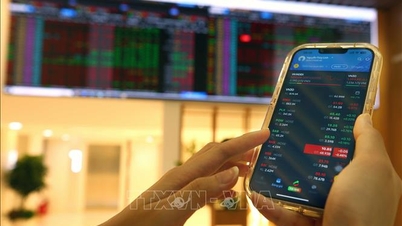
The stock market experienced a sharp decline, with the VN-Index plummeting by more than 94 points.
After a long rally and a few minor corrections, the stock market unexpectedly plunged today, creating an unforeseen shock for investors. While not the sharpest percentage drop, in terms of absolute points, this was the steepest decline in trading history.
At the close of trading on October 20th, the VN-Index fell 94.76 points to 1,636.43 points. Trading volume reached over 53,294 billion VND with 1.7 billion shares traded. Only 34 stocks rose, while 325 fell, 19 remained unchanged; notably, 108 stocks hit their lower limit.
On the HNX exchange, the HNX-Index lost 13.09 points to 263.02 points, with a trading volume of 190.2 million shares, equivalent to over 4,558 billion VND. The UPCOM-Index also decreased by 2.36 points to 110.31 points, with 63.5 million shares changing hands, totaling over 1,003 billion VND.
Selling pressure was widespread: all 30 stocks in the VN30 index declined, with 13 hitting the floor limit. Only 2 banking stocks managed to stay in positive territory, while 10 fell to the floor limit. Stocks in the securities, oil and gas, insurance, real estate, information technology, and media sectors all plunged into the red, with many hitting the floor limit.
After two consecutive days of decline, the VN-Index has lost a total of approximately 130 points from its peak, wiping out all gains since the beginning of October. Analysts believe that short-term profit-taking pressure and net selling of over 2 trillion VND by foreign investors are the main reasons for the sharp market drop.
At the recent Investor Day event, Mr. Le Anh Tuan – General Director of Dragon Capital – commented: “Volatility during an uptrend is unavoidable. A 5-10% increase or decrease in the market is completely normal. When understood correctly, these corrections are actually opportunities.”
Mr. Tuan emphasized that the long-term trend and inherent strength of the Vietnamese stock market are still being strongly consolidated thanks to a stable macroeconomic foundation, increasing interest from foreign capital, and the development of domestic financial institutions.
According to Mr. Tuan, Vietnam is gradually fulfilling the criteria to be upgraded from a frontier market to an emerging market (MSCI Emerging Markets) and further to an advanced emerging market (FTSE Advanced Emerging Market) within the next 3-5 years.
The upgrade is particularly significant because it would place Vietnam in the investment portfolios of hundreds of major global investment funds, attracting tens of billions of USD in foreign capital into the stock market, creating a strong transformation and opening up a new, more sustainable growth cycle.
Previously, many securities companies also advised investors to be cautious, considering the correction necessary for the market to rebalance. In the medium and long term, Vietnamese stocks are still considered an effective channel for attracting capital thanks to the positive macroeconomic foundation and loose fiscal and monetary policies supporting growth.
Source: https://vtv.vn/vn-index-giam-gan-95-diem-100251020164632868.htm










































































































Comment (0)