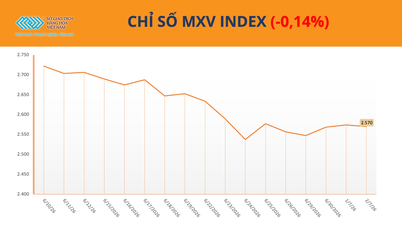
The Vietnamese stock market experienced its sharpest weekly decline since the beginning of the year due to profit-taking pressure from investors. The market started relatively positively with a slight increase on April 2nd, however, increased selling pressure caused the VN-Index to continuously fall in the remaining four sessions of the week.
Following significant fluctuations, the VN-Index closed the week down 28.98 points, or 2.26% compared to the previous week, at 1,255.11 points. The HNX index fell 1.9% to 239.68 points.
The real estate sector was one of the few bright spots in the market last week, notably DIG which rose 0.3% and NVL which increased 6.1%. The banking and securities sectors performed the least positively and experienced sharp corrections.
Net selling pressure from foreign investors continues to negatively impact the market. Last week, foreign investors sold a net 15,681 billion VND, marking the seventh consecutive week of net selling.
In addition, the USD/VND exchange rate surpassing its historical peak and heading towards 25,000 despite the State Bank of Vietnam's efforts to absorb excess liquidity through the OMO channel has also contributed to negative investor sentiment.
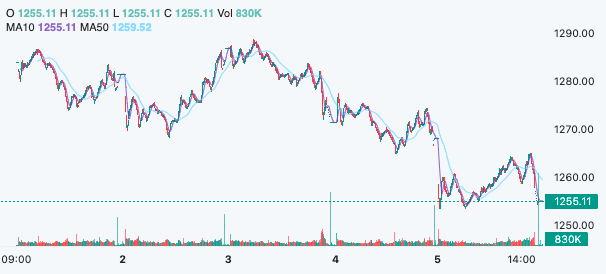
VN-Index performance last week (Source: FireAnt).



Regarding developments in the coming trading week, Mr. Dinh Quang Hinh – Head of Macroeconomics and Market Strategy Department, Analysis Division of VNDIRECT Securities, believes that the VN-Index is currently in short-term downward momentum and may correct to the support zone of 1,230 points (+/-10 points).
However, investors should not rush to buy at the bottom given the continued volatility of the exchange rate and the high level of market fluctuations. Investors need to patiently observe market demand at the support level around 1,230 points and wait for the market to establish a short-term equilibrium before making any new investment decisions.
Conversely, investors with high leverage ratios need to adhere to discipline and watch for rallies to reduce leverage in order to control portfolio risk.
Meanwhile, Mr. Bui Van Huy – Director of DSC Securities Branch – commented that the factors supporting the market in the medium and long term have not been violated, but the market needs to find a balance point with the new developments in the domestic and global context.
Globally, major stock markets are showing signs of short-term weakness, and risky assets like cryptocurrencies are also undergoing sharp corrections. Meanwhile, US government bond yields continue to rise, and commodity markets remain volatile, significantly reducing expectations of a Fed interest rate cut. Recent resurgence of geopolitical risks has fueled a sharp rise in commodity markets, a key factor requiring close observation.
Domestically, it involves the balancing act of the regulatory body in the trade-off between monetary policy factors, economic growth, and the strength of domestic capital flows on one hand, and exchange rates and foreign capital flows on the other.



Experts from DSC stated that the market has experienced a long upward trend, and it is normal for the market to need a few weeks or longer to find a new equilibrium point and consolidate again.
However, to definitively confirm the trend, the pillars of a bull market need to be carefully evaluated. For a market as fragmented as it has been recently, influenced by many large-cap stocks with relatively low liquidity, the index score isn't the most important factor. What matters is that the market finds a new equilibrium point and that macroeconomic factors are balanced as soon as possible.
The nearest support for the market is around 1,240 points, with strong support around 1,200 points. Meanwhile, the strong resistance zone is the 1,280-1,300 point range .
Source