|
The VN-Index recovered, but liquidity remained at its lowest level in months. Photo: Phuong Lam . |
The Vietnamese stock market recorded a slight recovery on June 10th. However, trading activity showed that cautious sentiment still prevailed as capital flows were not yet ready to return strongly, meaning the increase in the indices was mainly driven by large-cap stocks.
From the start of the trading session, the VN-Index fluctuated continuously around the reference point as buyers and sellers fiercely vied for control. Investor caution kept liquidity low, while market breadth did not yet clearly lean towards positive territory.
It wasn't until more than an hour into trading that demand for leading stocks gradually improved. Banking, real estate, and construction/public investment stocks all rose in price, providing the impetus for the VN-Index to regain its positive momentum and maintain its upward trend until the end of the session.
Nevertheless, liquidity remains a concern. The total trading value across all three exchanges reached just over 15,000 billion VND , remaining at its lowest level since the beginning of 2025. This indicates that capital is still staying on the sidelines rather than actively participating in the market, despite significant price corrections for many stocks in recent times.
At the close of trading, the VN-Index rose 10.66 points (+0.6%) to 1,803.71 points. Meanwhile, the HNX-Index fell 4.59 points (-1.5%) to 301.15 points, and the UPCoM-Index increased 0.54 points (+0.4%) to 125.67 points.
In terms of breadth, the market leaned towards the positive side with 387 stocks rising (including 22 that hit the ceiling price), 866 stocks remaining unchanged, and 298 stocks falling (including 11 that hit the floor price).



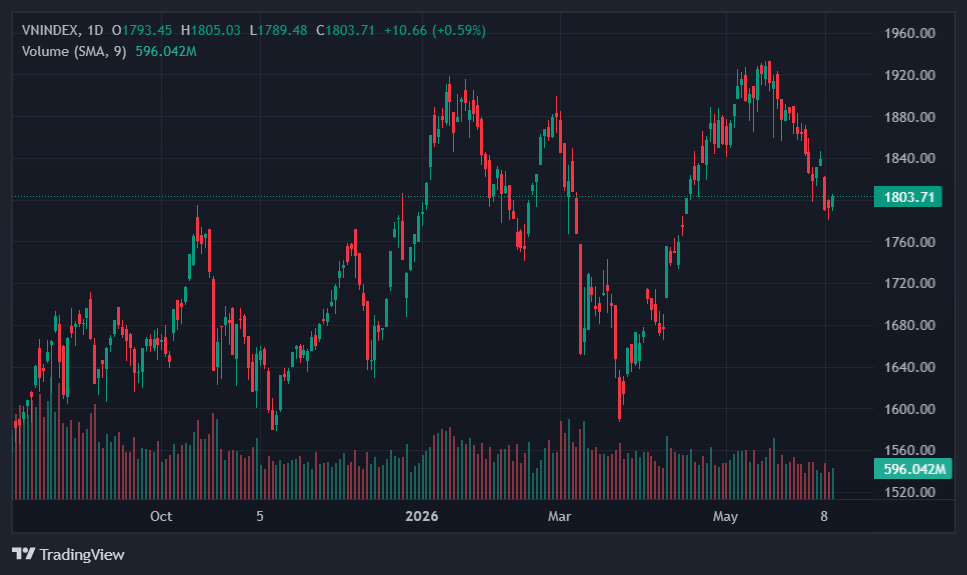 |
The VN-Index returned to the 1,800-point mark. Photo: TradingView. |
The VN30 basket continued to play a leading role, recording 22 gainers, 5 losers, and 3 unchanged stocks. As a result, the VN30-Index rose by more than 9 points, to 1,958 points.
The main driving force behind the VN-Index maintaining its positive performance came from leading stocks in key sectors such as banking and real estate. Notable examples include BID (+1%), VIC (+0.4%), GVR (+1.8%), VHM (+0.3%), NVL (reaching the ceiling price), VJC (+1.7%), VCB (+0.3%), VPB (+0.6%), VNM (+1%), and LPB (+1%).
Conversely, downward pressure persisted in some large-cap stocks, but the impact was not significant. STB fell 1.4% and was the stock with the most negative impact on the VN-Index during the session. Following STB were BVH (-2.2%), MSN (-0.7%), PLX (-1.1%), GMD (-0.5%), KDC (-0.5%), BSR (-0.4%), VCK (-0.2%),SHB (-0.1%), and VPL (-0.2%).
Foreign investor activity remained a negative point, with both buying and selling volumes significantly reduced compared to previous sessions. Despite this, foreign investors maintained a net selling position of over 500 billion VND across the entire market.
Selling pressure was concentrated mainly in the financial and securities sectors. MBB saw the strongest net selling, with a value of approximately 83 billion VND , followed by VPB (-73 billion VND ) and SSI ( -47 billion VND ).
On the net buying side, VJC continued to be the focus with foreign investors disbursing approximately 43 billion VND . In addition, foreign capital also recorded net buying in CII (+38 billion VND ) and MWG (+30 billion VND ).



Source: https://znews.vn/vn-index-lay-lai-moc-1800-diem-post1658573.html