(Illustrative photo: VNA)
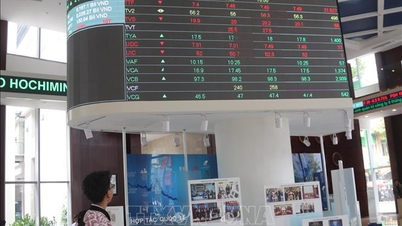
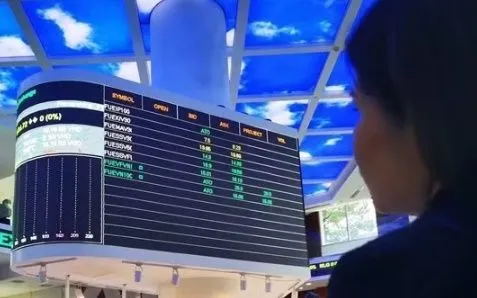
After a strong surge in the morning session, the VN-Index cooled down towards the end of the day as selling pressure spread across many stock groups.
At the close of trading, the VN-Index rose 24.27 points to 1,830.47 points. The HNX-Index increased 5.96 points to 336.16 points, while the UPCOM-Index gained 1.16 points, closing at 128.23 points.
Although the main indices maintained their upward momentum, the market picture revealed a significant disparity between buyers and sellers. Across the market, 377 stocks declined, including 7 that hit the lower limit, significantly outnumbering the 283 stocks that rose, with 18 reaching the upper limit.
Selling pressure emerged across many sectors, including banking, securities, real estate, software, infrastructure, food, and retail. However, the strong upward momentum of stocks within the Vingroup ecosystem became the main driving force helping the market maintain its positive performance.
Specifically, the trio of VIC, VHM, and VRE all surged to their upper limit right from the start of the session, contributing a total of approximately 33 points to the VN-Index. In addition, VPL increased by nearly 2%, adding about 0.65 points to the index. This means that if the impact of these four stocks were removed, the VN-Index might have fallen during today's trading session.
Market liquidity was also noteworthy, cooling down in the afternoon session. The total trading value across all three exchanges reached nearly 18,900 billion VND; of which, the HOSE exchange alone recorded over 17,300 billion VND. This development was not considered surprising, as June 18th coincided with the expiration date of index futures contracts, a time when liquidity tends to decline towards the end of the session.
Regarding foreign investor transactions, foreign investors continued to maintain a strong net selling position. The value of purchases reached approximately VND 1,280 billion, while the value of sales amounted to over VND 3,147 billion, corresponding to a net selling of nearly VND 1,868 billion.
Selling pressure was concentrated on many large-cap stocks;FPT experienced the strongest net selling with over 501 billion VND. Following closely were VHM with nearly 182 billion VND, TCB with over 159 billion VND, and VCB with nearly 127 billion VND. Notably, FPT has been consistently facing significant net selling pressure from foreign investors in recent sessions, becoming one of the stocks experiencing the strongest capital outflows on the market.
Despite the VN-Index gaining over 24 points, the June 18th trading session showed a significant dependence on Vingroup-related stocks. The market leaned heavily towards selling pressure, coupled with strong net selling from foreign investors, particularly in large-cap stocks like FPT, indicating that cautious sentiment persists. In the short term, the market is likely to continue experiencing significant volatility and divergence among stock groups, given that capital flows have not yet truly spread widely across the market.



Asian stocks hit all-time highs: Nikkei surpasses 71,000 points, KOSPI breaks through 9,000 points.
On the afternoon of June 18th, the Japanese and South Korean stock markets simultaneously set unprecedented records after the US and Iran officially signed a Memorandum of Understanding (MoU) to end hostilities, along with explosive growth in global semiconductor stocks.
In Tokyo, Japan, the Nikkei 225 index closed up 1,151.24 points (1.65%) at 71,053.49 points. This was the first time in history that the index surpassed the 71,000-point mark at the end of a trading session, marking a six-day winning streak. During the trading session, the Nikkei index even briefly touched a record high of 71,398.58 points.
The expanded Topix index also rose 54.95 points (1.37%) to 4,068.18 points, setting new records both for intraday and closing gains.
Tokyo investors reacted enthusiastically after US President Donald Trump and Iranian President Masoud Pezeshkian signed a 14-point agreement to end hostilities. This news was released shortly after the US market closed the previous night. The peace agreement also pushed US West Texas Intermediate (WTI) crude oil prices back to around $75 per barrel.
Masahiro Ichikawa, chief strategist at Sumitomo Mitsui DS Asset Management, said the market breathed a sigh of relief as the two countries finally reached a formal agreement after a long wait. Similarly, Maki Sawada, an expert at Nomura Securities, emphasized that the market is now focusing on restoring normal maritime traffic through the Strait of Hormuz without customs fees.
Besides geopolitical factors, the Nikkei index was also boosted by the rise in technology stocks, following the US market after Intel Corp. announced the start of early production for its most advanced chip process.
Following the upward trend, in Seoul, the KOSPI index surged 199.6 points (2.25%) to close at 9,063.84 points, officially breaking the 9,000-point mark. During the day, the KOSPI reached a high of 9,106.07 points, extending its winning streak to six consecutive sessions.
Besides news of easing restrictions in the Strait of Hormuz, South Korean stocks were also boosted by expectations for artificial intelligence (AI) and tight chip supply. Analyst Kim Seok-hwan from Mirae Asset Securities noted that semiconductor companies have a significant negotiating advantage.
Meanwhile in China, Hong Kong's Hang Seng index fell 2.2% to 23,785.75 points, while the Shanghai Composite index dropped 0.4% to 4,090.48 points.



Meanwhile, the Israeli stock market continued its sharp decline in recent days as investors viewed the agreement between the US and Iran as an unfavorable development for Israel's security environment and strategic prospects. The TA-125 index fell 1.72% on June 18th and has lost approximately 9.5% from its recent peak. The TA-35 index of large-cap companies fell 1.54%, while the TA-90 dropped 2.03%. Banking, real estate, insurance, and energy sectors were among the hardest hit. The banking index has fallen 7.7% since the beginning of the month, while infrastructure and energy stocks have declined by more than 6%.
The US Federal Reserve (Fed) has just decided to keep interest rates unchanged for the fourth consecutive time, while signaling that monetary tightening over the next year is unavoidable in order to curb inflation. However, Asian investors appear to be little affected by this decision.
In the currency market, the US dollar traded within a narrow range, remaining above 160 yen/USD in Tokyo. Meanwhile, the South Korean won weakened, falling 13.7 won to close at 1,527.1 won/USD.
Source: https://vtv.vn/vn-index-tang-hon-24-diem-100260618171942436.htm