

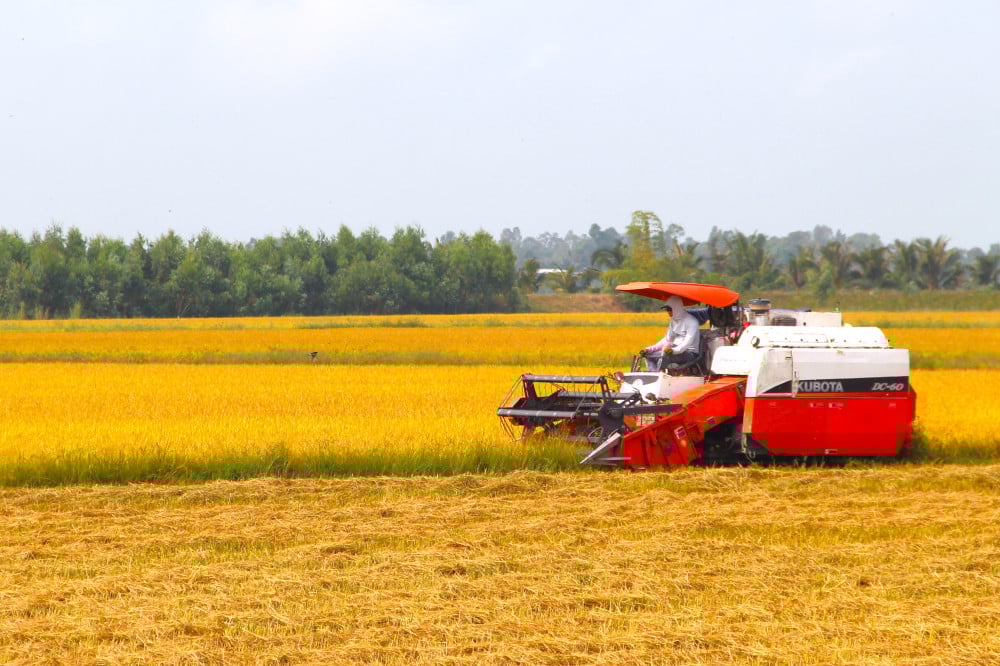
Farmers harvest the 2025 Summer-Autumn rice crop.
Harvest quickly.
Visiting the low-lying villages of Dong Thap Muoi these days, one can easily witness the bustling scene of the summer-autumn rice harvest. In the fields, combine harvesters work tirelessly from early morning until late afternoon. Along the rural roads, a line of trucks carrying rice leaves the fields, transporting the "golden grain" to collection points or milling facilities.
This year, the weather wasn't ideal, and diseases broke out in many places. However, the people and agricultural experts proactively responded, maintaining stable yields.
Mr. Nguyen Van Moi (residing in Vam Gura hamlet, Vinh Chau commune), who has over 20 years of experience in rice cultivation, shared: “This season, I sowed 2 hectares, and the rice yield is relatively stable, about 6 tons/ha. Many households that harvested earlier only achieved 3-4 tons/ha due to bacterial infections. After harvesting, I will ‘open the fields’ to release floodwater, and I will sow again in November.”
Not only in Vinh Chau commune, but also in many other localities such as Thanh Phuoc, Vinh Hung, Tan Hung communes, etc., farmers are busy harvesting rice. Everyone is taking advantage of every hour and every day to "clear the fields" before the upstream floodwaters arrive. This is not only the peak harvest season but also a pivotal time to prepare for the 2025-2026 Winter-Spring crop - the most important rice crop of the year.
Because this area is low-lying, the locals still maintain the practice of "flooding" after the summer-autumn crop to improve the soil, eliminate pathogens, and replenish silt. Harvesting at the right time ensures sufficient time for the flood season, significantly contributing to the success of the following crop.
In Vinh Hung commune, thanks to well-organized production, simultaneous planting, and comprehensive mechanization, the entire 7,500 hectares of summer-autumn rice crop have been harvested. However, low rice prices have resulted in low profits for farmers.
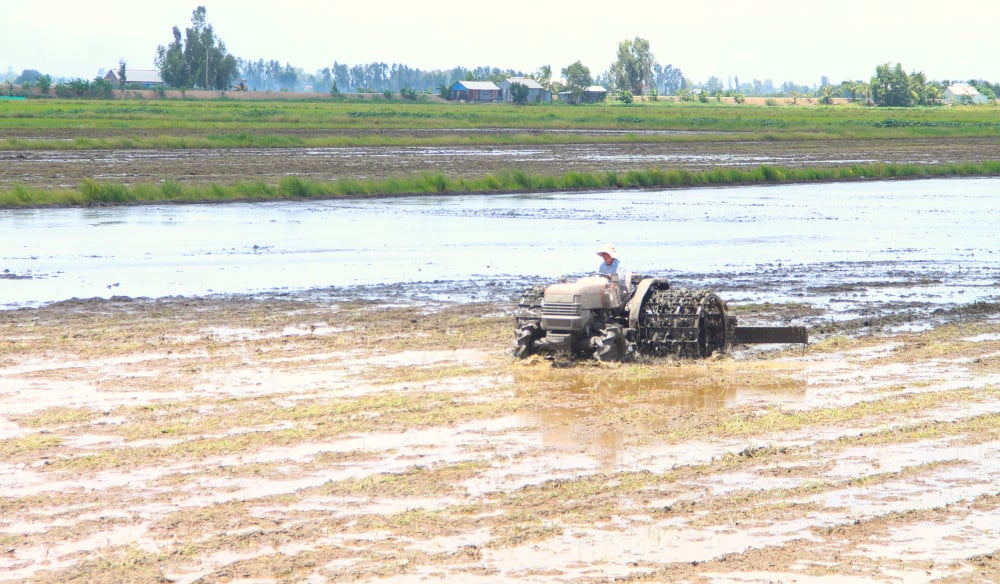
Farmers in Vinh Hung commune are plowing the land, preparing for flooding.
According to Dinh Chau Phong, Deputy Head of the Economic Department of Vinh Hung commune: “This season, the average rice yield is about 6 tons/ha. However, the price of rice this year is not high; some farmers broke even, while others made a profit of 7-12 million VND/ha.”
In Thanh Phuoc commune, the situation is even more difficult with widespread pest and disease outbreaks. Mr. Nguyen Hoai Han (residing in Thanh Lap hamlet) worried: “This season I sowed 6 hectares of IR4625 glutinous rice, preparing to harvest in 4-5 days. But this year the rice is heavily infested with stem borers and grain discoloration disease, so the yield will surely decrease. The price is also low, only 6,900-7,000 VND/kg, a decrease of about 500-600 VND/kg compared to last year, so I probably won't make a profit.”
According to Le Ngoc Tuong, Vice Chairman of the People's Committee of Thanh Phuoc commune: “To date, the commune has sown 8,643 hectares of summer-autumn rice. In Da Bien hamlet, farmers have started harvesting, with 20-25 hectares already harvested, yielding 6-6.2 tons/ha. The People's Committee of the commune has directed specialized departments to inspect dikes and monitor water levels regularly to protect the crop and prepare well for the next production season.”
According to statistics from the Department of Agriculture and Environment, in the 2025 Summer-Autumn crop season, the entire province sowed over 263,670 hectares, reaching 98.8% of the plan. By the end of July, 95,058 hectares had been harvested, with an average yield of 58.5 quintals/hectare, and an estimated production of 555,874 tons.
Ready to face the flood
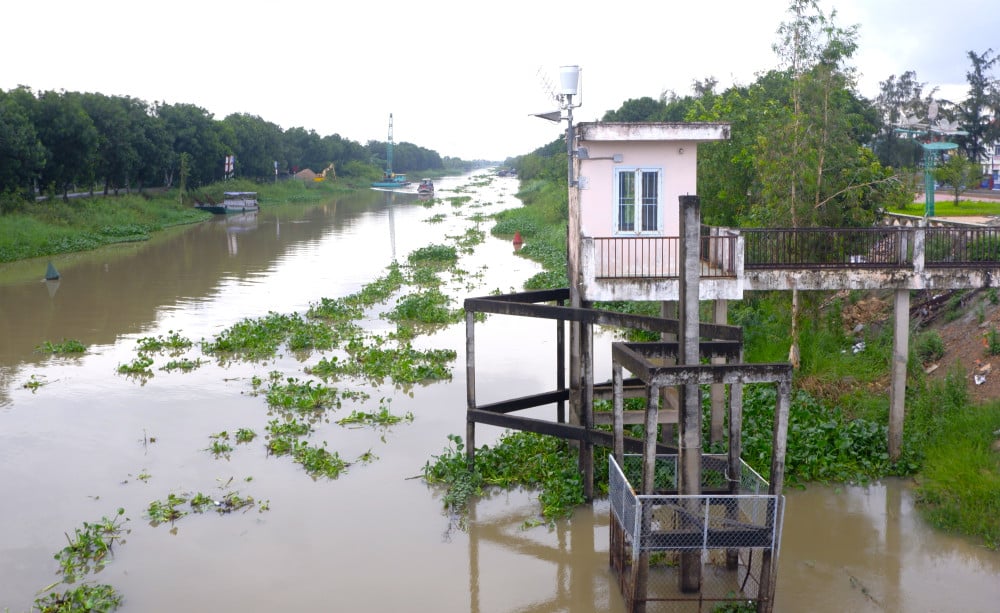
Water levels in the upstream communes of the province are rising by 2-5cm per day.
Immediately after completing the harvest, many households didn't wait but quickly plowed and dried the land, preparing to welcome the floodwaters. Mr. Ho Tan Thanh (Vam Gura hamlet, Vinh Chau commune) shared: "I just finished harvesting 1.5 hectares of OM18 rice, yielding about 6 tons/hectare. After harvesting, I immediately plowed the land to prepare for the flood. During this flood season, I plan to let the land rest for a few months, and only replant when the water recedes."
According to information from the Tay Ninh Meteorological and Hydrological Station, floodwaters in the Dong Thap Muoi region are rising rapidly due to local rainfall combined with water flowing from upstream. On average, water levels are rising by 2-5cm per day and night, and are predicted to peak locally in August, creating favorable conditions for farmers to irrigate their fields.
Mr. Tran Van Mem (residing in Vinh Hung commune) said: “I have just finished plowing 5 hectares of land to flood it. Flooding is essential for a successful upcoming Winter-Spring crop. It helps to wash away acidity, kill pathogens, and accumulate silt in the fields, reducing fertilizer costs and minimizing pests and diseases for the next crop.”
Simultaneously, over 30,000 hectares of rice for the 2025 Autumn-Winter crop have been sown in the province. Given the rising floodwaters, authorities are advising localities to absolutely avoid complacency.
The Department of Agriculture and Environment requires its affiliated units and local authorities to closely monitor weather and hydrological developments, accurately assess the area and growth stage of each rice crop to take appropriate response measures, and simultaneously deploy forces to patrol, inspect, and reinforce vulnerable dikes and dams; and prepare pumps and equipment ready to respond in case of incidents.
From timely harvesting and proactive plowing to dike protection and irrigation regulation, the people of the Dong Thap Muoi region are clearly demonstrating a flexible agricultural production mindset, closely connected to nature. They don't race against floods, but live in harmony, utilizing the floods to benefit the land and the people.
Bui Tung
Source: https://baolongan.vn/vu-lua-he-thu-tap-trung-thu-hoach-sn-sang-don-lu-a200052.html













































































Comment (0)