

 |
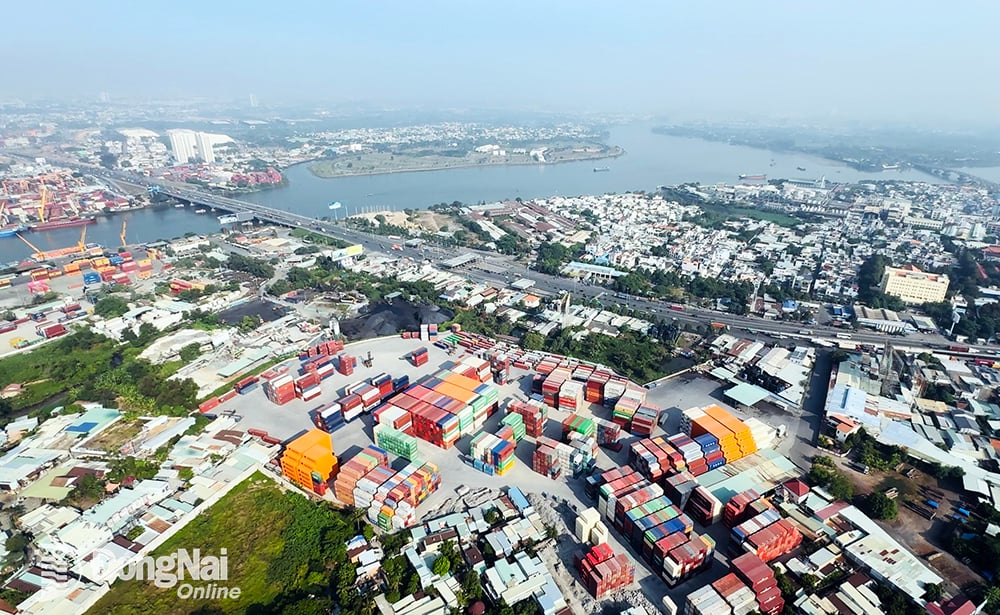
| The Dong Nai Port area viewed from above. Photo: B. Nguyen |
After many changes, from 1997 to the present, the Southeast region has one centrally-governed city - Ho Chi Minh City - and five provinces: Dong Nai, Tay Ninh, Binh Phuoc, Binh Duong, and Ba Ria - Vung Tau. The Southeast region has risen to become the most economically developed region in Vietnam, contributing more than 30% of the country's GDP and having an urbanization rate of 62.8%.
A great battlefield with glorious victories.
The Southeast region is a strategic area, connecting with the Southern Central Highlands, the South Central region, and the Mekong Delta. Therefore, during the resistance war, this region played a very important role in contributing to the historic victory of the nation, the complete liberation of the South, and the reunification of the country.
During the resistance war against French colonialism, the army and people of the Eastern region waged heroic battles such as Trung Hung - Rang, Dat Cuoc, Dong Xoai, La Nga - Dinh Quan..., joining the people of the whole country in "sharing the fire" with Dien Bien Phu , achieving a victory that "shook the world and resonated across five continents".
During the resistance war against the American imperialists, the Southeast region was a major battlefield with glorious battles and brilliant victories in many historical campaigns: North Tay Ninh defeated the American imperialists' "Junction City" operation; the 1968 Tet Offensive and Uprising attacked American-puppet regime strongholds in the South; the Xuan Loc - Long Khanh Campaign opened the "steel gate" into Saigon... Particularly, with the 1975 Spring Offensive and Uprising, culminating in the historic Ho Chi Minh Campaign, the Eastern and Southern regions completed a long journey of sacrifice, hardship, and glorious victory, contributing to the reunification of the country.
After the war, the war-torn eastern region embarked on overcoming the consequences of war and developing its economy. This dynamic, creative, and proactive region continued to break down barriers, revise outdated policies, and implement bold, unprecedented solutions for socio-economic development. The Southeast region effectively exploited its geographical advantages, attracting a large, highly skilled workforce, and numerous training, research, and technology facilities.
The Southeast region has emerged as a key economic hub of Vietnam, boasting the largest tourism center and development of industrial services, information technology, telecommunications, and logistics in the country. The region's economic growth rate is consistently 1.3-1.5 times higher than the national average.
The region also boasts a well-developed urban system and industrial zones, becoming a central hub connecting the southern provinces with the rest of the country and internationally. This creates favorable conditions for socio-economic development within the region, as well as expanding inter-regional and international economic relations. The Southeast region possesses most of the outstanding conditions and advantages for industrial and service development, leading the way in industrialization and modernization; in particular, developing high-tech industries, semiconductor industries, electronics, information technology, oil and gas industries, and petrochemical products. The Southeast region provides livelihoods for millions of workers nationwide. Simultaneously, it forms centers for supply, processing, logistics chains, and exports.
In 2024, the Southeast region continued to affirm its role as the economic engine, with total budget revenue reaching over 733 trillion VND, accounting for 42.2% of the national total revenue, exceeding the projected figure by 3.6%. Exports grew strongly, reaching 115.7 billion USD, accounting for 31% of the country's total export turnover, an increase of 11% compared to the previous year. Per capita income in the region reached over 7,500 USD/year, more than double the national average.
The Southeast Region Planning for the period 2021-2030, with a vision to 2050, approved by the Prime Minister in 2024, aims to build the Southeast region into a civilized, modern, and dynamically developing area; a leading center of the country and Southeast Asia in economics, finance, education and training, science and technology, and innovation...
Dong Nai leverages its airport to "take off".
In 2025, many localities in the Southeast region aim for double-digit GRDP growth, including Dong Nai province.
According to Tran Vu Hoai Ha, Deputy Director of the Department of Finance, Dong Nai continues to maintain its position as one of the leading localities in industrial development with 37 industrial parks established, covering a total land area of over 13,100 hectares. Of these, 31 industrial parks are operational, 1 is in the land acquisition and infrastructure construction phase to attract investment, and 5 newly established industrial parks are in the planning and construction preparation stages.
In 2024, the province's Gross Regional Domestic Product (GRDP) reached over VND 260.2 trillion, an increase of more than 8% compared to the same period of the previous year. This growth rate is higher than the average of many provinces and cities in the Southeast region. Dong Nai currently has the 4th largest economy in the country and is one of the top 5 localities nationwide in attracting foreign direct investment (FDI), while also being among the top 5 localities with the largest budget revenue in the country.
Economist and PhD holder Tran Sy Chuong commented that Dong Nai is located in the heart of the Southeast region, possessing the best and fastest development opportunities in the country. The focus of Dong Nai's development should be on high-tech industries, clean industries, the Long Thanh International Airport urban area, and high-quality logistics. These development goals must be connected to the entire Southeast region, leveraging the advantages of the airport city to become an economic center for the region and the country. This means that, having an airport, Dong Nai should consider serving neighboring provinces and cities with the goal of mutual benefit and shared development. This is not just about the value of the airport project itself, but also about the hundreds or thousands of hectares surrounding the airport that need to be developed to bring value not only to Dong Nai, but also to neighboring provinces and cities and the national economy.
Sharing the same viewpoint, Dr. Ngo Viet Nam Son, Chairman of NgoViet Architects & Planners, believes that localities in the Southeast region need to change their approach to attracting FDI from the previous "localization" mindset to a more regional one. Specifically, Dong Nai's growth should be viewed within the context of the economic quadrilateral sub-region with Ho Chi Minh City and Ba Ria - Vung Tau. Dong Nai must leverage this connection to develop and become the leading economic engine of the country. The new thinking when developing the Long Thanh International Airport urban area is to build a sub-urban area centered around the airport, connecting with urban functional areas including: industrial zones, creative urban areas, education and healthcare zones, etc., linking with many provinces and cities in the Southeast. Long Thanh International Airport aims to serve 100 million passengers per year and must serve the entire Southeast urban region, which has the largest economic potential in the country, especially the large market of Ho Chi Minh City.
Plains
Source: https://baodongnai.com.vn/dong-nam-bo/202504/vung-dat-lua-tro-thanh-dau-tau-kinh-te-fc11701/


![[Photo] Announcement Ceremony of the Art Program “Light Concert – Welcoming the New Year 2026”](/_next/image?url=https%3A%2F%2Fvphoto.vietnam.vn%2Fthumb%2F1200x675%2Fvietnam%2Fresource%2FIMAGE%2F2026%2F01%2F27%2F1769514762857_le-cong-bo-ct-hoa-nhac-anh-sang-1772-9042-jpg.webp&w=3840&q=75)

![[Photo] Commemorating the unwavering friendship between Vietnam and Laos](/_next/image?url=https%3A%2F%2Fvphoto.vietnam.vn%2Fthumb%2F1200x675%2Fvietnam%2Fresource%2FIMAGE%2F2026%2F01%2F27%2F1769518372051_ndo_br_1-jpg.webp&w=3840&q=75)


![[Hightling] Conference on the Implementation of Tasks for 2026](/_next/image?url=https%3A%2F%2Fvphoto.vietnam.vn%2Fthumb%2F402x226%2Fvietnam%2Fresource%2FIMAGE%2F2026%2F01%2F27%2F1769477856197_dsc01637.jpeg&w=3840&q=75)


![OCOP during Tet season: [Part 2] Hoa Thanh incense village glows red.](/_next/image?url=https%3A%2F%2Fvphoto.vietnam.vn%2Fthumb%2F402x226%2Fvietnam%2Fresource%2FIMAGE%2F2026%2F01%2F27%2F1769480573807_505139049_683408031333867_2820052735775418136_n-180643_808-092229.jpeg&w=3840&q=75)
![OCOP during Tet season: [Part 1] Ba Den custard apples in their 'golden season'](/_next/image?url=https%3A%2F%2Fvphoto.vietnam.vn%2Fthumb%2F402x226%2Fvietnam%2Fresource%2FIMAGE%2F2026%2F01%2F26%2F1769417540049_03-174213_554-154843.jpeg&w=3840&q=75)





Comment (0)