

( Quang Ngai Newspaper) - Archaeological and ethnographic studies have proven that ancient people created salt through the evaporation of water by the sun or by boiling brine. And in most cases, especially in prehistoric times in Europe and Asia, brine was obtained from inland springs and lakes with high salinity. In Vietnam, the Sa Huynh culture reached a high level in iron smelting and glassmaking, so naturally they knew about salt production from a very early age.
According to historical records...
Salt exists in two basic forms: rock salt and sea salt. Rock salt accounts for the majority of human extraction and use, while handcrafted sea salt accounts for approximately 20%. Globally , salt production began very early in the Mesopotamian culture. With the development of urban civilization in Syro-Mesopotamia in the fourth millennium BC, the discovery of Qraya, located on the Euphrates River, revealed a salt production site supplying the city.
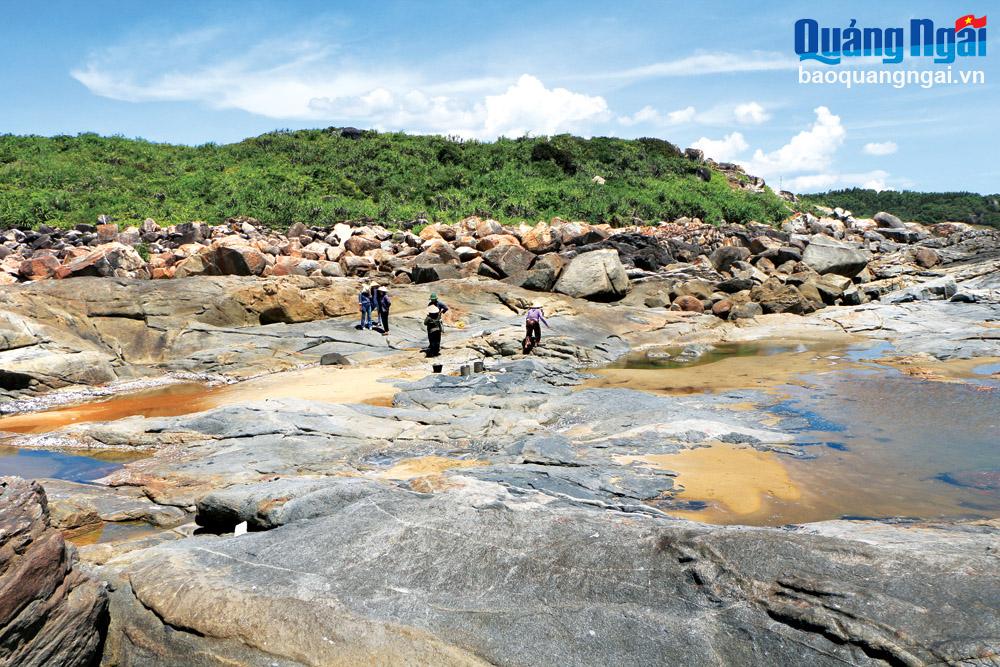 |
| Trang Muoi is a salt-making area where people have worked from ancient times to the present day. Photo: NGOC KHOI |
The Liangzhu culture is recognized as the first “state” society in East Asia and developed in the eastern coastal plains of China around 3,300 BC. Its economy was based on rice agriculture, characterized by settlements with ancient cities, sophisticated jade craftsmanship, and salt production. The Neolithic Daxie site, on the island of the same name off the East China Sea coast, is recognized as the earliest sea salt production site excavated to date in China, providing evidence that sea salt production on the eastern coast of China was practiced by Neolithic communities.
Vietnam, a tropical country, boasts over 3,200km of coastline characterized by a gently sloping and sheltered continental shelf, resulting in numerous salt-producing villages along its coast from north to south. The central region, the heartland of the Sa Huynh culture, has always been closely connected to international maritime trade routes. These trade lines, extending from the sea to the upstream and inland, have led to a large concentration of salt fields. From here, salt is transported throughout the country via a network of seaports and markets in the mountainous regions.
Salt is an essential component of the human diet; it has also been used to preserve and transport fish and meat since prehistoric times. Therefore, salt may even have provided an economic foundation for a community or served as a means of social interaction, which could have spurred urbanization and the formation of early, complex societies. Salt may even have provided an economic foundation for a community or served as a means of social interaction, which could have spurred the process of ancient urbanization and the formation of early, complex social organizations.
In the map showing the distribution of Sa Huynh cultural sites in Central Vietnam, the important Sa Huynh sites are all located near river mouths and salt fields. Specifically, comparing this to the Quang Ngai region, we see the close relationship between the Sa Huynh settlements and the river mouths and salt fields: Sa Huynh site - Sa Huynh estuary - Tan Diem salt field; Binh Chau site - Sa Ky estuary - Diem Dien salt field (now lost); Go Que site - Sa Can estuary - Tuyet Diem salt field (now lost).
This archaeological evidence reflects the salt production activities of the Sa Huynh people. This area became a hub for maritime trade and river transport to mountainous Sa Huynh locations, spreading through the forests to villages, hamlets, and settlements in the remote highlands. The salt of the Sa Huynh people was a means of social interaction, a driving force for two-way exchange between the upstream and downstream areas.
...to the ancient salt-making region
On a hot summer afternoon, with temperatures reaching 40°C, I went with Ms. Bui Thi Van, Ms. Nguyen Thi Ga, and their niece Tran Thi Thu Thuy to Trang Muoi area. It's a region with a flat, rocky surface, where their ancestors used to make salt on the rocks.
Trảng Muối is the local name for a flat area specializing in salt production on rocky surfaces. The exposed rocky ground of Trảng Muối is durable, ensuring its longevity against continuous erosion from seawater and waves, and the salt field heritage landscape has been preserved to this day.
Trang Muoi covers an area of approximately 10 hectares, bordered by the sea on one side and mountains on the other, located near the settlements and burial grounds of the Sa Huynh Culture. Trang Muoi has two areas: a large seawater reservoir where seawater flows in naturally with the tides and waves; the water in the reservoir has been exposed to sunlight, resulting in a higher salinity than normal seawater. The salt fields on rocks are small plots on the rock surface, bordered by clay embankments or depressions.
From the sun-dried seawater reservoir, people use small buckets to pour the water into the salt fields. After about a week of sun-drying, the seawater evaporates, turning into shimmering white salt crystals, with larger grains than regular salt. Residents in the Co hamlet still practice salt production on the rocky plains of Trang Muoi, just like their ancestors. Most of the ancient salt fields have the characteristic of chloride penetrating the rock layer over a long period of time, causing erosion and giving them a dark black color.
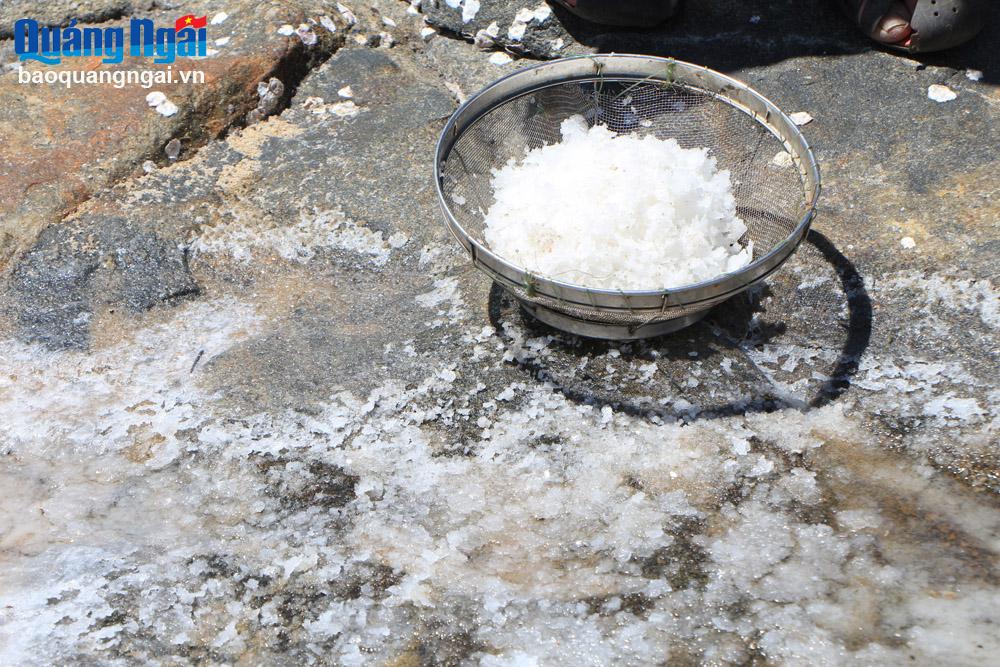 |
| Crystalline salt harvested from ancient salt fields. Photo: NGOC KHOI |
Trang Muoi is the site where the Sa Huynh Culture inhabitants produced sea salt by drying water on rocks about 2,000 years ago. It's comparable to the ancient Yangpu salt fields in Hainan (China), dating back to around 800 AD. This area comprises over 1,000 flat rocks used to evaporate seawater for salt production. Both sites share a similar method of drying seawater on rocks to crystallize salt.
The Sa Huynh salt village is located within the Sa Huynh Culture National Special Monument area and is an inseparable component of this archaeological culture. The tradition of sea salt production has continuously spanned from Sa Huynh - Champa - Dai Viet without interruption. Therefore, it is necessary to study and plan the salt field site within the Sa Huynh Salt Cultural Heritage Park.
Dr. DOAN NGOC KHOI
RELATED NEWS AND ARTICLES:
Source: https://baoquangngai.vn/quang-ngai-que-minh/dat-va-nguoi202407/vung-lam-muoi-co-xua-5bf2a0d/

![[Photo] Prime Minister Pham Minh Chinh receives the Chinese Ambassador to Vietnam](https://vphoto.vietnam.vn/thumb/1200x675/vietnam/resource/IMAGE/2026/04/05/1775397481797_ndo_br_dsc-5512-jpg.webp)


































































Comment (0)