

DONG NAI - Once a site for experimental rubber cultivation by the French in 1906, Dong Nai still preserves ancient rubber plantations over 100 years old.

The 8-hectare rubber plantation (also known as Lot 9) in Bau Ham 2 commune, Thong Nhat district, was first planted in Vietnam by the French under the name Suzanah plantation in 1906. Currently managed by An Loc Rubber Plantation, it is considered a conservation area for the Vietnamese rubber industry.

In 2015, the Dong Nai Rubber Corporation restored a model of a rubber worker's house from the French colonial era within the garden grounds, allowing visitors, students, and schoolchildren to better understand the historical and traditional values of the industry.
According to historical records, around 1906, the French planted 1,000 rubber trees experimentally in Dau Giay. Seeing that the trees grew quickly and produced latex, they expanded plantations throughout the southeastern provinces of Vietnam.

The traditional Vietnamese glazed tile roof is still preserved in the conservation house. Inside, many items are recreated from the rubber tappers of the past. Currently, the rubber plantation conservation area has been recognized as a provincial-level historical site by Dong Nai province in 2009.


According to An Loc Rubber Plantation, currently, out of a total of 700 trees planted in 1906, 224 trees are over 100 years old and are thriving. To facilitate conservation and care, the management unit has assigned sequential numbers to each tree.

Many trees over 100 years old have thick, rough bark that bears witness to the vicissitudes of time.
Mr. Nguyen Tuan Quang, Head of Technical Department at An Loc Farm, said the orchard's purpose is conservation, not economic exploitation. "Every month, the farm assigns workers to care for, clean, sweep, mow the grass, and protect the trees to prevent people from damaging them," Mr. Quang said.

The rubber trees planted by the French were seedlings (grown from seeds) spaced 5x5 meters apart, so they have very large trunks, ranging from 1-3 meters in diameter, and reach heights of 30-40 meters; some trees are so large that it would take several people to encircle them.
The first rubber plantation workers were recruited from the northern and central regions, but mainly from Trieu Phong district, Quang Tri province. Lot 9 rubber plantation was the largest plantation at that time.


Besides the rubber trees that are still thriving, there are many trees that have died due to the weather and insect infestation.


The 100-year-old rubber tree is hollow inside, but its top continues to grow well, sprouting branches and leaves that cover a large area of the sky.
According to the management of An Loc rubber plantation, the company plans to care for the trees annually, treat diseases, and spray pesticides to prevent them from drying out and rotting.

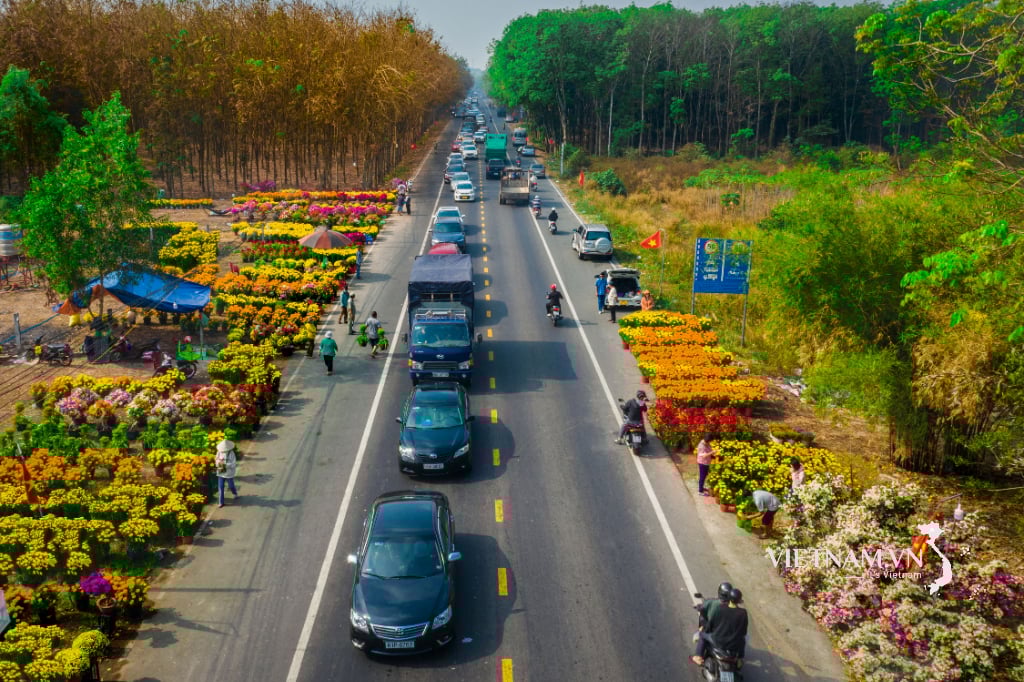
After shedding their leaves and leaving the trees bare, spring arrives, and new leaves begin to sprout, signaling a new latex-producing season in the rubber forests of southeastern Vietnam.
Phuoc Tuan - Vnexpress.net
Source
![[Photo] Prime Minister Pham Minh Chinh presides over a dialogue with Japanese businesses.](https://vphoto.vietnam.vn/thumb/1200x675/vietnam/resource/IMAGE/2026/03/21/1774097547316_ndo_br_dsc-0448-jpg.webp)















































































Comment (0)