

Israeli scientists discovered a crown, approximately 6,000 years old and shaped like a thick ring, in a cave in the Judean desert in 1961.
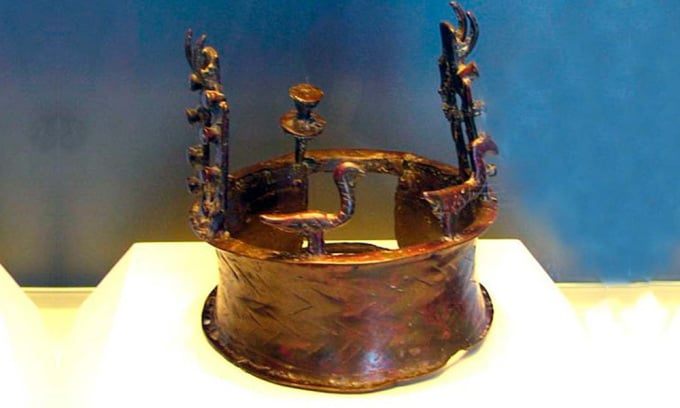
The world's oldest crown is located in the Nahal Mishmar antiquities collection. Photo: Hanay/Ancient Origins
Crowns often symbolize power, strength, and leadership. They can be associated with individuals of high status, such as rulers, rulers, or religious figures. Wearing a crown is a tangible symbol of that person's status and influence in society, or it is part of important rituals and events.
The world's oldest crown is one of more than 400 artifacts found in a cave in the Judean desert, Israel, near the Dead Sea, in 1961, Ancient Origins reported on June 25. These artifacts are collectively known as the Nahal Mishmar hoard.
In 2020, the crown was publicly displayed at the Institute for Ancient World Studies at New York University in an exhibition. It dates back to the Bronze Age, approximately 4,000–3,500 BC.
The crown is shaped like a thick ring with carvings of vultures and protruding doors. Experts believe this artifact played a significant role in the burial rituals of important people during that period.
Other items in the Nahal Mishmar hoard were likely used in rituals related to hunting, livestock herding, agriculture , and defense. The significant weight and value of the bronze artifacts indicate the importance of bronze in ancient society.
The Nahal Mishmar Hoard, discovered by archaeologist Pessah Bar-Adon, was hidden in a natural crevice and wrapped in a reed mat, located in a cave north of Nahal Mishmar. It contains a total of 442 artifacts, including 240 maces, 100 scepters, crowns, gunpowder horns, tools, and weapons made from bronze, ivory, and stone.
Carbon-14 dating revealed the reed mat to be at least 3,500 years BCE. During this period, the use of copper became widespread throughout the Levant, demonstrating that technological advancements went hand in hand with significant social progress in the region.
The artifacts in the Nahal Mishmar hoard appear to have been hastily gathered. Therefore, experts believe they may be sacred treasures belonging to the abandoned Bronze Age temple Ein Gedi, located about 12 km from the cave. It is likely they were hidden in the cave in an emergency. The purpose and origin of the hoard remain a mystery.
Thu Thao (According to Ancient Origins )
Source link






![[Photo] My Son at night: A thousand-year-old heritage site amidst the Milky Way](https://vphoto.vietnam.vn/thumb/402x226/vietnam/resource/IMAGE/2026/04/15/1776261039184_ndo_br_chon6-jpg.webp)


































































































Comment (0)