These included many difficult tasks such as relocating nearly 700 graves in the days leading up to Tet (Lunar New Year), and disadvantaged households voluntarily handing over land right before the forced eviction... Behind these results is the effective management role of the two levels of government with the motto of being close to the people, promptly resolving difficulties, thereby building and multiplying the strength of the grassroots.
When trust replaces command
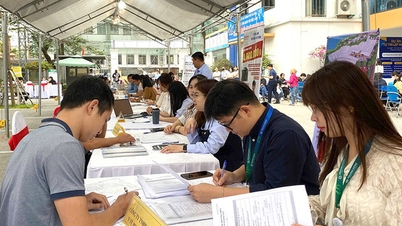
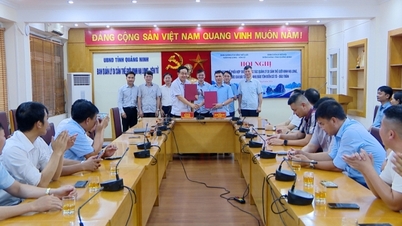
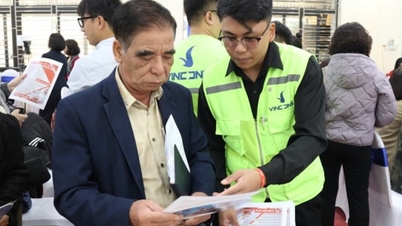
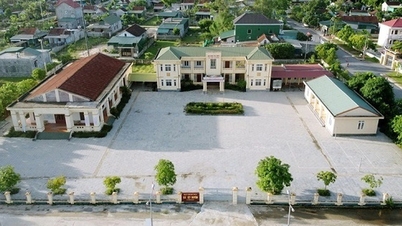
Throughout May 2026, the headquarters of the Investment and Infrastructure Project Management Board of Phu Dong commune was almost always lit up before 11 pm. This was the peak period for land clearance work for a series of key projects such as the road connecting Gia Binh airport with Hanoi city, the Lao Cai - Hanoi - Hai Phong railway line, the Duong River waterway upgrade project, and many other key infrastructure projects. The Board's staff and specialists continuously worked on the ground, from surveying the current situation and completing documentation to meeting with, engaging in dialogue with, and persuading residents to agree to hand over the land...
Speaking to reporters, Mr. To Anh Chien, Director of the Investment and Infrastructure Project Management Board of Phu Dong Commune, said that despite the large volume of work and the tight deadline, the results achieved were extremely positive. Before the recent Lunar New Year, the "22-day and night campaign" for land clearance to serve the project connecting Gia Binh Airport with Hanoi City was completed exceeding expectations. To date, the project has achieved an 88% land clearance rate; nearly 3,000 households have had their compensation plans approved; nearly 144 hectares of land have been recovered; nearly 700 graves have been relocated in just 22 days; and the total compensation paid has reached 658 billion VND. It is expected that land clearance will be completed in June 2026.
Behind those figures lies the synchronized involvement of the entire political system, along with a flexible and humane approach based on dialogue and consensus. According to Mr. Nguyen Hong Minh, Secretary of the Trung Quan village Party branch, to create consensus, the locality implemented a transparent and open process throughout, from holding community meetings and gathering opinions to drawing lots for cemetery plots in the new cemetery. Village and neighborhood officials persistently visited each household to disseminate information and explain the process. In particular, the locality proactively arranged for households within the same lineage to draw lots for plots close together, making it convenient for future worship and care of the graves. "When everything is both in accordance with regulations and in line with the people's wishes, the people will agree and voluntarily participate," Mr. Minh shared.


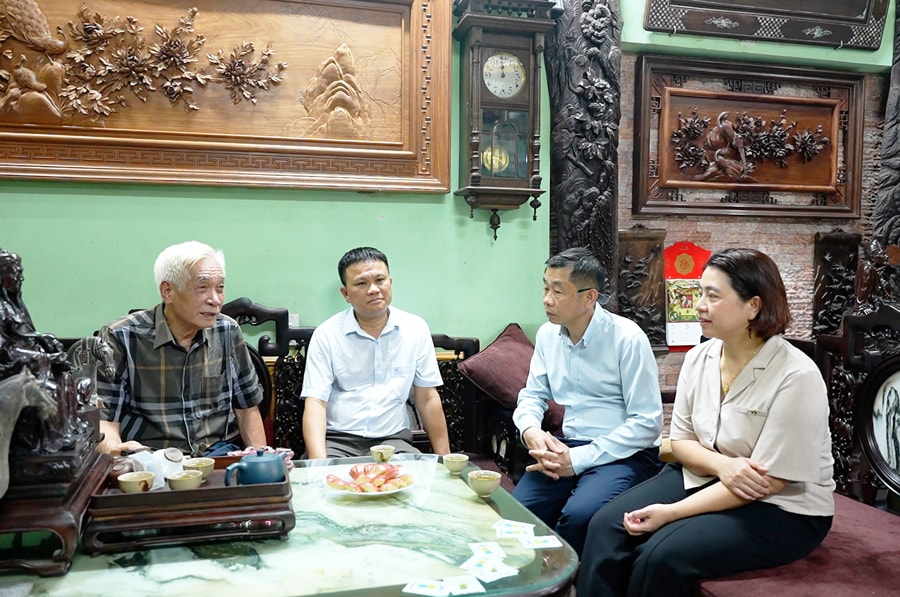
Another story recently unfolded during the land clearance process for the Da Dike Road project in Phu Dong commune. The project required the acquisition of over 29,500 m² of land, affecting 151 households. Among them, Mr. Nguyen Van Loc's household (Phu Dong 1 village) was subject to forced land acquisition due to not meeting the eligibility criteria for compensation.
Mr. To Anh Chien stated: "After many days of persistent efforts and understanding their circumstances, we realized that the reason was not that the family was deliberately resisting, but rather due to extremely difficult economic conditions, making them unable to rebuild their house after handing over the land."
Based on that situation, the Vietnam Fatherland Front Committee of Phu Dong commune proactively proposed providing financial support for the construction of a house for Mr. Loc's family from the program for disadvantaged cases. At the same time, the commune People's Committee and the Investment and Infrastructure Project Management Board mobilized additional social resources from officials and businesses in the area. On May 12th, the local authorities handed over 230 million VND in support to Mr. Nguyen Van Loc's family. Just two days before the scheduled forced eviction, his family voluntarily handed over the land.
The two-tiered local government model has proven effective.
Speaking with reporters, To Anh Chien, Director of the Investment and Infrastructure Project Management Board of Phu Dong Commune, said that the effectiveness of land clearance work in the past period clearly demonstrates the advantages of the two-tiered local government model.
“Previously, a problem would often have to go through many intermediate stages, from the commune to the district, from the district to the city, and then back to the local level for handling. That process was not only time-consuming but also affected the progress of work. Now, with clear decentralization, the commune level has become the direct point of contact for resolving issues, proactively handling everything from document verification to implementation. As a result, information and suggestions from the people are received and processed more quickly and promptly,” Mr. Chien shared.
According to Nguyen Hong Minh, Secretary of the Trung Quan village Party branch, during the relocation of the cemetery for the project, the commune was responsible for planning and constructing the new cemetery, while the village was tasked with proactively organizing the allocation of burial plots and drawing lots for households. This clear division of responsibilities allowed the local authorities to flexibly handle tasks in accordance with practical realities, while also ensuring transparency and openness, thus receiving high levels of public support.


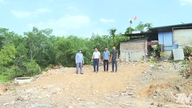
According to Mr. Minh, another advantage is that the coordination mechanism between the village and the commune government is implemented more quickly and effectively. Any difficulties or obstacles that arise are promptly reported by the local authorities for joint resolution. As a result, many legitimate requests from the people are considered and resolved from the outset, contributing to strengthening trust and ensuring the progress of land clearance.
The experience at Phu Dong shows that when local authorities are truly close to the people, listen to them, and promptly address practical issues, trust is fostered, creating a consensus to implement development tasks. From that perspective, the two-tiered local government model not only shortens the work process but also enhances governance efficiency at the grassroots level.
Source: https://hanoimoi.vn/xa-phu-dong-tao-dong-thuan-de-go-nut-that-giai-phong-mat-bang-1159397.html
![[Photo] Opening Ceremony of the 13th National Congress of the Ho Chi Minh Communist Youth Union](https://vphoto.vietnam.vn/thumb/1200x675/vietnam/resource/IMAGE/2026/06/24/1782286753905_ndo_br_1-8510-jpg.webp)
![[Photo] General Secretary and President To Lam attends the Central Public Security Party Committee Conference](https://vphoto.vietnam.vn/thumb/1200x675/vietnam/resource/IMAGE/2026/06/24/1782302063612_a1-bnd-9302-9166-jpg.webp)
![[Photo] The 13th National Congress of the Youth Union conducts personnel work.](https://vphoto.vietnam.vn/thumb/1200x675/vietnam/resource/IMAGE/2026/06/24/1782299943080_ndo_br_1-6868-jpg.webp)