Before becoming the owner of this eco-friendly business model, Truong Quang Cuong worked at Da Nang Airport. In 2019, he returned to his hometown and began his entrepreneurial journey.
“Since I was a child, I’ve been passionate about gardening, plants, and farming. Seeing the large areas of low-lying land lying fallow in my hometown, with abundant water resources that aren’t being exploited, I’ve always felt compelled to do something to transform this place into a green space with economic value,” Cường confided.
The land he chose to start his business was about 5,000 square meters , unproductive rice paddies that were difficult to grow other crops on, so it had been left fallow for nearly 20 years. Mr. Cuong hired an excavator to level the land, dig ponds, build embankments to retain water, and channel water from the Khe Tan irrigation canal to the fields.
In the early days, due to lack of experience, the lotus plants died in droves. Undeterred, he worked while simultaneously experimenting with techniques, "following nature" to adapt to the challenging soil.
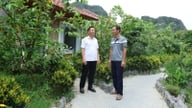

Not content with simply cultivating lotus, Mr. Cuong proactively planned a multi-value model, "using short-term gains to support long-term growth." On the embankments, he planted Siamese coconut trees to provide shade, enhance the landscape, and harvest fruit, while intercropping them with fruit trees such as betel nut, sapodilla, Thai rattan, dates, jackfruit, and also planned a bio-secure chicken and duck farming area.
He scientifically divided the entire cultivated area, including a model of growing lotus combined with raising natural fish (carp, tilapia, crucian carp, and other species) covering more than 6 sao (approximately 6,000 square meters); and a pond for growing water lilies combined with raising fish, black snails, and rice snails covering 1 sao (approximately 1,000 square meters).
On the remaining land next to the lotus pond, he continued to improve the soil, preparing it for planting organic vegetables. Cuong also partnered with his cousin to raise black snails on 3 acres of land as a backup crop.

Thanks to his consistent use of organic farming methods, Mr. Cuong's agricultural products quickly established a reputation for quality. He successfully connected with and became a supplier of clean agricultural products to high-end resorts such as Furama Resort and Thai restaurants in Da Nang. Annually, the income from fresh lotus seeds, lotus flowers, lotus stems, lotus roots, along with various freshwater fish and black snails, brings him hundreds of millions of VND.
Although the production model is still being perfected and expanded, Mr. Cuong's lotus field has become an attractive destination for tourists during the summer. Speaking about his future plans, Mr. Cuong shared: “I want to transform this place into a destination where people far from home or urban tourists can come to relax on weekends. There, they can personally go down to the pond to catch fish and snails, pick lotus flowers, enjoy sweet coconut water in the garden, or savor authentic country dishes and drink a cup of An Bang green tea.”



According to representatives from the Phu Thuan Commune Economic Department, a field survey has shown that Mr. Cuong's economic model has proven effective in exploiting the potential of abandoned land. In the future, the local authorities will continue to support him, guiding him through legal procedures, providing technical assistance, and advising on solutions to replicate this effective circular agricultural economic model.
Source: https://baodanang.vn/xanh-hoa-dat-bo-hoang-3340206.html
![[Photo] Opening Ceremony of the 13th National Congress of the Ho Chi Minh Communist Youth Union](https://vphoto.vietnam.vn/thumb/1200x675/vietnam/resource/IMAGE/2026/06/24/1782286753905_ndo_br_1-8510-jpg.webp)
![[Photo] General Secretary and President To Lam attends the Central Public Security Party Committee Conference](https://vphoto.vietnam.vn/thumb/1200x675/vietnam/resource/IMAGE/2026/06/24/1782302063612_a1-bnd-9302-9166-jpg.webp)

![[Photo] The 13th National Congress of the Youth Union conducts personnel work.](https://vphoto.vietnam.vn/thumb/1200x675/vietnam/resource/IMAGE/2026/06/24/1782299943080_ndo_br_1-6868-jpg.webp)