

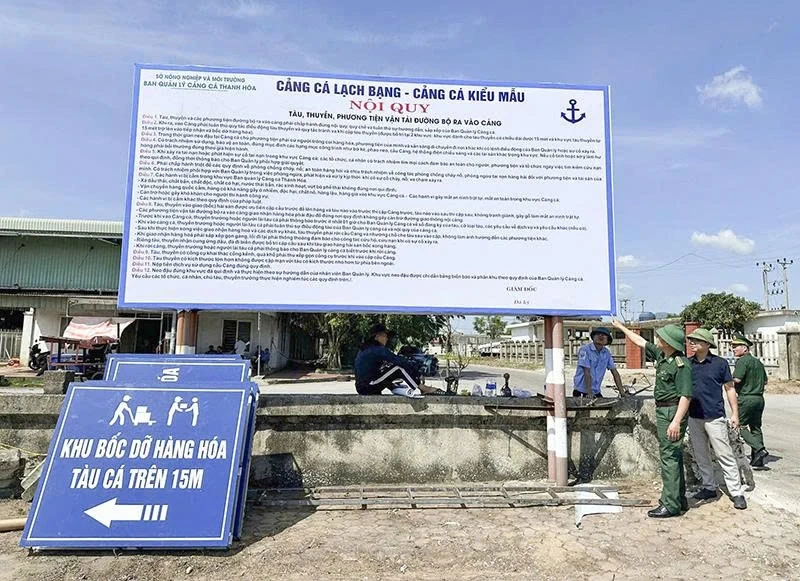
The forces are equipping and installing functional zoning signs for the construction of the model fishing port at Lach Bang, Hai Binh ward.
Lach Bang Fishing Port in Hai Binh Ward is a Class II fishing port with a 400m long wharf, capable of accommodating fishing vessels 15m or longer. With a cargo handling capacity of approximately 80,000 tons per year, the port is not only a mooring and trading hub but also an important logistics service center for the fishing industry. It is also a fishing port designated by the Ministry of Agriculture and Environment as having a complete system for verifying the origin of seafood from fishing. Here, fishermen are provided with all essential services such as ice, fresh water, food stores, seafood processing facilities, fishing gear, fuel, and a cold storage system for preserving seafood. This integrated system helps fishermen shorten the time needed to prepare for fishing trips and minimize intermediary costs.
From September 2025, Lach Bang Fishing Port will be one of three fishing ports nationwide selected for a pilot project to build a model fishing port. This project involves coordinated efforts from the border guard, the Department of Marine and Fisheries, the Thanh Hoa Fishing Port Management Board, and the local authorities. The model fishing port project focuses not only on investing in physical infrastructure but also on digitalizing management, enhancing supervision, and increasing transparency in fishing operations.
One of the key highlights in building a model fishing port is ensuring that 100% of fishing vessels 15 meters or longer maintain a connection to their vessel monitoring system (VMS). All data on fishing vessels entering and leaving the port is integrated and shared seamlessly between the Ministry of National Defense 's management system and the national fisheries database system (VNFishbase). This allows for strict monitoring of vessel routes, fishing grounds, and operating times, contributing to the prevention of illegal, unreported, and unregulated (IUU) fishing.
Notably, the port management has organized and divided mooring areas according to vessel length, from 6m to under 15m and from 15m and over. Vessels that do not meet the requirements for fishing are also assigned a separate area. This approach not only ensures order and safety but also helps to speed up the cargo handling process, reducing collisions and congestion during peak hours.
Fisherman Nguyen Van Cuong, from Hai Binh ward, owner of fishing vessel TH-90286.TS, with a capacity of 450 horsepower, specializing in fishing in the Gulf of Tonkin, regularly docks at Lach Bang fishing port. He shared: “Previously, every time a large number of boats returned, there was crowding and long waits. Now, with clearly defined zones and quick data verification and comparison, the procedures are completed in a short time. Seafood is unloaded quickly and put into cold storage promptly, ensuring better quality and higher prices. With the VMS equipment, we can fish in the correct areas and according to regulations, which gives us more peace of mind. When we enter the port, the data is already available, so we don't have to explain much. Transparent business practices build more trust with traders and businesses.”
In addition, the Lach Bang Fishing Port Management Board, in coordination with Viettel and the Border Guard Command, has installed 3 surveillance cameras in the port area and 2 cameras at the Lach Bang Border Guard Control Station. This system monitors and stores images of fishing vessels entering and leaving the port and the estuary area in real time, ensuring security and order and serving as a basis for handling violations when necessary. This helps make inspection and control by functional forces more transparent, reduces cumbersome procedures, and facilitates compliance with regulations by fishermen. Not only is the vessel's journey monitored, but information on aquatic species, catch volume, and fishing areas is also digitized at the port. The data is compared with fishing logs, the electronic traceability system, and VMS data, enabling quick and accurate verification of seafood origin, meeting the increasingly stringent requirements of the export market. This is considered the "key" to enhancing product value, especially in the context of the whole country's determination to lift the IUU "yellow card".
Mr. Le Van Thang, Director of the Thanh Hoa Fisheries Port Management and Vessel Registration Board, said: “The goal of the model fishing port is not only to meet management requirements but also to better serve fishermen. We consider fishermen as the central focus. The management process is digitized to reduce inconvenience while still ensuring strict control. When fishing vessels enter and exit, they are fully monitored, production is accurately recorded, and traceability is facilitated, which will help increase the value of seafood, contribute to preventing IUU fishing, protect aquatic resources, and enhance national prestige.”
The construction of the model fishing port of Lach Bang represents a comprehensive transformation in the management and development of the fisheries sector towards a modern, transparent approach, becoming a "support base" for long fishing trips and contributing to the sustainable development of the province's fisheries industry.
Text and photos: Le Hoi
Source: https://baothanhhoa.vn/xay-dung-cang-ca-kieu-mau-281792.htm

![[Photo] Memorable moments at the 10th Vietnam-China Border Defense Friendship Exchange](https://vphoto.vietnam.vn/thumb/1200x675/vietnam/resource/IMAGE/2026/03/20/1773986226876_giao-luu-bien-gioi-vntq-lan-10-ben-tq-9737-4225-jpg.webp)













![[E-Magazine] Placing complete trust in the Party newspaper of our homeland](https://vphoto.vietnam.vn/thumb/402x226/vietnam/resource/IMAGE/2026/03/20/1773995851186_e-magazine-gui-w1200t0-di2611d199d5152855t11920l1-bth-026.webp)

















































Comment (0)