The final blow after 20 years.
The model of the Kính Thiên Palace from the early Lê Dynasty, published by Associate Professor Bùi Minh Trí (Vietnam Institute of Archaeology), has attracted much attention and sparked controversy.
At the time of the model's unveiling, Associate Professor Tri stated: "We are publishing the research and model of the Kính Thiên Palace from the early Lê dynasty so that viewers can visualize and reminisce about the past, not with the intention of reconstructing it." He also explained that building models is similar to what the Đại Minh Cung historical and cultural park in China has done with ancient architecture, allowing people to appreciate the beauty of ancient court life.
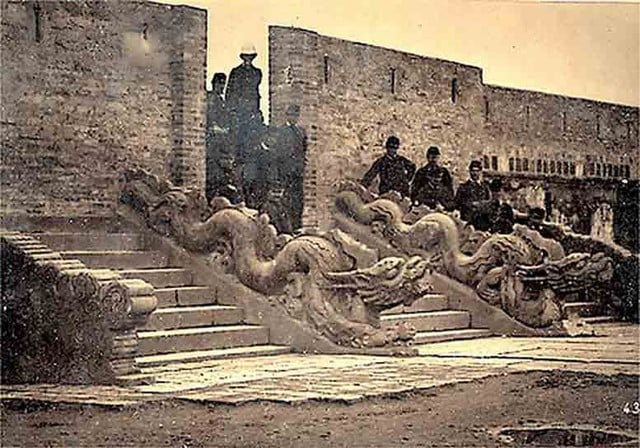
Kính Thiên Palace Terrace
PHOTO: ARCHIVE
The reconstruction of the Kính Thiên Palace model is currently causing debate around two issues. Firstly, whether the model of the imperial city only has one main palace (Kính Thiên) and one central axis. Secondly, how can the many details of the burned palace be recreated as accurately as possible?
Professor Momoki Shiro (Japan) shared on social media: "Since UNESCO has recognized it as a world cultural heritage site, it means that research and preservation of the site must also be conducted according to truly modern scientific theories and methods."
According to Professor Nguyen Quoc Thong, former Vice President of the Vietnam Architects Association, archaeological excavations have clearly revealed large foundation stones from the Ly Dynasty, and have also unearthed the royal road leading directly to Doan Mon Gate. UNESCO's agreement to excavate has helped uncover the very wide and large Kinh Thien terrace. Thanks to this, our understanding of Kinh Thien has become much deeper.
Professor Thong stated: "UNESCO has come here for meetings many times, their expert advisory council has also come for meetings many times, questioning our experts and directly inspecting the site... The biggest question now is what form it will take; we need a basis for this, and this is something we are currently working on."
According to architect Nguyen Quoc Thong, there has been a debate for the past 20 years with two opposing viewpoints. The first viewpoint argues that there is no need to restore the Kinh Thien Palace; the area should remain as a historical and cultural park within the Imperial Citadel. The second viewpoint focuses on researching and reconstructing the Kinh Thien Palace. This approach requires evidence and the approval of UNESCO.
"Of course, when restoring something, we have to ensure that the traces of several centuries are preserved and accessible to visitors. That would be much better, much better than leaving them exposed to the elements. In Japan, they also restore things, and you can go inside to see them," Professor Thong shared.
National story
Professor Nguyen Quoc Thong stated that he belongs to the group advocating for the restoration of Kinh Thien. "Why did the Japanese restore Nara, along with a sense of national pride? Rebuilding Kinh Thien also involves ceremonies. Who knows, perhaps in the future, many heads of state will be held there, or international agreements will be signed… My view is that we must do this so that future generations will know us and appreciate our history," he said.
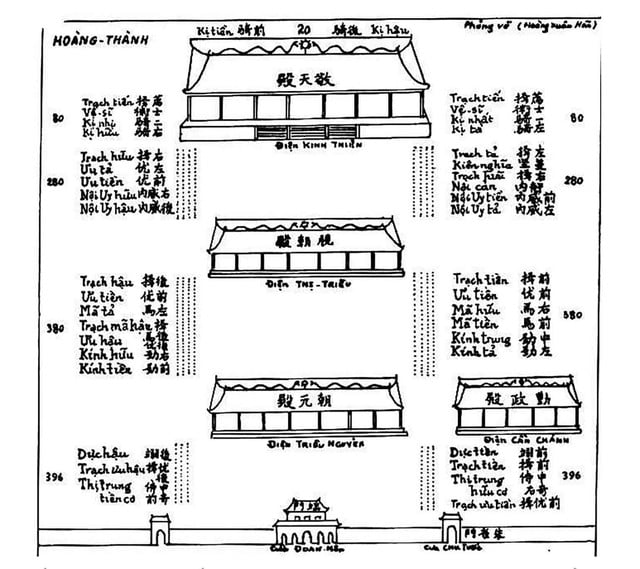
The palace design was proposed by scholar Hoang Xuan Han.
PHOTO: ARCHIVED
According to Professor Thong, the basic documentation is sufficient. "Next is the research to create a beautiful palace, one that, when viewed from the front, doesn't feel Sinicized, but embodies the national spirit. There are wooden replicas, but they are so beautiful, so Vietnamese, and when you visit them, you feel warm inside, unlike a structure that resembles those of the Qing dynasty… Our ancient wooden architecture isn't as ornate as China's, but it's very beautiful and sophisticated. If there were a structure in a location accessible to everyone, that would be wonderful," he shared.
Meanwhile, Associate Professor Dr. Dang Van Bai, Vice Chairman of the National Heritage Council, who is leading the research on intangible cultural heritage at Thang Long Imperial Citadel, said: "There are many branches of research. These include exchanging international experiences, and then outlining from the overall picture those that can be immediately presented as experiential activities. For example, we can research and select rituals and festivals such as the Quang Chieu Lantern Festival, the examination rituals honoring the lineage, etc. Then we can make selections and proposals. After that, each ritual needs its own research, aiming towards experiential learning."
According to Associate Professor Dr. Dang Van Bai, there will be research on rituals that were transformed from folk traditions into court rituals and vice versa. "There are rituals that were transformed from folk traditions into court rituals, and then when Thang Long lost its status, they were folk-ized again. After researching, we can reverse the process. There are traditions whose images are still reflected in village festivals. For example, the 'con di danh bong' dance – we can research how it was folk-ized from a court ritual, and then re-court-ized it. Of course, there will also be new cultural layers that are not exactly the same as the past, and we have to accept that."
In addition, according to Professor Bai, there are similarities in rituals, and existing research and practices can be utilized. "For example, how can we present the ritual of passing on the throne in Hue? Basically, the rituals have similarities; we can add more creative elements, but not invent them. If it's not entirely reasonable, we can add to it in subsequent years, gradually perfecting it," said Associate Professor Dang Van Bai.
Source: https://thanhnien.vn/tang-toc-phuc-dung-dien-kinh-thien-185260319213552784.htm
































































Comment (0)