

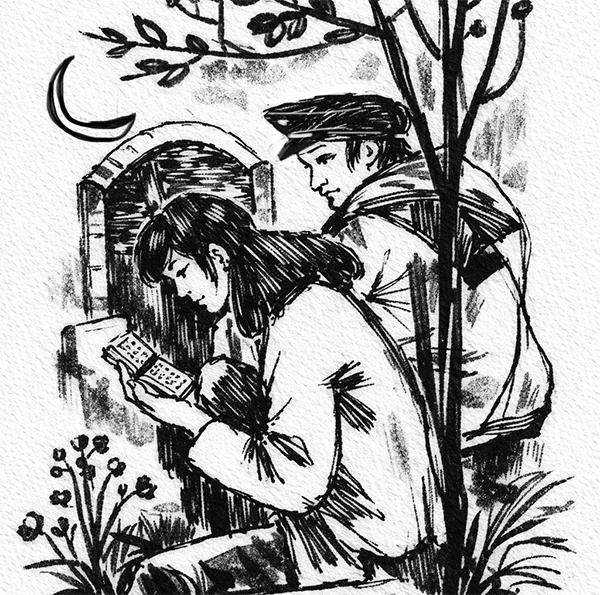
Illustration: BH
Winds blew from the deep valleys, winds from the vast, rushing river carrying the pungent scent of wild grass mixed with the aroma of smoke from distant village kitchens. Tén Tằn was unlike any place he had ever been: the mountains flanking the river were not only high, but seemed to listen to the howling wind; the streams not only flowed, but were tirelessly recounting a folk tale, originating from the dawn of time. As a soldier with a dreamy soul, as he walked along the upper reaches of the Mã River, Mai Đức Nam felt as if each step he took was touching an echo reverberating from the past.
*
Mai Duc Nam hails from a coastal region. He grew up amidst the salty winds and crashing waves, the sound of oars splashing, and the smell of sun-dried fish. His mother said that a man from the coast must know how to travel far, the furthest being out at sea and into the mountains. After many years serving as a border guard on Me Island, he was transferred to Ten Tan outpost to work as a grassroots scout, staying close to the people and villages. This was a normal transfer for a border guard. However, on this journey to the western part of Thanh Hoa province, besides his military equipment, his backpack contained a small, dark brown, frayed cloth bundle. Inside was a yellowed piece of paper containing a poem by his father, Mai Duc Dong, a Vietnamese volunteer soldier who fought in Laos during the war against the US.
On a calm, windless morning, his mother gave the poem to Nam without crying. She only said, "Go up there, and if fate allows, help me find it. Not to bring it back, but just to know where your father is buried, so I can call him by his proper name." Nam heard his mother's voice, as gentle as a wave lapping against the sand. But he knew that her words came from a heart burdened with the weight of decades.
Around 1973, before going to the battlefield in a foreign country, my father sent my mother a poem in the seven-syllable, six-line verse form. My mother said it was the only letter, and also the last letter, that my father ever sent her.
Captain Nam opened the cloth wrapping and reread the time-worn words, feeling the vibrant, throbbing beat of his heart: "The stars twinkle at Tén Tằn Gate / I write to you in this land / It's already past midnight / On the road to war, I miss you so much / The more I miss you, the more I worry about my mission / I long for the day I return to be the father of our son / To build you a big house / So our son can play freely / The night at Tén Tằn is bright with moonlight / Sending you countless loving messages / When the enemy is defeated and the country is at peace / I return, my wife welcomes me, and we are together."
Captain Nam folded the poem. The moon over Tén Tằn on the first night he arrived shone with an unusual brightness. He had the feeling that the moon was shining down on the very road his father had once traveled, on the ferry that carried the Tây Tiến army.
***
My mother received the poem when she was not yet twenty years old. She remembers that just five days after their wedding, her young husband packed his bags and went to war. She recounted that on the day she saw him off, the sea wind blew strongly, and sand swirled everywhere. He laughed and joked, "I'll be gone for a few days, then I'll come back and be the father of a baby boy for you to be happy about." My mother blushed and turned away, but her heart burned with the warmth of youth.
The poem arrived a month and a half after my father left. The mailman was a young soldier, his voice still trembling as he read the recipient's name. My mother received the letter, her hands shaking even more than the mailman's. Opening it, the words were like waves, both gentle and fierce. She read it over and over until she knew it by heart. She placed the poem under her pillow and took it out to read every night, as if reading it aloud would allow my father to hear her.
Then the news of my father's death arrived with a death certificate bearing the general statement: "The body of martyr Mai Duc Dong is buried on the Western front, in the loving affection of his comrades." There were no remains. No specific burial address. The only belongings left by the martyr were a backpack, a set of clothes, a pair of embroidered scarves that his mother had made for him on the day he left, and a notebook containing a poem that his father had sent to his mother. His mother clutched the notebook with the poem and the scarves to her chest and collapsed. The villagers said that from that day on, she considered the poem as if it were her husband's body. She carried it with her wherever she went. The poem was tattered, the edges worn, but the writing grew bolder each day, as if etched with memory.
Nam's mother gave birth to him on a rainy night. Out at sea, the waves roared. She said that when she heard her son's cries, she remembered the poem, "I promise to return someday to be his father," and tears streamed down her cheeks. His father didn't return, but the promise remained, like a thread connecting two worlds .
***
Nam grew up with that poem. Every time Nam asked about his father, his mother didn't say much. She would just take out the poem and read it aloud. Her voice was low and slow, like reciting a prayer. Nam didn't understand everything, but each word seemed to seep into his skin. By the age of ten, he knew it by heart. By fifteen, he began to understand. At eighteen, after graduating from high school, Nam joined the border guard, the same age his father left his boat to go to war. Every time he read his father's poem, Nam felt certain, as if his father's path to war had been written in those verses before he was even born.
The day Nam received his assignment to leave Me Island and move to Ten Tan, the headwaters of the Ma River, his mother suddenly seemed to brighten. She gave Nam his father's poem and repeated her words: "I know you've memorized it already, but take it with you, son. Maybe your father's intelligence will guide you. That's how I feel. Since hearing the news of your transfer, I've dreamt of your father coming home several times. He was so happy, he kept inviting me to go to sea with him."
From the moment he set foot in Tén Tằn, Nam missed his mother even more, he missed her so much, he loved her so much!
***
One evening, Nam accompanied his comrades from the unit down to a remote village. The village was holding a cultural event. A bonfire blazed. The sounds of flutes and drums mingled with laughter. Veteran Thai soldiers sat in a circle, their hair gray and their eyes bright. They recounted old stories, stories of the forest, stories of the days of bombing and shelling.
Suddenly, an old man stood up. He leaned on his cane, his voice hoarse but resonant. He recited poetry. Nam was startled. Every line, every word was familiar, yet heartbreaking: "The gate of Tén Tằn is covered with so many stars..."
Nam jumped to his feet. His heart pounded like a drum. The old man finished reciting the poem, then slowly recounted, “This poem was written by a comrade of mine, from the lowlands, at the mouth of the Ma River. He wrote it on a moonlit night in Ten Tan, before our unit crossed the river to carry out an international mission in Laos. We passed it around, like passing a torch to light the way and warm our hearts with love. Afterwards, whenever there was a cultural event, we would recite it; those with wives remembered their wives, those with lovers remembered their lovers. And we all joined in the love and the intense longing for our homeland. The Laotian soldiers also liked this poem; they adapted it into folk songs, very emotional.” The old veteran then turned the poem into a folk song. Everyone joined in, singing along in unison.
When the performance ended, Nam walked up to the old veteran and asked in a trembling voice:
- Sir... do you know the name of the person who wrote that poem?
The old man stared at Nam for a long time. The firelight illuminated his wrinkled face. "I know him. He's in the same unit as me. His name is Dong, I think his last name is Mai."
***
The old man's name was Ha Mui. He and Nam's father were in the same unit. He mentioned several times that the poem was very popular among the soldiers back then. Every time they were tired from marching, someone would recite a few lines. Missing home, missing their wife, missing their children whom they hadn't yet seen – all those feelings poured into those simple lines of poetry. Finally, Mr. Mui put his arm around Nam's shoulder and said emotionally, "Your father was very talented. He wrote without fuss, yet each word seemed to breathe life into it, filled with his heart!"
After a brief pause, Mr. Mui pressed his hand under his nose before continuing: “Your father died when his unit was ambushed. Bullets ripped through the forest. Your father was seriously wounded, but still tried to pull his comrades to safety. I was the last person left alive beside him. Your father held my hand and whispered, ‘If… if I’m still alive, remember to tell my wife to take care of… our son…’ Then I was also wounded, fell unconscious, and when I woke up, I was at a forward surgical station. I asked and learned that your father had died. The medical team couldn’t find his remains. The rainforest had swallowed them up.”
Mr. Ha Mui kept the poem in his memory for decades. He said it was something he carried with him when he returned to his village, when he worked in the fields, and when he grew old. "The poem doesn't let me forget how I lived," he continued.
Nam knelt before Mr. Ha Mui. He didn't cry. The tears seemed to freeze somewhere in his chest.
***
Captain Nam reported to his unit. The unit agreed to let him, along with Mr. Ha Mui and a few others, go to Laos to search for the remains. There was no map. Only the memories of an old man and faint clues in the forest. They traveled for many days. The forest beyond the Ten Tan estuary was dense, its roots entwined with rocks. At times, it seemed hopeless.
One afternoon, they came to a high piece of land. Mr. Ha Mui stopped. He said the battle had taken place around here. He pointed to a dry stream bed: "He fell there." Nam stepped down, his heart pounding. He dug. The earth was soft. A piece of decaying cloth was revealed. Then a bone. Nam embraced the bone. For the first time in his life, he whispered: Father!
The moon rose. The crescent moon shone brightly in the distance. Nam took out the poem and read it aloud. His voice blended with the forest breeze. Mr. Ha Mui stood beside him, his hands clasped. It seemed as if the mountains were listening. It seemed as if the stream had stopped flowing.
***
The remains were gathered. Nam stood before his father's grave, placing the poem on it. He whispered, "I'm returning this poem to you, Father. But every line, every word, I vow to carry with me for the rest of my life." The wind blew, the leaves rustled. The moon shone.
Upon his return, Nam brought with him a copied version of the poem. He left the original at his father's grave. His mother heard the news and remained silent for a long time. Then she smiled. With that rare smile, she said, "Thank God, thank Buddha, he's not lost anymore!"
That night, Nam dreamed of his father. His father stood at the Tén Tằn gate, his shadow cast by the bright moonlight. He recited poetry. Nam listened silently to each line and word, feeling an unusual sense of peace.
The poem was sent, then sent back. Through war, through loss, through generations. And somewhere amidst the mountains beyond the Tén Tằn gate, in neighboring Laos, the moon still shines...
Short stories by Tran Doan Trang
Source: https://baothanhhoa.vn/bai-tho-viet-o-cua-ten-tan-281639.htm
![[Photo] First session of the 14th Congress of the Vietnam Trade Union](https://vphoto.vietnam.vn/thumb/1200x675/vietnam/resource/IMAGE/2026/06/03/1780465947883_ndo_br_img-3852-jpg.webp)
![[Photo] General Secretary and President To Lam presides over a meeting with the Central Organizing Committee.](https://vphoto.vietnam.vn/thumb/1200x675/vietnam/resource/IMAGE/2026/06/03/1780482764658_a1-bnd-4741-3342-jpg.webp)


![[Photo] Secretary of the National Assembly Party Committee, Chairman of the National Assembly presides over the meeting of the Standing Committee and Executive Committee of the National Assembly Party Committee.](https://vphoto.vietnam.vn/thumb/1200x675/vietnam/resource/IMAGE/2026/06/03/1780480353201_ndo_br_bnd-2585-jpg.webp)



![[Infographic] Over 1.2 million candidates registered for the 2026 High School Graduation Exam](https://vphoto.vietnam.vn/thumb/402x226/vietnam/resource/IMAGE/2026/06/03/1780496872518_w_20260603205412.jpeg)



![[Podcast] Capital City Law 2026: Increased penalties for violations in the fields of culture and advertising](https://vphoto.vietnam.vn/thumb/402x226/vietnam/resource/IMAGE/2026/06/03/1780487283783_4522222.png)
































![[Video] Sunset at Lap An Lagoon – Where the sun sets over the fishing nets](https://vphoto.vietnam.vn/thumb/1200x675/vietnam/resource/IMAGE/2026/05/31/1780192137701_beach-landscape-sea-water-nature-grass-745871-pxhere-com.jpeg)































Comment (0)