

The new Lunar Terrain Vehicle (LTV) that NASA is planning to build will carry two astronauts and operate in a semi-autonomous mode to conduct experiments independently.
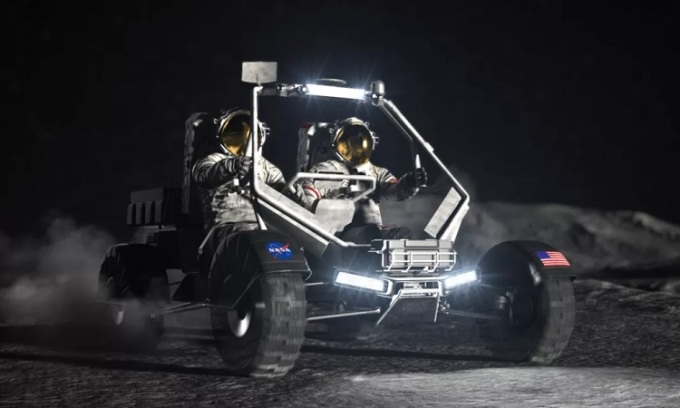
A rendering of a next-generation lunar rover. Photo: NASA
NASA is calling on private companies to submit design proposals for LTVs (Land Vehicle Vehicles) for future Artemis missions to the Moon, with a deadline of July 10, according to Space. The agency has provided a list of design requirements that potential manufacturers must meet. Manufacturers will need to offer a complete service package, from development and delivery of the vehicle to operational management.
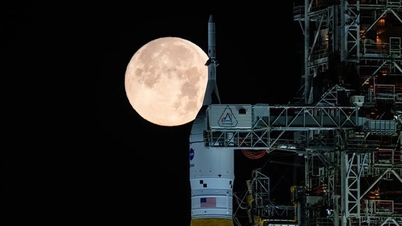
According to NASA, the LTV needs automation and a suite of scientific instruments, a robotic arm, and probes to continue exploration during downtime between crewed missions in the Artemis program. This program is the first to return astronauts to the lunar surface in over five decades.
Artemis 1 launched the unmanned Orion spacecraft into lunar orbit in November 2022. Artemis 2 is aiming for a similar crewed flight in 2024. Artemis 3 will mark the first lunar landing in the program, scheduled for launch in late 2025. Crewed astronaut missions using LTVs will begin after the Artemis 5 mission in 2029.
With LTV, NASA hopes to search for resources on the Moon more efficiently. NASA's crewed Artemis missions target the lunar south pole due to the readily available resources, including abundant water ice, which can be used to create a range of necessities from drinking water to rocket fuel.
Utilizing local resources to supplement supplies for interplanetary missions (ISRUs) is a key component of long-duration space missions. To survive in the harsh environment of the Moon's south pole, the LTV needs to operate and navigate well under diverse conditions and extreme temperature fluctuations, while maintaining power during extended periods of darkness when photovoltaic cells cannot be used. The LTV will survey areas rich in potential resources and suggest locations for future lunar stations.
NASA will announce the manufacturer that has been awarded the contract to design and build the LTV in November 2023.
An Khang (According to Space )
Source link

![[Photo] The General Secretary and the Prime Minister attend the groundbreaking ceremony for multiple-level boarding schools in border areas.](https://vphoto.vietnam.vn/thumb/1200x675/vietnam/resource/IMAGE/2026/03/19/1773888999705_vna-potal-tong-bi-thu-va-thu-tuong-du-le-khoi-cong-dong-tho-dong-loat-cac-truong-noi-tru-lien-cap-bien-gioi-8649904-3885-jpg.webp)
![[Photo] Tran Cam Tu, Standing Member of the Secretariat of the Central Committee, presides over the first meeting of the Central Steering Committee on the Development of Vietnamese Culture.](https://vphoto.vietnam.vn/thumb/1200x675/vietnam/resource/IMAGE/2026/03/19/1773895004549_ndo-br-bnd-1195-2-jpg.webp)






























































































Comment (0)