

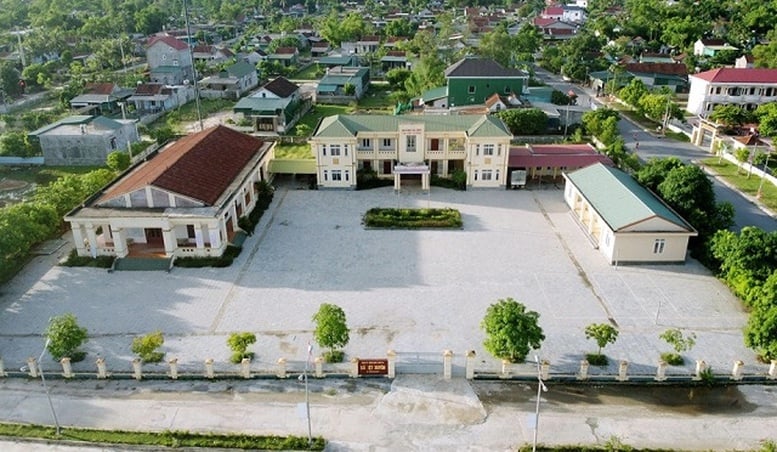
Local authorities have plans to handle surplus office buildings after the merger of provincial-level administrative units - Illustration photo.
According to the Ministry of Interior 's summary report, preparations are being carried out seriously and proactively by localities, aiming to use resources effectively, avoid waste, and ensure the smooth operation of the political system during the transition period.
According to data compiled by the Ministry of Interior from administrative unit reorganization projects, there are currently a total of 38,182 public offices at the provincial level. Of these, 33,956 will continue to be used, while the remaining 4,226 are identified as redundant.
Prioritize converting existing structures to serve community purposes.
Currently, most localities are requesting to continue using the existing offices of agencies and units in their old locations because the infrastructure in the new provincial administrative and political center cannot yet fully meet the working needs of officials, civil servants, and employees after the reorganization. This is a temporary solution, ensuring the normal operation of state agencies while giving localities more time to assess and re-plan overall.
In the coming period, localities will conduct a comprehensive review and assessment of the current status of public offices and assets at the provincial level and the needs for their use in order to propose plans for the construction of additional offices for provincial-level agencies and units to ensure suitability, meet operational requirements, and minimize waste.
In addition, the exchange (transfer) of headquarters and operational facilities between provincial, district, and commune-level agencies, organizations, and central agencies in areas with surplus premises should be implemented; multiple agencies, organizations, and units may share one building or land to ensure maximum utilization of existing facilities, headquarters, and operational sites in the area.
For surplus office buildings and operational facilities after rearrangement, the disposal of assets will be carried out in accordance with the law on the management and use of public assets; priority will be given to converting their functions to serve as medical facilities, educational institutions , or for local community purposes (libraries, parks, cultural and sports facilities, etc.).
In addition, surplus office buildings may be reclaimed and handed over to local state land management agencies for management and exploitation (management for the purpose of auctioning land use rights, land allocation, land leasing, etc.); temporarily allocated to agencies and units for use or leasing of buildings attached to land; or handed over to the local land fund development function for management, development, and exploitation in accordance with the law.
Ministries, central agencies, and People's Committees of provinces and centrally-administered cities are responsible for ensuring funding for the protection, preservation, handover, acceptance, and handling of surplus public assets after restructuring, preventing deterioration, loss, and waste of assets.
This includes focusing on consolidating and assigning tasks to eligible public service units and enterprises (especially local land development organizations) to manage and exploit surplus public land and buildings through the restructuring process; directing the preparation, supplementation, and adjustment of planning to serve the arrangement, organization, and handling of public service headquarters and facilities; and completing administrative procedures regarding land for agencies, organizations, and units that inherit or receive working headquarters and operational facilities according to the restructuring plan.
Streamlining the organizational structure: Reducing bureaucracy, increasing efficiency.
Besides handling public assets, reorganizing the political and administrative apparatus is also a key aspect in the process of restructuring provincial-level administrative units. According to the Ministry of Interior's submission to the Government on the restructuring of provincial-level administrative units, the plan for consolidating the provincial-level organizational apparatus after restructuring is clearly defined, ensuring continuity, stability, and improved operational efficiency.
Accordingly, for Party and mass organizations, the Party Committees of provinces and centrally-administered cities will be established after the reorganization based on the merger of the number of Party members and subordinate Party organizations of the provincial and city Party committees before the reorganization. The Executive Committees of the reorganized provincial and city Party committees will be appointed according to the regulations on decentralization of personnel management and the guidance of the Central Committee...
Regarding the government sector, the local government of the new provincial-level administrative unit consists of the People's Council and the People's Committee, organized and operating according to the provisions of the Constitution and the Law on Organization of Local Government (amended).
After reorganization, the People's Councils of provinces will establish three committees: the Legal Affairs Committee, the Economic and Budget Committee, and the Culture and Social Affairs Committee (provinces with a large ethnic minority population may also establish an Ethnic Affairs Committee). The People's Councils of centrally-governed cities will establish four committees (Legal Affairs Committee, Economic and Budget Committee, Culture and Social Affairs Committee, and Urban Planning Committee).
For departments and agencies equivalent to departments, consolidate departments and agencies with similar functions and tasks. For some specialized agencies under the Provincial People's Committee (not uniformly organized across provinces and cities undergoing restructuring), the organizational model, functions, tasks, organizational structure, and staffing will be basically maintained to ensure the performance of state management functions in the newly restructured provincial-level administrative units.
After the reorganization, provincial People's Committees will have a maximum of 14 departments and equivalent agencies (except for Ho Chi Minh City, which will have a maximum of 15 departments and equivalent agencies).
The National Assembly delegations of the provinces and cities before the reorganization will be merged into the National Assembly delegation of the province or city after the reorganization, and will continue to operate until the end of their term.
Regarding the internal organizational structure of departments and agencies, specialized professional departments and sub-departments with similar functions and tasks will be merged. The inspection functions of departments will be transferred to the Provincial Inspectorate, and the Provincial Inspectorate will be reorganized (according to the Central Government's plan on the restructuring of inspection agencies).
For public service units, the existing public service units in healthcare and education within the province will remain unchanged. For other public service units under the Provincial People's Committee and under the direct control of departments and agencies, the guidance of the competent authority will be followed.
Following the reorganization, localities will conduct surveys, assessments, and consider restructuring to improve the quality and efficiency of operations, ensuring the continued provision of public services and aligning with the practical situation.
According to the Ministry of Interior, the reorganization of provincial-level administrative units is a major and complex task with far-reaching impacts on the organizational structure, personnel, and infrastructure of localities. However, with proactive and coordinated efforts in developing plans, handling public assets, streamlining the apparatus, and maintaining the operation of public service institutions, this process is expected to create a solid foundation for streamlining the apparatus, improving the efficiency of state management, and maximizing local development resources.
Thu Giang
Source: https://baochinhphu.vn/xu-ly-tru-so-doi-du-tan-dung-tai-san-cong-sau-sap-nhap-tinh-102250510154844955.htm

































































Comment (0)