

Attending the event were representatives from the Ho Chi Minh National Academy of Politics , the Center for Educational Quality Accreditation (Vietnam National University, Hanoi), the Academy of Journalism and Communication, a team of experts, and all faculty, staff, and students of the school.
From April 15th to 19th, a survey team consisting of independent experts, scientists, managers, and experienced and reputable lecturers from domestic educational institutions conducted a survey based on 11 evaluation standards according to Circular No. 04/2016/TT-BGDĐT dated March 14, 2016, of the Ministry of Education and Training , corresponding to 6 functions: curriculum design and development; teaching activities; assessment of student learning outcomes; quality assurance conditions including faculty, staff, facilities and equipment; quality improvement; and learning outcomes.
The survey was conducted through the following steps: reviewing records, gathering information through direct interviews, telephone interviews, distributing questionnaires, discussions with relevant units, attending classes, surveying facilities, etc.
The expert team conducted a survey through 472/543 discussions and interviews with various target groups: school leaders, lecturers, alumni, employers, students, and student union officials; collected 558 responses; and received feedback from 416 people…
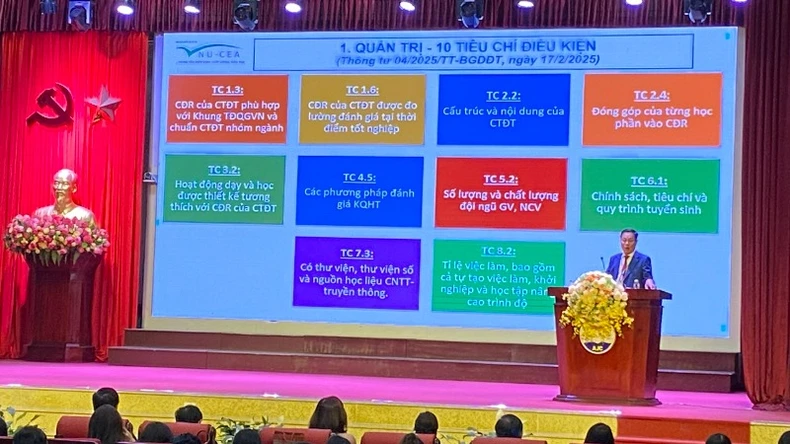 |
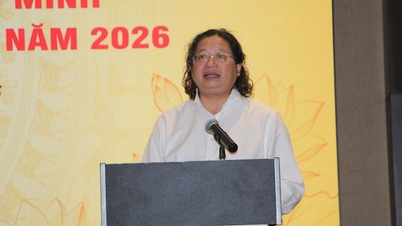
Professor, Doctor Nguyen Huu Duc, Head of the expert team, delivered a speech. |
The survey results across six academic disciplines show that the programs have clear criteria, align with the school's goals and vision, and are concretized through output standards. The content and structure of the training programs are reasonable. Teaching methods are diverse, active, and increase practical application, especially in Journalism, Public Relations, Multimedia Communication, and Mass Communication.
The faculty and research staff are increasingly highly qualified, with 60% holding doctoral degrees in the Journalism Department and 100% in the Political Science Department. The high competition for admission reflects the influence of the academic disciplines on societal needs. The infrastructure, including lecture halls, libraries, and faculty and staff offices, is quite adequate in both quantity and quality. The methods of testing and evaluating learning outcomes are aligned with the school's training objectives. The employment rate for graduates in the six training programs is 80% or higher, with the Journalism program reaching 96.6%. Overall, based on the 11 criteria of the Ministry of Education and Training, the Academy's six training programs achieved a 92% employment rate.
Based on the survey results, the expert team recommended that the Academy of Journalism and Communication review and reassess its teaching methods, improve the quality of its faculty, enhance teaching quality, and develop training programs based on the principles of integration, resilience, inspiration, and connection with innovative entrepreneurship and digital capabilities; and develop the Uniwood University model – a digital university model focusing on developing a multi-platform digital content learning-creation-publishing ecosystem, integrating AI and advanced digital media technologies to train creative human resources for the digital society and the digital creative industry.
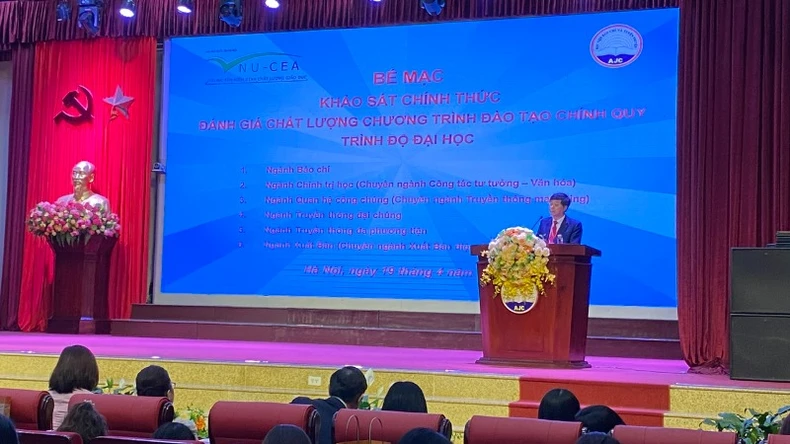 |
Associate Professor, Dr. Pham Minh Son, Director of the Academy of Journalism and Communication, delivered a speech. |
Associate Professor, Dr. Pham Minh Son, Director of the Academy of Journalism and Communication, noted: The survey and evaluation results are an important basis for the school to develop action plans, maintain and promote strengths, overcome weaknesses and shortcomings in training programs, and propose directions and solutions to continue improving and perfecting the quality of training programs in the coming time.
Source: https://nhandan.vn/6-chuong-trinh-dao-tao-cua-hoc-vien-bao-chi-va-tuyen-truyen-dat-chat-luong-92-post873742.html
![[Photo] Prime Minister Pham Minh Chinh presides over a meeting on private sector economic development.](/_next/image?url=https%3A%2F%2Fvphoto.vietnam.vn%2Fthumb%2F1200x675%2Fvietnam%2Fresource%2FIMAGE%2F2025%2F12%2F20%2F1766237501876_thiet-ke-chua-co-ten-40-png.webp&w=3840&q=75)
![[Photo] Prime Minister Pham Minh Chinh presides over the conference announcing the establishment of the International Finance Centre in Vietnam.](/_next/image?url=https%3A%2F%2Fvphoto.vietnam.vn%2Fthumb%2F1200x675%2Fvietnam%2Fresource%2FIMAGE%2F2025%2F12%2F21%2F1766309817714_ndo_br_dsc-3400-jpg.webp&w=3840&q=75)

























































Comment (0)