1. Few countries are like ours, having used Chinese characters for thousands of years while speaking Vietnamese. Whether the ancient Vietnamese had their own writing system is a question many historians have searched for, but without success. My grandfather's generation considered Chinese characters "our script," meaning our own, but upon reflection, it still seems problematic. That script was used by intellectuals (Confucian scholars) and the state apparatus (monarchy), but the common people couldn't use it for communication. However, Vietnamese people read Chinese characters completely differently from the people of China or other culturally similar countries. Vietnamese people read Chinese characters according to Sino-Vietnamese pronunciation. Therefore, when Vietnamese people write Chinese characters, Chinese people can read them, but when Vietnamese people read Chinese characters, Chinese people cannot understand. Even within China, the same writing system is pronounced differently in different regions, meaning people in one region cannot understand what people in another are saying.

The revolutionary press in our country contributed to disseminating modern, clear, and accurate Vietnamese to the people. ( In the photo: A thematic exhibition on President Ho Chi Minh - the founder of the revolutionary press in Vietnam, at the Ho Chi Minh Museum branch in Ho Chi Minh City.)
PHOTO: LAC XUAN
Of course, the Vietnamese have spoken Vietnamese for thousands of years, although we haven't found evidence of a separate writing system. Around the 10th century, the Vietnamese relied on Chinese characters to record the Vietnamese language, which is the Nôm script. However, Vietnamese contains a significant proportion of Sino-Vietnamese words (for example, "quốc gia" (nation), "Dân tộc" (ethnic group), "độc lập" (independence), "giao thông" (transportation)...), which are written in Nôm script using original Chinese characters, and Chinese people who know traditional characters can read them all. As for purely Vietnamese words (for example, "bách năm trong cõi người ta" - a hundred years in the human world...), the Vietnamese used Chinese characters to "adapt" the writing and phonetic transcription – these words are unreadable by the Chinese.
For about ten centuries, the Nôm script was used alongside Chinese characters. Hàn Thuyên (during the Trần dynasty) is considered the first person to write Nôm literature with his " Eulogy for the Crocodile ," and is therefore regarded as the "founder of Nôm literature" (this is not entirely certain, as most Vietnamese literary works from the Hồ dynasty onwards have been lost due to the Ming invasion). Although for those ten centuries, the Nôm script was fundamentally not used in official documents of the monarchy, except for a brief period during the Hồ and Tây Sơn dynasties when attempts were made to use it, it's incorrect to say that Nôm was only for the common people. It was still used by intellectuals, emperors like Trần Nhân Tông and Lê Thánh Tông, and renowned scholars like Nguyễn Trãi. Nguyễn Trãi's Quốc âm thi tập ( Collection of National Language Poems) and Lê Thánh Tông's Hồng Đức quốc âm thi tập (Hồng Đức Collection of National Language Poems) are written in Nôm script. And Nguyễn Du's Truyện Kiều (The Tale of Kiều) is perhaps the pinnacle of Nôm script writing. My teacher of Sino-Vietnamese studies said that he only learned Nôm script through The Tale of Kieu , because the basic Vietnamese language is fully contained in that work; all you need to do is memorize The Tale of Kieu and then look it up in the Nôm script version to know everything.
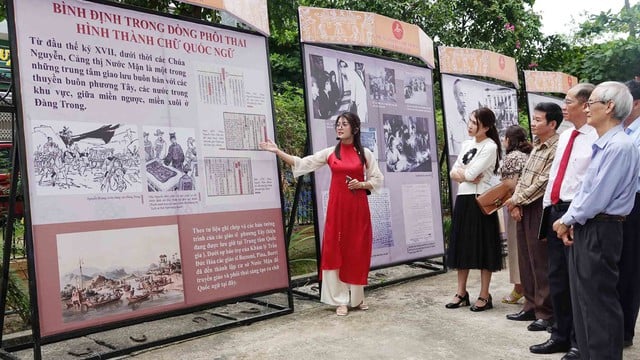
Documentary exhibition on the formation of the Vietnamese national script in Binh Dinh in 2024
PHOTO: HOANG TRONG
As mentioned, the ancients used the radicals of Chinese characters to record the Vietnamese language in Nôm script, also known as "national script." Later, they used the Latin alphabet to record Vietnamese, called "national language." Both are Vietnamese characters. Therefore, if the majority of our people knew Nôm script, it's unlikely that our country would have officially adopted the national script after the August Revolution. Before the August Revolution, over 95% of the population was illiterate, illiterate in both Chinese, Nôm script, and the national script. Eradicating illiteracy using the national script was much easier and faster than using Nôm script, because Nôm script was extremely difficult to write, as difficult as traditional Chinese characters. Therefore, after 1949, China had to reduce the strokes of Chinese characters to simplified characters to quickly eradicate illiteracy.
Some researchers argue that the popularization of the Vietnamese Quốc ngữ script created a "cultural rift," as most Vietnamese people today cannot directly read the original texts of their ancestors' writings and must rely on translations or transcriptions into Quốc ngữ. However, in the historical context of the time, popularizing the Quốc ngữ script was the wisest choice.
2. The classical literary culture of our country during the Ly-Tran-Ho dynasties and earlier was destroyed by the Ming invaders, and very few works remain. Only three books are considered the earliest surviving: Viet Dien U Linh Tap , Thien Uyen Tap Anh , and Linh Nam Chich Quai . Some works preserved in China that we later discovered include Viet Su Luoc (anonymous), An Nam Chi Luoc (Le Tac), and Nam Ong Mong Luc (Ho Nguyen Truong), along with some poems, prose, imperial decrees, letters, and inscriptions. Some other poems, prose, letters, and diplomatic documents can be found in the Song, Yuan, and Ming histories . We know about Le Van Huu's Dai Viet Su Ky from reading Ngo Si Lien's Dai Viet Su Ky Toan Thu and others, but that history has long been lost. All were written in Chinese characters.
You may also like

Businesses are "hunting" for technical personnel at the Job Fair.On June 4th, Hanoi College of Electrical Engineering (HCEM) organized the HCEM 2026 Job Fair for final-year students from the Electrical, Information Technology, and Mechanical Engineering departments, with the participation of many businesses in the industrial, mechanical, electrical, automation, information technology, and technical service sectors. 
Choosing the national script as a weapon to combat illiteracy was a wise decision by the Party. (In the photo: A literacy class in 1945)
PHOTO: TL
From the Le Dynasty onwards, due to the absence of raids and destruction, we have had more literary works preserved, but most of them were written in Chinese characters. Works written in Nom script were mainly poetry and prose, the most famous being Nguyen Du's *Truyen Kieu *. Valuable prose works – novels – were also written in Chinese characters, from * Hoan Chau Ky*, *O Chau Can Luc*, *Truyen Ky Man Luc*, *Tang Thuong Ngau Luc*, *Vu Trung Tuy But* to *Hoang Le Nhat Thong Chi* … Prose written in Nom script was both scarce and rudimentary, lacking significant value.
When the Vietnamese Quốc ngữ script was introduced, until the first half of the 20th century, we still lacked any valuable prose works in Quốc ngữ, and because they lacked value, they all fell into oblivion. It wasn't until 1925 that we had our first novel – Tố Tâm by Hoàng Ngọc Phách. As the first novel in Vietnamese, Tố Tâm was hailed as a breath of fresh air in literature, but it still employed a rhyming and romantic style that bordered on cliché.
It was not until the emergence of the Self-Reliance Literary Group (from 1934) along with the works of many writers outside this group such as Nguyen Cong Hoan, Vu Trong Phung, Nam Cao, To Hoai, Nguyen Tuan, etc., that modern Vietnamese prose began to take shape.
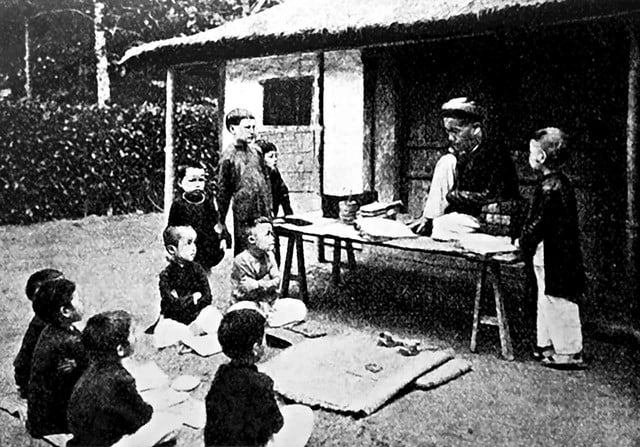
A tutor teaching children in the 19th century.
PHOTO: TL
3. As mentioned, before 1945, over 95% of the population was illiterate, despite many generations of Vietnamese people participating in the dissemination of the national script. Therefore, the vast majority of the population still did not have access to literature. This is also why, for centuries, works written in the Nôm script mainly used rhyming verse (six-eight or seven-six-eight) to make them easier to disseminate to illiterate people. In fact, many illiterate people still memorized The Tale of Kieu, The Lament of the Warrior's Wife, The Lament of the Concubine, or The Tale of Luc Van Tien by listening to literate people read them aloud and then reciting them to others.
The Communist Party of Vietnam was founded not only to lead the national liberation struggle but also to prepare for the construction of a new Vietnam. Among these tasks, raising the intellectual level of the people was a key objective. Following the initiative of Truong Chinh, the Society for the Promotion of the National Script was established in 1938 to "bring the light of culture to even the most remote huts." This movement not only significantly contributed to eradicating illiteracy but also profoundly impacted the development of Vietnamese literature and the Vietnamese language. General Secretary Truong Chinh, author of the famous "Outline of Vietnamese Culture," was a writer of political essays in clear, precise, and insightful Vietnamese, serving as a model for modern Vietnamese political writing. From this point on, our literature continued to flourish during the resistance against the French and Americans, and in the construction of socialism in the North, producing many enduring works. Since the country's reform and opening up to the arts, our literature has continued to develop to new heights and now has a form unprecedented in history.
Prime Minister Pham Van Dong was deeply concerned with preserving the purity of the Vietnamese language. Our writers have made significant contributions to this task.

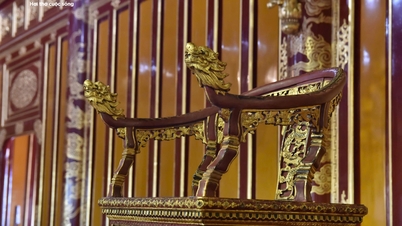
For centuries, Sino-Vietnamese characters served as the official writing system of the Vietnamese people. (In the photo: Tourists visiting the Temple of Literature in Hanoi)
PHOTO: NGOC THANG
When the national script was popularized, the revolutionary press in our country not only promoted patriotism and the indomitable will of our army and people, disseminating knowledge and skills in production and combat, but also spread to the people a modern, clear, and accurate Vietnamese language. A prominent example from the war was the daily broadcast of "This is the Voice of Vietnam, broadcast from Hanoi, the capital of the Democratic Republic of Vietnam" by the Voice of Vietnam radio station, with two voices from Hanoi and Saigon, using a majestic and refined Vietnamese that deeply moved people's hearts.
Before the August Revolution, Vietnamese was only used for teaching at the primary school level; at higher levels, teaching had to be done in French because Vietnamese lacked scientific terminology. After the Revolution, President Ho Chi Minh and Acting President Huynh Thuc Khang issued decrees stipulating that Vietnamese must be used in all levels, from primary school to university.
At that time, teaching in Vietnamese at the university level was controversial. Many argued that Vietnamese was not sufficient to convey scientific and technical content, and some even considered using Vietnamese for university-level teaching to be reckless. However, President Ho Chi Minh had a solid basis for his decision.
Since 1942, Professor Hoang Xuan Han had compiled and published a famous book, * Scientific Terminology *, using Vietnamese equivalents to refer to scientific concepts in French. President Ho Chi Minh understood the significance of this work very well and used this important achievement as the basis for deciding to teach Vietnamese at the university level.
Today, the Vietnamese language possesses a vocabulary sufficient to convey all content, from philosophy to social sciences, natural sciences, and modern technology, except for a few new concepts that require foreign names but are quickly Vietnamized. Vietnamese has enough words and nuances to express the full range of emotions within people, the cyclical transformations of nature, society, and the universe. As the country gains independence and freedom, people have more experiences, communication, and exploration, and the Vietnamese language becomes even richer. Linguists must "keep pace" with life to summarize the subtleties of the language, not the other way around. This represents the remarkable development of the Vietnamese language over the past 80 years.
Source: https://thanhnien.vn/80-nam-phat-trien-tieng-viet-185250828113612961.htm























































![[Video] Sunset at Lap An Lagoon – Where the sun sets over the fishing nets](https://vphoto.vietnam.vn/thumb/1200x675/vietnam/resource/IMAGE/2026/05/31/1780192137701_beach-landscape-sea-water-nature-grass-745871-pxhere-com.jpeg)


































Comment (0)