


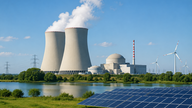
The Kudankulam nuclear power plant in Tamil Nadu state, southern India - Photo: Reuters
Large corporations such as Tata Power and Adani Group have begun exploring investment opportunities, while New Delhi is pushing ahead with a series of regulatory reforms aimed at attracting new capital. Will these reforms be enough to realize that ambitious goal, or are there still too many obstacles ahead?
Breaking the state monopoly.
According to the Financial Times on June 2nd, the biggest turning point in the reform came from New Delhi's decision to end the state's decades-long monopoly in the nuclear power sector.
According to a bill submitted by the Indian government to Parliament at the end of 2025, private companies and joint ventures with foreign investment could apply for licenses to build and operate nuclear power plants if selected by the government.
Previously, only the Nuclear Power Corporation of India (NPCIL) and a few state-owned entities were authorized to operate nuclear power plants. However, with the goal of increasing capacity from the current approximately 8GW to 100GW by 2047, the government recognizes that state resources are insufficient to meet the requirements for capital, technology, and deployment speed.
Late last year, Reuters reported that New Delhi wanted to attract around $26 billion from domestic corporations such as Tata Power, Adani Power, and Reliance Industries – which explains why these corporations quickly appeared in the government's development plans.
Tata Power – the power company of India's largest conglomerate, Tata Group – is one of the leading enterprises. The company is evaluating three sites in different states for the development of a nuclear power project.
CEO Praveer Sinha said Tata Power has identified suitable land and expects two 220MW power plants to be approved within the next two years.

Meanwhile, in February, Adani Power announced the establishment of Adani Atomic Energy Ltd, a unit specializing in nuclear power, operating in the production, transmission, and distribution of electricity from nuclear sources.
Alongside opening up to the private sector, New Delhi is also seeking to remove a long-standing barrier that has deterred many foreign corporations: legal liability in the event of a nuclear accident.
The new bill abolishes the provision allowing operators to sue technology suppliers in the event of equipment failure, and proposes the establishment of a nuclear liability fund and the adjustment of compensation mechanisms to align with international practices – an important signal to attract foreign technology and capital.
Big ambitions, big challenges.
Despite the promising investment prospects, the path to achieving the 100GW target remains fraught with obstacles.
The most challenging issue is land. According to internal documents accessed by Reuters, land acquisition for nuclear power projects typically takes four to five years, partly due to regulations requiring a exclusion zone with a minimum radius of about 1 km around the plant, prohibiting human habitation or economic activity.
To address this, regulators are considering narrowing the restricted zone by about half for some projects – a change that could help increase installed capacity at the same site by two or three times.
However, this is also the most controversial aspect of the reform process. Opposition parties argue that the government is focusing too much on attracting investment without adequately addressing concerns about nuclear safety. Many lawmakers warn that loosening regulations could undermine the safeguards built up over decades.
Even businesses interested in participating acknowledge the numerous challenges. Tata Power stated that the investment costs for nuclear power remain very high, while Indian private companies have virtually no experience operating large-scale nuclear projects.
Many key regulations regarding licensing, fuel supply, and approval processes are still being finalized.
Nevertheless, New Delhi has shown it will not back down. For a country still heavily reliant on coal but facing ever-increasing electricity demand, nuclear power is seen as one of the few energy sources that can provide stable electricity with low carbon emissions.
SMR: Next-generation nuclear technology
The Indian government is investing approximately $2.5 billion to develop at least five domestically designed small modular reactors (SMRs), with the goal of having them operational by 2033.
SMRs are nuclear reactors with a capacity typically below 300MW – significantly smaller than traditional nuclear power plants. Thanks to their compact size, SMRs are expected to have shorter construction times, lower investment costs, and greater flexibility in deployment.
Source: https://tuoitre.vn/an-do-mo-cua-dien-hat-nhan-nham-muc-tieu-100gw-2026060406202567.htm
































































![[Video] Sunset at Lap An Lagoon – Where the sun sets over the fishing nets](https://vphoto.vietnam.vn/thumb/1200x675/vietnam/resource/IMAGE/2026/05/31/1780192137701_beach-landscape-sea-water-nature-grass-745871-pxhere-com.jpeg)














































Comment (0)