From folklore
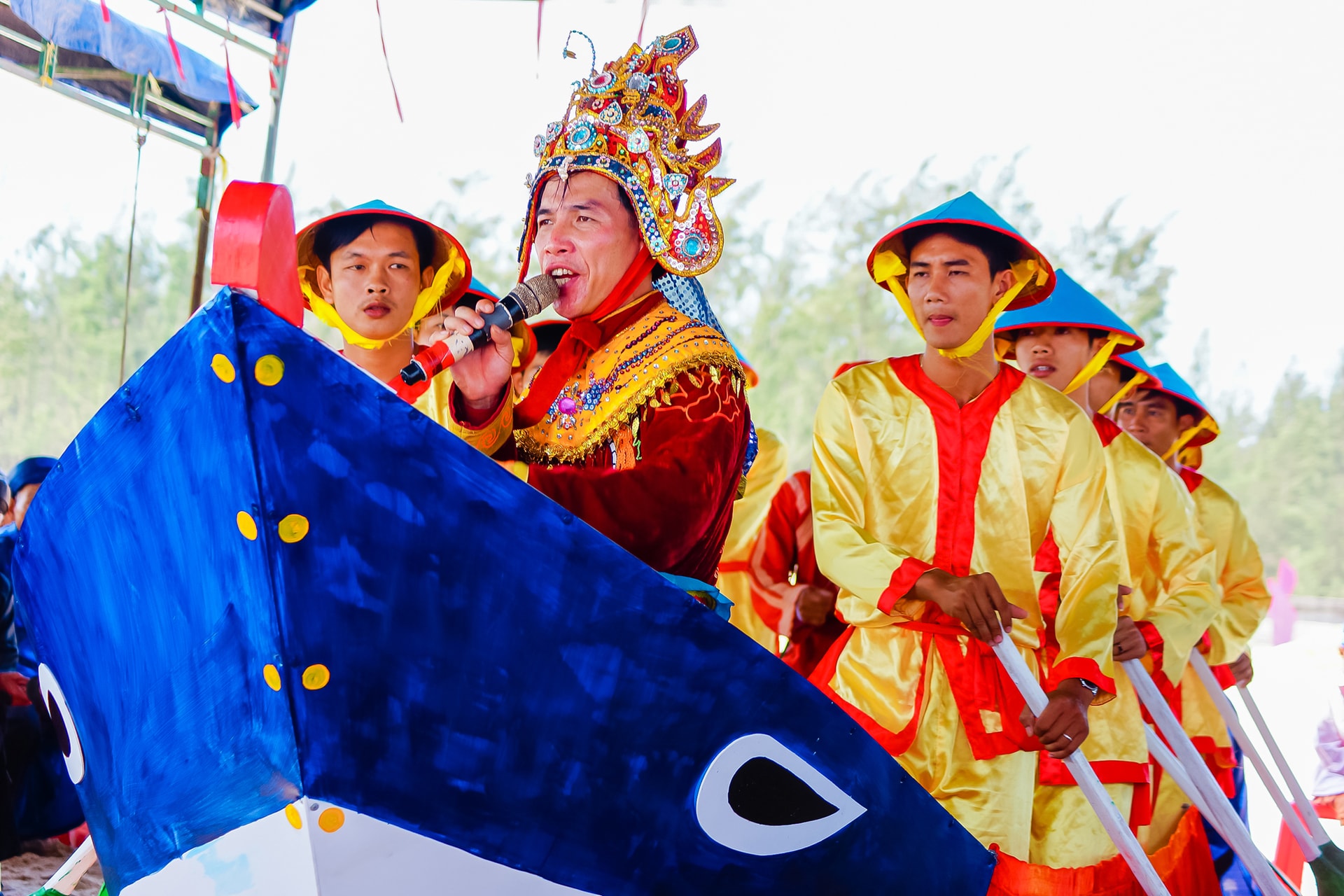
Folklorist Ton That Huong shared that in the coastal area of Thang Binh, the "ba trao" singing performance during the Fishing Festival usually begins with a procession of the ancestral spirit and a chanting of the spirit's farewell song led by the village elders, with the rowers singing along to the melody and performing rhythmic rowing movements to the tune.
A traditional boat dance troupe consists of 18 to 20 or even more people, but the number must be even and all are male, wearing red headscarves, white shirts, red sashes, barefoot, and holding oars. They perform collectively on land under the command of four village chiefs.
The chief helmsman is the person in charge of the boat, wearing traditional attire: a long black robe and white trousers. The bowman, also known as the front-row captain, wears traditional attire similar to the chief helmsman and holds a pair of cymbals to steer the boat. The rear-row captain (also known as the back-row captain) is in charge of logistics and wears a three-colored jacket. The trading captain, responsible for buying and selling goods, wears shorts and carries a bucket for scooping water.
That is the soul of the traditional Vietnamese dress, the "clothing of the sea waves" that has accompanied the coastal inhabitants through countless seasons of silver fishing, monsoon winds, and festivals.
The artisans in the traditional boat dance troupes often remember very clearly which costumes were worn during the five villages that welcomed the most successful fishing boat catches, which headdresses accompanied the troupe to provincial-level folk festivals, or which oars were present during the most lively fishing festival seasons.
Paddles of the fishing village


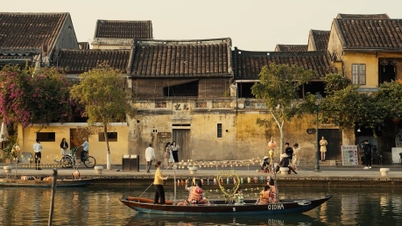
Mr. Cao Van Nhut, who holds the position of Head of the Ba Trao singing troupe at the Cau Ngu festival in Hoi An Dong ward, said that unlike everyday life, when wearing the Ba Trao costume with its ceremonial colors, one must automatically be humble and dignified in every step.
The costumes of the village chiefs and boatmen often feature bold colors such as red, yellow, blue, or even white. Red symbolizes auspiciousness, good fortune, and strength. Yellow evokes sacredness and reverence for the God of the South Sea. Blue represents the spirit of the ocean. Meanwhile, white suggests the purity of the ceremonial space.
The headscarf or headdress is also an important identifying feature. It bears the mark of traditional performance forms but has been adapted to suit the setting of a coastal village. These are also the costumes that express the spirit of those performing sacred rituals before the sea. In particular, the most typical symbol of the "ba trao" dance is the oar.
In many forms of folk performance, props only play a supporting role. But in the "ba trao" performance, the oar almost becomes the main character. Each oar is carefully painted and refurbished before the festival season. In some places, additional patterns are painted or colorful tassels are attached to enhance its solemnity.
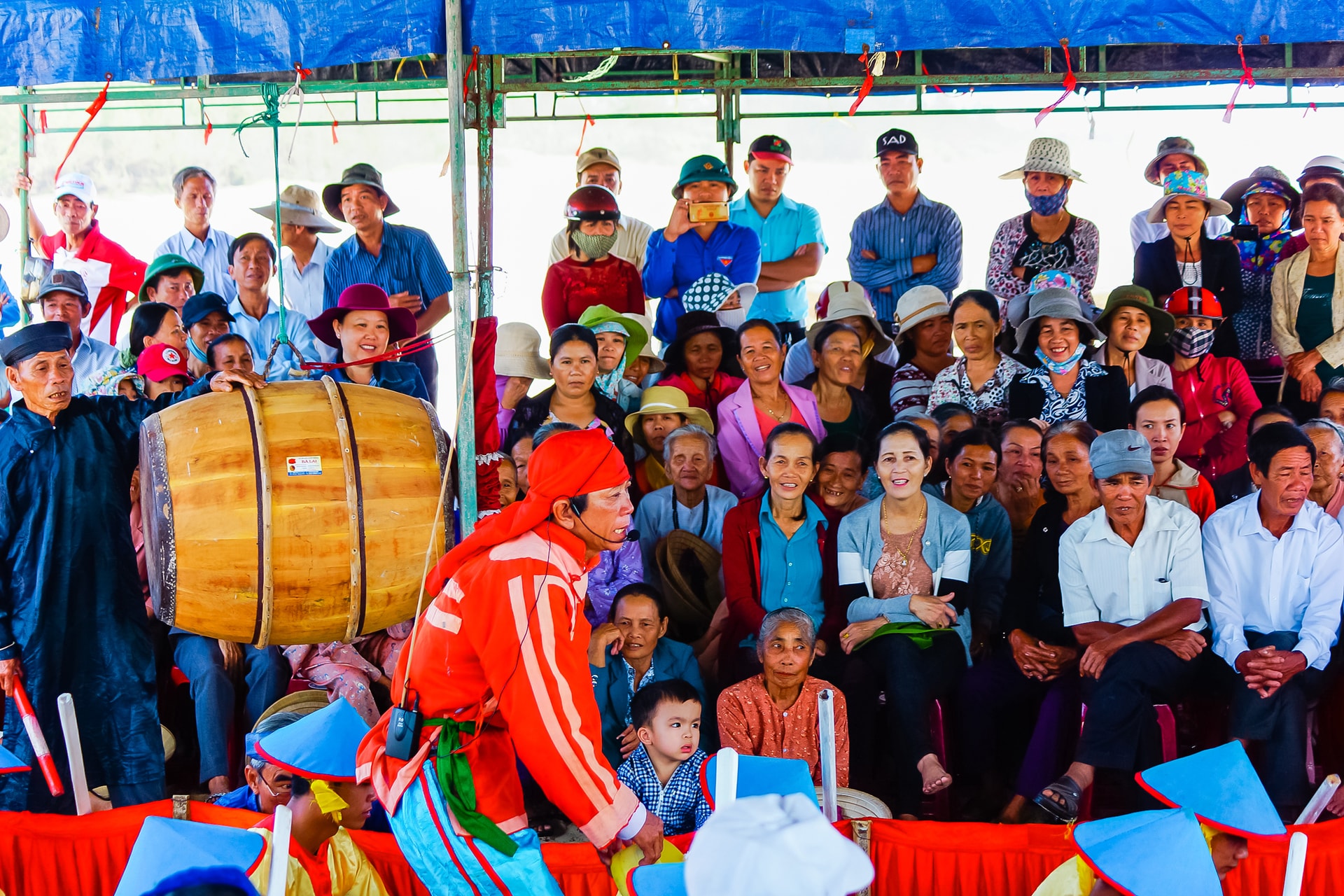
The rowing movements in the fishing festival become symbolic of the journey out to sea. The actions of raising, lowering, propping up, and raising the oars vividly recreate the life of coastal inhabitants. The rowing formation at this time resembles a large boat overcoming the waves. The oars move in unison, creating a undulating sensation like ocean waves. Without the oars, the rowing would lose its most important element.
According to artisan Cao Van Nhut, during each Fishing Festival, the traditional boat rowing performance lasts for more than two hours. The rowing troupe is arranged in a formation resembling a boat. Leading the boat rowing troupe on the dragon boat is the Chief Bowman, followed by the Chief Merchant and the Chief Steer, while the rowers are neatly arranged in two rows behind the Chief Bowman.
After the lines were in order, the master of ceremonies gave the order to begin, and the drums and gongs resounded, signaling the start of the performance. At this point, the lead singer began to shout: "Hey, rowing team!" Immediately, the rowers responded in unison: "Yes!" Then the lead singer began the rowing song.



According to researcher Ton That Huong, the songs and dances of the Ba Trao festival are currently structured according to a relatively strict model and format, while the lyrics are modified and adjusted to suit the occasion, scale, and social context.
***
Cultural researchers believe that forms of folk performance, such as hò khoan singing, nhân ngãi singing, bả trạo singing, bài chòi folk singing, and folk knowledge of coastal villages, are now only possessed by the elderly. When this generation passes away, all values will gradually fade away. Community memory, or even the coastal culture that has existed for generations, requires a great deal of effort to preserve.
Source: https://baodanang.vn/ao-mao-cua-song-bien-3339605.html