

On April 3-4, posing as someone needing a bank loan to buy an apartment in Ho Chi Minh City, a reporter from Nguoi Lao Dong newspaper contacted several banks to inquire about interest rates. An employee of the Agricultural and Rural Development Bank ( Agribank ) stated that the current interest rate for home loans is approximately 14% per year and there are no promotional programs available.
The interest rate on the old loan also increased.
At a branch of the Vietnam Foreign Trade Commercial Bank ( Vietcombank ), a credit officer stated that the bank is offering a fixed-rate loan package for 6 months with an interest rate of 9.6% per year, or 10.5% per year if fixed for the first 12 months. Several other commercial banks are also offering home loan interest rates of around 10%-11.5% per year, fixed for the first 12-24 months, then floating according to market conditions. These interest rates have remained high for several months recently.
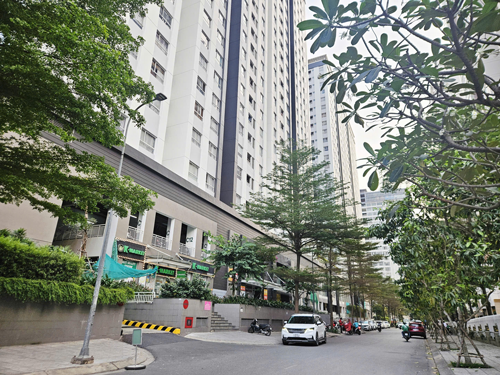
Homebuyers are still struggling as lending interest rates show no signs of cooling down. Photo: LAM GIANG
With interest rates rising rapidly since the beginning of 2026, many people are forced to adjust their home-buying plans. Mr. Hoang Nam (residing in Hiep Binh ward, Ho Chi Minh City) said he owns a plot of land over 50 m² in Long Phuoc ward, with a market value of approximately 3.5 billion VND. He plans to sell this land to buy an apartment in Binh Trung ward, costing around 6-7 billion VND and with an area of 70-80 m².
However, the land, which has been listed for sale since the end of last year, has yet to find a buyer, while bank loan interest rates continue to rise. "Currently, many banks are offering initial preferential interest rates as low as 10%-11%, and some even up to 14%. If I borrow around 2.5 - 3 billion VND, the interest costs will be very high, so I have to postpone my plans," Mr. Nam shared.
Not only new loans, but interest rates on existing loans have also been adjusted upwards. Ms. Minh Thu (residing in Tan Phu ward, Ho Chi Minh City) said that her home loan at Vietcombank recently had its interest rate adjusted for the second time, from 9% to 9.9% per year. Although the increase is not too high compared to the current market rate, two consecutive increases in a short period of time still create significant financial pressure for her and her family.
According to reports, lending interest rates have increased significantly recently, especially in the real estate sector. A report byACB Securities Company shows that high interest rates on home loans are negatively impacting consumer demand, as well as the sales plans and profits of real estate companies.
Specifically, in March 2026, the preferential fixed interest rate for the first 12 months ranged from 8.5% to 10% per year, an increase of approximately 2-3 percentage points compared to the same period last year. After the preferential period, the floating interest rate was commonly at 12%-14% per year, an increase of approximately 2-3 percentage points compared to the same period.
Just a short-term "turning point" (?!)
From a market perspective, Ms. Pham Thai Thanh Truc, Director of Real Estate Sector Analysis at ACB Securities Company, noted that the financial market is currently facing many difficulties as policies controlling credit flows into real estate are being tightened.
Specifically, from the beginning of the year, the State Bank of Vietnam required banks to control real estate credit growth so that it does not exceed the overall credit growth rate of the economy, which is projected to be around 15%.
Meanwhile, in 2025, real estate credit is projected to increase by 32%, significantly higher than the previous year's 20.4% and the overall economy's 19%. "In this context, only large, reputable real estate businesses with transparent legal frameworks will be prioritized in accessing capital. Conversely, smaller businesses or projects with incomplete legal documentation will face difficulties, forcing them to seek other fundraising channels such as bonds," Ms. Truc stated.
From the perspective of homebuyers, especially those borrowing to buy for actual occupancy, Dr. Nguyen Tuan Anh, a finance lecturer at RMIT University Vietnam, believes that current interest rate fluctuations are merely a short-term "turning point" in a long-term financial plan.
According to him, home loans typically last 15-20 years, while monetary tightening cycles usually only last 12-18 months. Although deposit interest rates tend to rise, the liquidity of the banking system remains maintained, allowing for the implementation of loan packages with fixed interest rates for the first 1-3 years, acting as a "buffer" for borrowers.
"For those who have prepared a safe equity ratio (over 30% of asset value) and have a stable income, decisions to buy a house or make long-term investments should not be delayed by short-term cyclical fluctuations," Mr. Tuan Anh emphasized.
Consequences after a period of rapid growth.
Economist Dr. Dinh The Hien believes that the increase in real estate lending interest rates is not an unusual development but a consequence of the previous period of "hot" credit growth. Specifically, from the end of 2025, real estate credit has increased by over 20%, forcing regulatory authorities to intervene. Compared to 2024, when interest rates for home loans were only 6%-8% per year and around 9%-10% after incentives, the current rate of 12%-14% per year is considered a significant increase.
According to this expert, although not yet reaching the same level of tension as some previous periods, the current interest rate hike is still having a significant impact on the market. "In the period of 2026-2028, high interest rates are predicted to comprehensively affect genuine homebuyers, investors, and project developers. In this context, short-term investment opportunities will narrow, and the market will enter a stronger period of consolidation, especially for speculative activities," said Dr. Dinh The Hien.
Source: https://nld.com.vn/ap-luc-cho-nguoi-mua-nha-196260403212310886.htm







































































































Comment (0)