

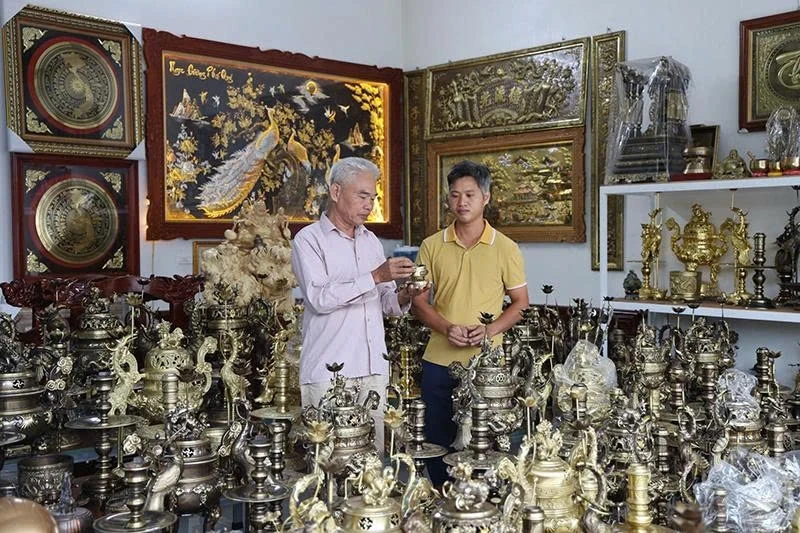
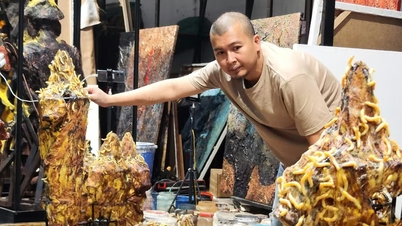
The Tra Dong bronze casting village, with its diverse range of products, has the advantage of attracting tourists . Photo: Thuy Linh
With their rich history and diverse forms, traditional craft villages in Thanh Hoa province hold a significant resource for tourism development. Beyond creating products, these villages preserve folk knowledge, customs, and the unique living spaces of the community. Therefore, linking tourism development with craft villages is expected to open up a new direction that both promotes cultural values and expands opportunities for sustainable economic development.
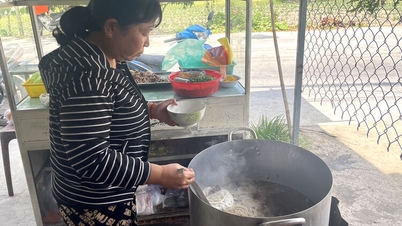
In Xuan Lap commune, the traditional rice cake-making village maintains a steady production pace. In the families involved in the craft, the work continues regularly for many years. From selecting the rice and grinding the flour to wrapping and steaming the cakes, everything is done according to experience passed down through generations. These small cakes are not only a culinary product but also carry the distinctive cultural imprint of the countryside.
Currently, the entire commune has 72 households participating in production, creating jobs for 155 workers with stable incomes. The "bánh lá răng bừa" (a type of traditional Vietnamese rice cake) product has been recognized as a 3-star OCOP product, gradually asserting its position in the market. According to the producers in the craft village, product consumption mainly comes from regular customers and orders. Some production facilities have boldly innovated and promoted their products on e-commerce platforms and social media, but the effectiveness is still unclear.
The craft village has welcomed several groups of visitors, but it hasn't yet developed into a regular experiential tourism activity. However, during festivals, especially the Le Hoan Temple Festival, the "banh la rang bua" (a type of rice cake) is displayed and promoted, and the villagers directly demonstrate the cake-making process, attracting the attention of many tourists.
Ms. Mai Thi Tu, owner of the Chu Tu rice cake production facility in Trung Lap 3 village, shared: “During festivals, visitors come to watch me make the cakes and ask many questions. Some people see how to wrap the cakes for the first time and they really like it. Through that, my craft is becoming more widely known.”
These demonstration activities, although not yet frequent, have begun to create a connection between the craft villages and tourists.
Besides its distinctive products, Xuan Lap also possesses a rich system of historical and cultural relics, and a rural landscape that retains its traditional charm. These are favorable factors for developing spiritual tourism and experiential tourism associated with traditional crafts, contributing to attracting tourists and promoting the local image.
However, these potentials are essentially still "awaiting development." Mr. Do Minh Son, chairman of the traditional rice cake making village in Xuan Lap commune, shared: "The scale of production is still small and fragmented, there is no concentrated area, a lack of reception and product display points; and the transportation and tourism infrastructure is not yet synchronized. Therefore, the development of tourism in the craft village is currently still mainly at the potential stage."
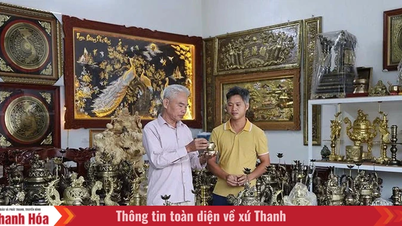
In Thieu Trung commune, the Tra Dong bronze casting village has seen more significant changes as it gradually integrates production activities with tourism and experiences. Beyond simply showcasing the craft at events, visitor activities are now gradually taking place within the daily production areas. To develop the village sustainably, the local authorities have planned a concentrated production area of approximately 5.7 hectares, creating conditions for households to expand production while also providing a convenient space for visitors. In recent years, the furnaces still burn brightly in the casting workshops, the sound of hammers still echoes, but interspersed with this is the arrival of groups of visitors coming to explore and learn about the craft. According to statistics, the village receives about 2,000 visitors annually. While not a large number, it shows that tourism has begun to "touch" the craft village, creating initial positive changes.
Linking traditional craft villages with tourism has been implemented in some localities and has initially yielded some results. However, compared to the potential, the effectiveness is still not commensurate. Visiting activities mainly focus on "observing the craft," and have not yet developed in-depth experiential products. Tourist stays are still short, and the economic value generated is not yet clearly evident.
In today's tourism trends, visitors not only want to buy a product, but also want to experience the production process, hear stories about the craft, the people, and the cultural context behind it. This is precisely the direction that traditional craft villages need to gradually approach.
To effectively harness its potential, the development of craft village tourism needs to be carried out in a synchronized manner, from infrastructure investment and spatial organization to product development and capacity building for the local people – the key stakeholders of the craft villages.
Mr. Tran Ngoc Tung, Vice Chairman of the People's Committee of Thieu Trung commune, said: "To attract and retain tourists, the commune will continue to improve infrastructure, build exhibition spaces, and organize suitable experiential activities, aiming to gradually develop tourism products associated with traditional craft villages."
Each craft village is choosing a different approach to developing craft village tourism. However, the common point is that all craft villages are gradually expanding their development space. Craft villages are not just limited to production and preserving crafts, but can also become destinations – connecting culture, people, and tourism in the development journey of Thanh Hoa province.
Thuy Linh
Source: https://baothanhhoa.vn/gan-phat-trien-du-lich-voi-lang-nghe-283428.htm
![[Image] Close-up view of the 10-lane road connecting to Long Thanh Airport](https://vphoto.vietnam.vn/thumb/1200x675/vietnam/resource/IMAGE/2026/04/04/1775291871988_ndo_br_1-resize-5690-jpg.webp)







































































Comment (0)