

Dr. Nguyen Duc Do assessed that Vietnam's inflationary pressure in 2024 is not significant, around 2.5-3.5%, lower than the target set by the National Assembly (4.5%).
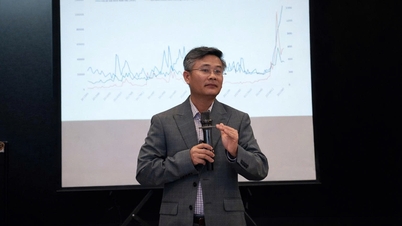
This assessment was made by Mr. Nguyen Duc Do, Deputy Director of the Institute of Economics and Finance, at a seminar on market and price forecasting on January 4th.
Mr. Do presented a scenario forecasting inflation in 2024 at 2.5-3.5%. This figure does not include the prices of goods and services managed by the State. "Inflationary pressure this year will not be significant, because the global economy, especially the US and China, is projected to slow down," Mr. Do said.
Another factor raised by this expert is that oil prices could fall sharply if the US economy enters a recession, hovering around $67 a barrel – equivalent to the average price level during the 2019-2023 period.
"The economy is still operating below its potential as exports will grow moderately, and GDP will be around 6%. This is a factor that helps to keep inflation under control," Mr. Do added.
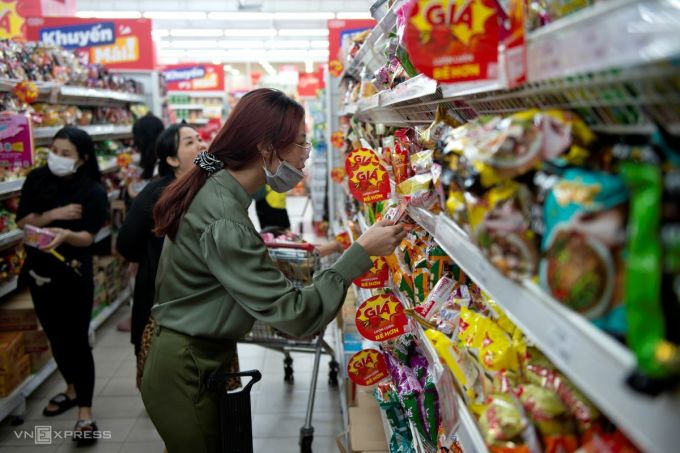
People select goods at a supermarket in Go Vap district, Ho Chi Minh City, June 2023. Photo: Thanh Tung
Low inflation was also the assessment of many experts at today's seminar. Mr. Dinh Trong Thinh, an expert from the Academy of Finance, believes that the inflation rate of goods and consumer goods will be around 3.2-3.5%.
"If the global economy recovers, and Vietnamese businesses take full advantage of opportunities from exports, imports, services, and public investment disbursement, inflation will only be 3.5-3.8%," he assessed.
The CPI in 2023 increased by 3.25% compared to the same period in 2022, meeting the target set by the National Assembly (below 4.5%). This marks the 10th consecutive year that inflation has been controlled in accordance with the National Assembly's target.
According to experts, inflationary pressure is not significant, which will create momentum for macroeconomic stability and growth this year. Mr. Thinh predicts GDP will fluctuate between 5.5% and 6.5%.
However, Associate Professor Phan The Cong, Head of the Economics Department (University of Commerce), noted that the economy still harbors "unknowns" that could put upward pressure on the consumer price index, such as the price of medical services, university tuition fees which have increased since the beginning of the year, or salaries that will increase from July 1st.
In light of external and internal economic variables, a representative from the Price Management Department (Ministry of Finance) stated that they will closely monitor developments to implement timely response measures, especially during holidays and Tet (Lunar New Year), and when adjusting wages.
Source link


![[Photo] General Secretary and President To Lam meets with National Assembly delegates from ethnic minorities.](https://vphoto.vietnam.vn/thumb/1200x675/vietnam/resource/IMAGE/2026/04/20/1776696701056_a1-bnd-8331-3342-jpg.webp)


![[Image] National Assembly discusses the implementation of the socio-economic development plan.](https://vphoto.vietnam.vn/thumb/1200x675/vietnam/resource/IMAGE/2026/04/20/1776696707422_ndo_br_img-20260420-185419-jpg.webp)
































































































Comment (0)