

The 2023 Nobel Prize in Physics was awarded to three scientists for their research on the attosecond, which could lead to breakthroughs in electronics and chemistry.
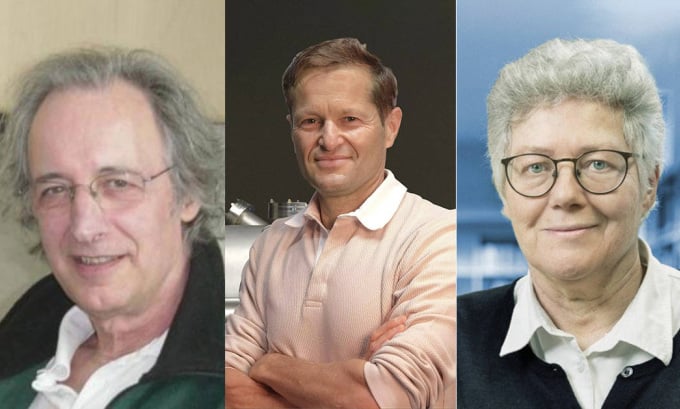
The three scientists Pierre Agostini, Ferenc Krausz, and Anne L'Huillier received the 2023 Nobel Prize in Physics. Photo: CNN
The Royal Swedish Academy of Sciences announced that scientists Pierre Agostini (55 years old), Ferenc Krausz (61 years old), and Anne L'Huillier (65 years old) are the recipients of the 2023 Nobel Prize in Physics, for their experimental methods that help create attosecond light pulses to study electron dynamics in matter, at 4:45 PM on October 3rd ( Hanoi time).
Their work with lasers provides scientists with tools to observe, and possibly even control, electrons. This could drive breakthroughs in many fields, such as electronics and chemistry.
An attosecond is one billionth of a billionth of a second. To put it more simply, the number of attoseconds in a second is equivalent to the number of seconds in the entire 13.8 billion-year history of the universe. According to Hans Jakob Woerner, a researcher at the Swiss Federal Institute of Technology (ETH Zurich), the attosecond is the shortest period of time that humans can directly measure.
The ability to operate within this time frame is crucial because this is the speed at which electrons—the vital components of an atom—operate. For example, it takes an electron 150 attoseconds to travel around the nucleus of a hydrogen atom.
This means that studying attoseconds allows scientists to access a fundamental process that was previously beyond their reach. All electronic devices are affected by the movement of electrons, and the current speed limit is nanoseconds, according to Woerner. If microprocessors were converted to attoseconds, processing information a billion times faster could become possible.
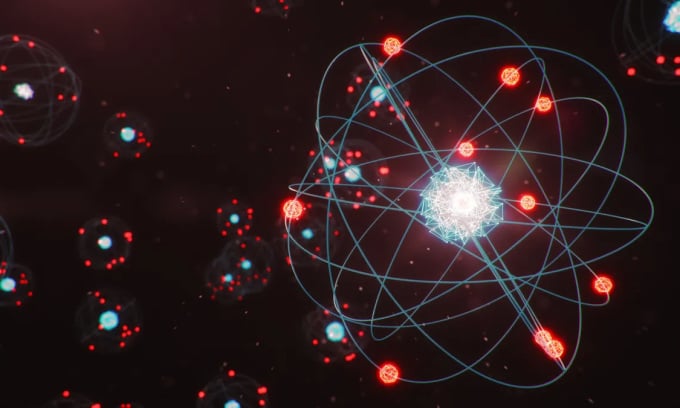
An atom consists of a nucleus made up of protons and neutrons, surrounded by electrons. (Image: Rost-9D/Getty)
The Swedish physicist of French origin, Anne L'Huillier, was the first to discover a tool that would unlock the world of the attosecond. This tool uses high-power lasers to generate pulses of light in extremely short intervals.
Franck Lepine, a researcher at the French Institute of Light and Matter who previously worked with L'Huillier, describes the tool as like a film created for electrons. He compares it to the work of two pioneering French filmmakers – brothers Auguste and Louis Lumière – who constructed scenes by taking a series of photographs. According to John Tisch, professor of laser physics at Imperial College London, it's like a device with extremely fast pulses of light that can be shone onto materials to gather information about their reactions over that time.
All three winners yesterday previously held the world record for the shortest light pulse. In 2001, a research team led by French scientist Pierre Agostini created a light pulse lasting just 250 attoseconds. L'Huillier's team surpassed that record with 170 attoseconds in 2003. In 2008, Austrian-Hungarian physicist Ferenc Krausz reduced that by more than half with a pulse of 80 attoseconds.
Woerner's research team currently holds the Guinness World Record for the shortest light pulse, with a duration of 43 attoseconds. Woerner estimates that this time could be further reduced to just a few attoseconds with current technology.
Experts say that attosecond technology is not yet widespread, but the future looks promising. To date, scientists have been able to use attoseconds primarily to observe electrons. Controlling electrons and manipulating their movement is fundamentally still unattainable, or only just beginning to become feasible, according to Woerner. This could make electronic devices much faster and potentially spark a revolution in chemistry.
"We won't be limited to what molecules do naturally, but instead can tailor them to our needs," Woerner said. He added that "atto chemistry" could lead to more efficient solar cells, or even use light energy to produce clean fuels.
Thu Thao (According to AFP )
Source link


![[Photo] Standing Committee member of the Party Central Committee Tran Cam Tu presents the Decision appointing the Secretary of the Party Committee of the Ho Chi Minh National Academy of Politics.](/_next/image?url=https%3A%2F%2Fvphoto.vietnam.vn%2Fthumb%2F1200x675%2Fvietnam%2Fresource%2FIMAGE%2F2026%2F02%2F02%2F1770039902160_le-cong-bo-bt-hvctqg-11-7880-jpg.webp&w=3840&q=75)


![OCOP during Tet season: [Part 3] Ultra-thin rice paper takes off.](/_next/image?url=https%3A%2F%2Fvphoto.vietnam.vn%2Fthumb%2F402x226%2Fvietnam%2Fresource%2FIMAGE%2F2026%2F01%2F28%2F1769562783429_004-194121_651-081010.jpeg&w=3840&q=75)


Comment (0)