

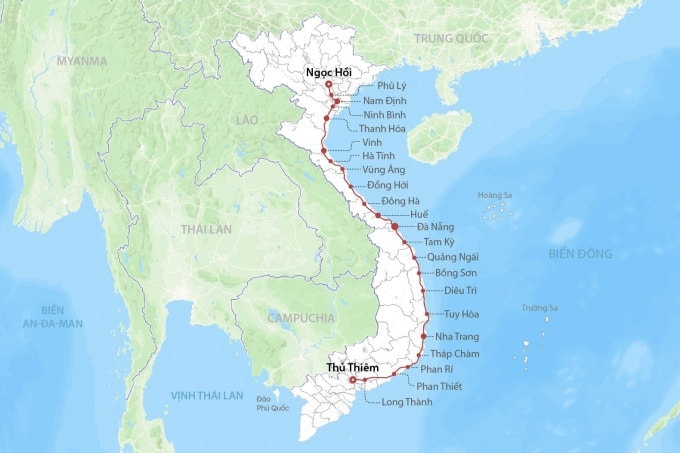
According to the North-South high-speed railway project, the line will be newly constructed as a double track, with a gauge of 1,435 mm, a design speed of 350 km/h, a maximum operating speed of 320 km/h for long-distance trains, and a maximum speed of 250-280 km/h for short-distance trains. Freight trains will run at speeds of 120-160 km/h; with a load capacity of 22.5 tons per axle.
The high-speed rail line prioritizes passenger transport on the route and can transport goods at other times when needed. The existing North-South railway line is being upgraded to transport goods and containers.
The high-speed railway line passes through 20 provinces and cities, with at least one passenger station in each province. The average distance between stations is approximately 67 km, with the shortest distance being less than 45 km between stations in the Ha Nam - Nam Dinh - Ninh Binh section. Given this station spacing, the high-speed train schedule is adjusted to ensure sufficient distance for acceleration and deceleration sections.
According to the consultant's proposal, passenger trains will operate from 6:00 AM to 12:00 AM daily. In Phase 1, the passenger trains will use 8-car trains with distributed propulsion technology, each carrying 610 people. In Phase 2, 16-car trains will be used, carrying 1,220 people.
The operating unit will arrange two types of trains running throughout the North-South route. The express passenger train (Type 1) operates at a maximum speed of 320 km/h and stops at several major stations along the route such as Hanoi , Vinh, Da Nang, Nha Trang, Long Thanh, and Thu Thiem. The travel time for the express train along the entire route is 5 hours and 20 minutes. Specifically, the Hanoi - Nghe An section takes 56 minutes, and the Nha Trang - Ho Chi Minh City section takes 71 minutes.
Passenger trains, typically numbered 2A and 2B, operate at a maximum speed of 320 km/h, making alternating stops, with some trains stopping at even-numbered stations and others at odd-numbered stations. The total travel time for the entire route is 6 hours and 50 minutes. The stop time at each station is 2 minutes.
In addition to the North-South trains mentioned above, the route will have trains operating on sections (2C) such as: Hanoi - Vinh, Hanoi - Da Nang, Ho Chi Minh City - Nha Trang, Ho Chi Minh City - Da Nang. The train running time depends on the operating distance of each section.
Freight trains only operate when the demand for freight transport exceeds the capacity of the existing North-South railway. Freight trains operate at a maximum speed of 120-160 km/h, are scheduled to operate at different times from passenger trains (from 0h to 6h), and must not obstruct track maintenance, ongoing elevated equipment maintenance, and other infrastructure projects.
Initially, two pairs of express trains and two pairs of regular trains will operate between North and South; each section will have two pairs of freight trains operating within that section. In the later phase, the number of regional train pairs will increase to five pairs per day. The operation of 8-car or 16-car trains will be flexibly adjusted to suit demand.
The consulting firm calculated that the North-South high-speed railway could accommodate approximately 133.5 million passengers per year for direct North-South trains and approximately 106.8 million passengers per year for regional passenger trains.
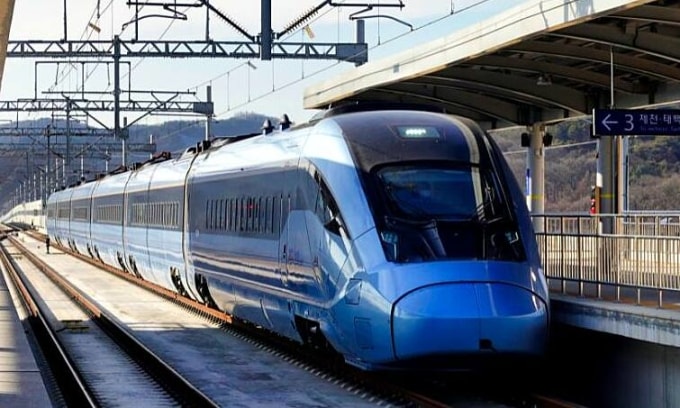
To match affordability and attract passengers, high-speed rail tickets are divided into three price tiers. The projected prices are: first class at $0.187/km (VIP compartment, fewer stops); second class at $0.078/km; and third class at $0.047/km.
Thus, for the Hanoi - Ho Chi Minh City route, the projected price for a first-class ticket is 7.34 million VND; a second-class ticket is 3.05 million VND; and a third-class ticket is 1.83 million VND. Meanwhile, the price of a Thong Nhat railway ticket ranges from 0.9 million VND (seated) to 1.5 million VND (sleeper); a bus ticket is 1.1 million VND. These prices are not significantly different from those in countries with similar conditions to Vietnam or for long-distance railway routes.
According to the pre-feasibility study report, the North-South high-speed railway line is approximately 1,541 km long, of which about 60% is bridges, 10% is tunnels, and 30% is on-ground with barriers. The line includes 23 passenger stations, 5 freight stations, 5 passenger depots, 4 freight depots, 45 infrastructure maintenance facilities, and approximately 28.5 km of connecting lines to freight stations for freight train operations when needed.
VN (according to VnExpress)Source: https://baohaiduong.vn/ba-loai-tau-khach-toc-do-cao-bac-nam-398334.html






















































































Comment (0)