

Modernizing production processes
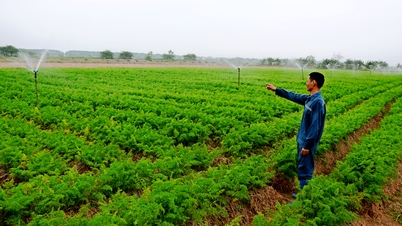
According to Mr. Dang Thanh Hue, Party Secretary and Deputy Director of the Duc Lan Village Agricultural Service Cooperative in the former Yen Phu commune (now Van Mon commune), despite industrial and urban development, 100% of the cooperative's member households maintain the cultivation of glutinous rice (Nếp Cái Hoa Vàng). Given the current difficulties in agricultural production, with only 58.3 hectares remaining under cultivation, the local authorities are focusing on improving the quality of this local specialty rice variety. Mr. Hue stated: “To encourage people to persevere in farming, the cooperative is promoting mechanization in all stages from land preparation to harvesting, so each household only needs 1-2 people to participate in production during the planting season. Farmers are guided to cultivate in concentrated areas, using a single rice variety to minimize cross-pollination. Simultaneously, tasks such as sowing, spraying pesticides by aircraft, and supplying materials and fertilizers directly to the fields help reduce labor and significantly increase productivity.” As a result, in 2025, the cooperative was able to supply 700 tons of glutinous rice according to VietGAP standards and was recognized as a 4-star OCOP product, attracting many buyers directly from the fields with stable prices.
 |
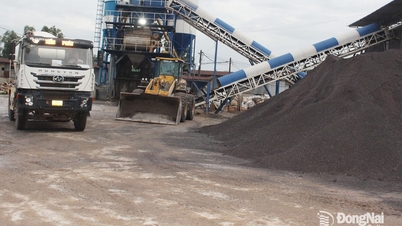
A synchronized machinery system is used to optimize the rice milling process at Mr. Chu Van Dao's household. |
As a large rice milling facility in Cau Gao village, Van Mon commune, and directly purchasing glutinous rice of the "golden flower" variety, Mr. Chu Van Dao's household has also invested in machinery to process and improve the quality of rice for the market. In the final days of the year, the sounds of people and machines blend harmoniously at Mr. Dao's workshop. Here, after purchasing the raw glutinous rice from farmers each season, he carries out the processes of separating, cleaning, polishing, and packaging the product. Since 2016, with the capital borrowed for youth entrepreneurship, he has upgraded his family's traditional rice milling equipment, including an automatic heat dryer, a husk separator, a whitening machine, and an excavator...
Recently, he also hired designers to install an air dust filtration system and conveyor belts for transporting rice, reducing labor costs. The total investment in the production line reached nearly 6 billion VND. Thanks to this, his family can store nearly 1,000 tons of fresh glutinous rice annually, drying and processing it into 700-800 tons of dried rice. In the two months leading up to Tet (Lunar New Year), when demand increases, the mill also increases its milling capacity by 30-40%, selling about 40-50 tons of rice each month. "My family specializes in milling glutinous rice for making cakes and other processed foods, which require very high standards of whiteness and minimal impurities such as bran, blackhead, and grit... Thanks to the synchronized and modern machinery system, we can better control the quality of the rice, reduce labor costs, and ensure safety for my family and the surrounding environment of the mill," Mr. Dao shared.
Investing in processing technology
Thanks to reputable and modern milling facilities, many households in Van Mon commune now have access to standardized raw materials for processing higher-quality rice noodles and spring roll wrappers. Over time, the production of these processing facilities has also shifted from small-scale to large-scale production. The famous Dao Lien spring roll wrapper facility in Cau Gao village, Van Mon commune, is undergoing a comprehensive transformation, installing electric drying ovens and electric steamers to replace all previously manual equipment, resulting in noticeable improvements.
 |
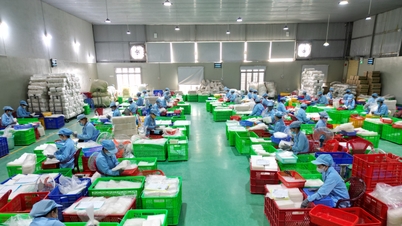
The Dao Lien spring roll wrapper production facility has installed an electric drying oven to increase productivity. |
Ms. Dao Thi Lien excitedly shared: “Having worked in this profession for nearly 30 years, after a period of traditional production methods such as making rice paper wrappers over a wood-fired stove and drying them outdoors on racks, I invested billions of dong to purchase a system of 3 drying ovens with a capacity of 400 kg of wrappers per batch and a large-capacity electric steam boiler. Using electricity is more expensive, but the quality of the wrappers is consistent, ensuring food safety and hygiene, and most importantly, we no longer have to depend on the weather as before. Along with a professional processing process, the facility can meet large orders from distribution companies nationwide. Thanks to the improved quality, Dao Lien rice paper wrappers participated in the province's OCOP program and achieved a 3-star certification.”
Currently, the Dao Lien spring roll wrapper production facility produces about 1 ton of finished products daily. During the days leading up to Tet (Lunar New Year), order demand increases by 10%, providing employment for nearly 20 regular workers. The products are not only sold within the province but also in Hanoi and exported to demanding markets such as Japan, South Korea, and Europe. To meet large orders, the Dao Lien facility now also collaborates with and acts as a distribution hub for many other households in the village.
It can be said that in Yen Phu district at this time, the atmosphere of production is always bustling and busy. Most establishments and businesses proactively import high-quality raw materials in preparation for the peak Tet (Lunar New Year) season. The shift from traditional, experience-based production to standardized production not only enhances the value of glutinous rice and preserves the traditional crafts of Yen Phu but also helps many households prosper right in their hometown. The combination of the dedication of those who love their craft and technological support is creating a new face for the traditional craft village, moving towards a more professional and sustainable direction.
Source: https://baobacninhtv.vn/bac-ninh-vung-dat-tram-nghe-doi-moi-cong-nghe-postid438211.bbg







































































Comment (0)