


ELEGANT DEPARTMENT STORE
According to the book Les Annales coloniales , the GMC building was owned by Société Coloniale des Grands Magasins, a French company founded in 1921. They also owned the Grands Magasins Réunis building in Hanoi (now the Tràng Tiền Department Store). In 1925, the Saigon Port Authority also installed a large horn on top of the GMC to announce that ships from France had arrived.
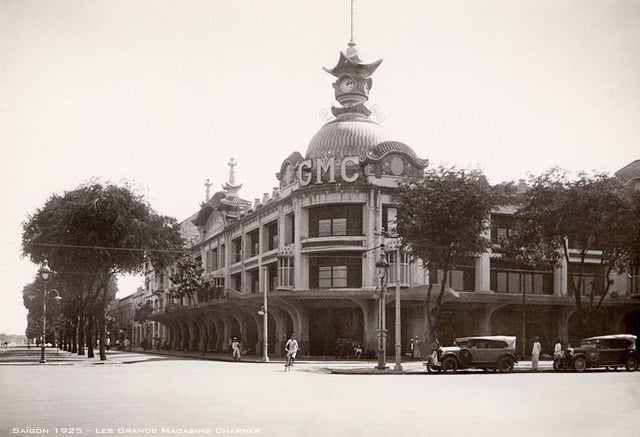
The Charner Department Store building in 1925, viewed from the intersection of Charner (Nguyen Hue) and Bonard (Le Loi) streets.
PHOTO: COLLECTED BY MANH HAI FLICKR.COM
Grand Magasin Charner (GMC) is a three-story building overlooking two streets, Charner (Nguyen Hue) and Bonard (Le Loi), constructed between 1922 and 1924. At its center is a round, bell-shaped tower, similar in design to the tower of the famous Au Printemps department store in Paris.
However, the top and sides of the GMC tower feature an interesting difference: the clock faces are positioned under tiled roofs. Furthermore, the tiled roofs have a wavy border, reminiscent of traditional Japanese roofs. The building's roof slopes gently down to the upper edge of the top floor, adding to its East Asian influence. The exterior of the two upper floors lacks balconies, instead featuring large windows, each containing a smaller glass pane.
Furthermore, unlike Au Printemps, the ground floor of the Charner Department Store features an awning that runs along the entire facade. This awning has a slightly curved section, showcasing elegant lines. Inside the main hall, two gracefully shaped staircases lead to the first floor. Notably, the tiled floor between the staircases is designed like a stunning mosaic carpet. At each end of the staircase railings are bronze statues of the Gallic rooster – a traditional symbol of France.
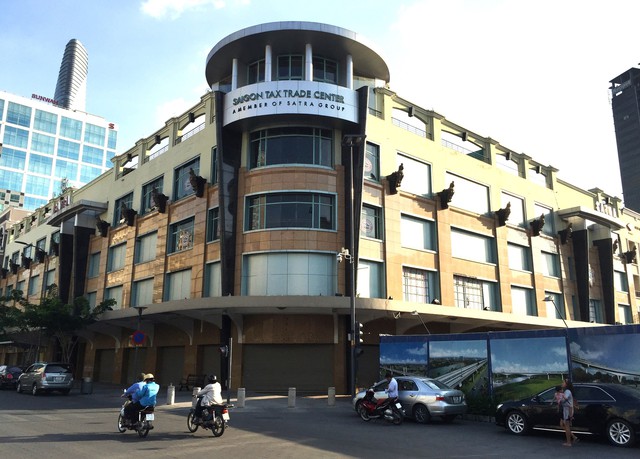
The Tax Department Store before its demolition to make way for a 40-story shopping mall.
Photo: QUYNH TRAN
Back then, department stores were a new type of upscale retail in Vietnam. They showcased high-end consumer goods, primarily catering to the upper class, and were divided into many smaller sections organized by product category. Department stores were typically located in large buildings with elegant and sophisticated designs.
Huong Xa became bustling from the mid-1950s.
The GMC department store was not the first upscale and modern shopping center in Saigon. Prior to it, on Catinat Street (Dong Khoi Street), there were the Bazar Saigonnais department store (1885, now the Sheraton Hotel building) and the Les Nouveautés department store (1887, currently the Opera View building, 161 Dong Khoi Street), located opposite the Hotel du Théâtre (Caravelle Hotel). Additionally, on Catinat Street there was the Mottet et Cie department store (1908, now an extension of the Grand Hotel).
However, the aforementioned department stores were all small in scale, while GMC was many times larger and housed in a more imposing building, in a very prime location. The GMC department store not only showcased a fresh take on French-Indochinese architecture but also served as a commercial symbol of prosperous Saigon. In the late 1940s, the GMC building was renovated; the clock tower was removed to add a new floor on top of the existing one. The roof tiles on the facade were also removed, giving the overall building an Art Deco style.
From 1955 until April 1975, GMC was renamed Tax Department Store, serving as both a luxury shopping center and an office building. The landscape of Nguyen Hue Street in front of the department store also changed with the emergence of many kiosks selling souvenirs, clothing, music services, and fresh flowers. At times, the sidewalk in front of the department store became an open-air market selling PX goods (goods supplied to American soldiers and sold cheaply) and goods from many other countries. The Pole Nord ice cream shop, located at the very beginning of the ground floor facing the fountain, was a popular spot for many families. During Christmas and Tet (Lunar New Year), the area around Tax Department Store and Nguyen Hue Street was always bustling with people shopping and celebrating.
After peace was restored, in the early decades, the Tax Department Store was sometimes called the General Department Store or the City Children's Store. Around the early 1990s, for several years, it served as the "Russian Market," specializing in clothing, shoes, and various other household goods for customers from socialist countries. Since 1997, the building has returned to its original function, with a diverse range of activities including many small shops, a supermarket, restaurants, and cafes. All interior spaces are air-conditioned. The building's exterior is clad in granite tiles, and a new floor has been added. A Gallic rooster head sculpture is added along the exterior facade, separating the third and fourth floors.
Unfortunately, since 2014, the Tax Department Store ceased operations and was completely demolished in 2016 to make way for a planned 40-story skyscraper. However, the project has yet to progress, and the entire large plot of land remains vacant. (to be continued)
Source: https://thanhnien.vn/bach-hoa-charner-thuong-xa-tax-185250416213915365.htm

![[Photo] General Secretary To Lam working with the Central Inspection Committee](https://vphoto.vietnam.vn/thumb/1200x675/vietnam/resource/IMAGE/2026/03/05/1772718314670_a1-bnd-8682-5192-jpg.webp)


![[Photo] Prime Minister Pham Minh Chinh receives the Minister of Emergency Situations of the Russian Federation.](https://vphoto.vietnam.vn/thumb/1200x675/vietnam/resource/IMAGE/2026/03/05/1772712011395_ndo_br_thiet-ke-chua-co-ten-76-png.webp)













































































Comment (0)