

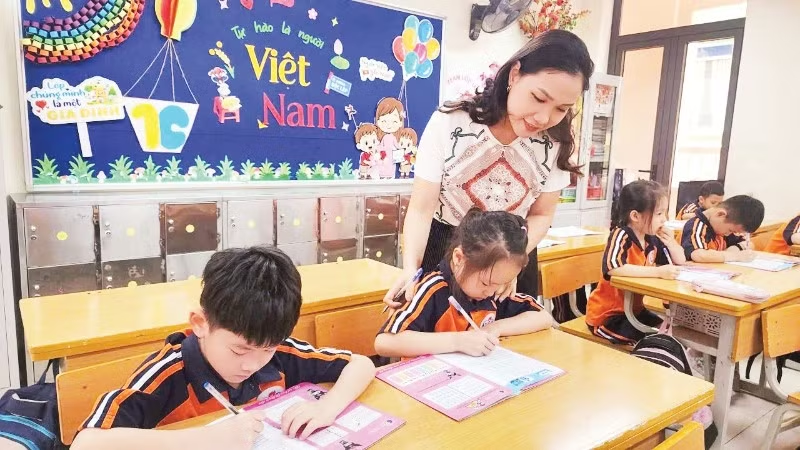
The enrollment process for preschool, first grade, and sixth grade in major provinces and cities is being implemented in a way that facilitates learning and reduces pressure on students. While there have been many improvements with the implementation of these enrollment solutions, to address the "bottleneck" regarding quality, schools need to innovate teaching methods and improve facilities to enhance quality and build trust among parents.
Instead of admitting students based on their household registration, the admissions process will focus on online applications based on the student's actual place of residence. This is considered an important solution to overcome the problem of students living in one place but studying in another…
Quality or distance?
The issue of primary school enrollment, the problem of choosing schools and classes leading to overcrowding in central schools in recent years, has always attracted public attention. The question is whether this situation is due to a shortage of schools and classrooms or the uneven quality of schools.
In a discussion with us about the enrollment process for the 2026-2027 school year, the Principal of Thang Long Primary School ( Hanoi ) stated that in recent years, parents' mindset when choosing a school for their children has tended to prioritize quality over distance.
According to the new regulations, when admitting students, the school prioritizes Group 1, which includes students who actually live near the school; Group 2 includes students whose parents work at agencies within the ward, if there are still available slots. The advantage of this year's admissions is that students can study near home and even have the right to choose their preferred school.
This makes it convenient for parents to drop off and pick up their children. However, enrollment based on residence also poses challenges for schools. In reality, forecasting enrollment targets at the beginning of the school year is more difficult because there are no longer fixed zoning lists from the wards as before. Schools are forced to conduct their own surveys to estimate the number of students in order to assign teachers and prepare the necessary facilities. On the other hand, schools must proactively visit preschools in the area to collect data because many children have household registration but do not live in the locality, and vice versa.
In Ho Chi Minh City, the registration process for primary and secondary school enrollment is conducted entirely online. The allocation of school places is flexible, based on coordination between the Department of Education and Training and the People's Committees at the commune level, taking into account three factors: the local and adjacent school network, the number of children in the age group, and the actual distance. Importantly, a digital mapping system is used to accurately determine the distance from residence to school, aiming to create the most convenient conditions for students to attend school near their homes.
According to education experts, the overcrowding in some schools in recent years is due to several reasons. However, the main reason is the uneven quality of education among schools, which leads parents to seek out prestigious schools at all costs.
To reduce the pressure of primary school enrollment, Hanoi, as well as other localities, need a roadmap to improve the quality of schools uniformly, especially in densely populated areas with rapid urbanization.

Dr. Hoang Ngoc Vinh, former Director of Professional Education Department (Ministry of Education and Training)
Dr. Hoang Ngoc Vinh, former Director of Professional Education (Ministry of Education and Training), believes that to reduce the pressure of primary school enrollment, Hanoi and other localities need a roadmap to improve the quality of schools uniformly, especially in densely populated areas with rapid urbanization. Schools near home should be places where parents can confidently send their children, with minimum facilities, safe boarding options, and diverse educational activities. If quality is not improved, parents will still seek out "prestigious" schools, even if it means traveling further or incurring additional costs. Therefore, priority should be given to investing in schools that are still weak, rather than spreading investment unevenly across all levels. Only by reducing the disparity in quality can the mentality of "school hopping" be reduced. Furthermore, since parents choose schools primarily based on trust, schools need to publicly disclose practical information such as class size, teaching staff, learning conditions, safety levels, student support activities, and student progress. We shouldn't just publish achievements or exam scores, as that approach easily fosters a preference for "top-performing schools."
Notably, strong schools have a responsibility to share experiences, support core teachers, rotate teachers and administrators appropriately, replicate good models, organize professional development activities, model lessons, and extracurricular activities with disadvantaged schools in the same area. When schools share and learn from each other, it helps improve the quality and standing of weaker schools. The quality of education must be improved through targeted investment, better governance, and the genuine dissemination of capabilities among schools.
Learner-centered approach
Hanoi's enrollment process for the 2026-2027 school year will be conducted online, integrating GIS mapping. Preschools, primary schools, and junior high schools will conduct online enrollment from July 4th to 9th.
The 10th grade admissions process has also been adjusted, as this is the first year students can register for three preferences at any three public high schools, regardless of their enrollment area as in previous years, to facilitate and increase their chances of admission.
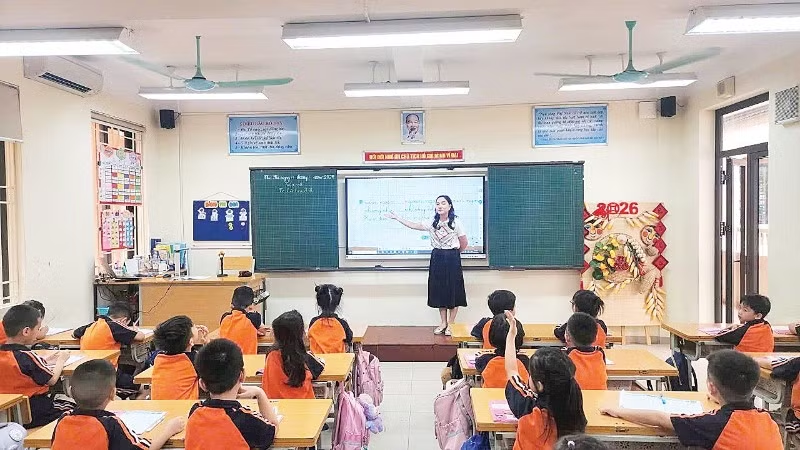
According to Nguyen Van Hien, Director of the Hanoi Department of Education and Training, the 2026-2027 school year will see the implementation of a new enrollment and management model that is student-centered and prioritizes students studying in their place of residence. This new approach may give rise to specific situations, but it will ensure the best interests of students are protected.
However, schools must conduct admissions in accordance with regulations, without conducting surveys or entrance exams for first grade, and without collecting any fees outside of the regulations. Schools with a number of applications exceeding the quota must report to the Department of Education and Training to ensure reasonable allocation and prevent the concentration of applications in a few schools, which could cause overcrowding.
Faced with the difficulties of insufficient school places, Hanoi has prioritized allocating budget for the construction of new schools, while simultaneously renovating and repairing dilapidated schools and classrooms that do not meet the learning requirements and needs of students. Along with the public school system, Hanoi also supports the construction and improvement of the quality of private schools to increase educational opportunities for students.
According to Vice Chairman of the Ho Chi Minh City People's Committee Tran Thi Dieu Thuy, the city is currently preparing adequate facilities and equipment to meet the learning needs of students; prioritizing school places for children from policy beneficiary families, poor families, workers, and orphans. The local authorities are strengthening propaganda, guidance, and encouragement for students to register for the 10th grade entrance exam based on their abilities, prioritizing schools near their current residences to ensure convenience in their studies and to implement the city's policy of reducing traffic congestion.
The disparity in quality between high schools is the main reason for the pressure in the admissions process.

In reality, the disparity in quality between high schools is the main reason for the pressure on enrollment. The ultimate goal of the 2018 general education program is to develop students' competencies and qualities. A crucial factor in improving quality is to continue innovating teaching methods, applying advanced teaching models, and organizing two-session-per-day teaching...
Minister of Education and Training Hoang Minh Son stated that in the coming period, localities need to complete the network of educational facilities at all levels, increasing investment in infrastructure, from classrooms to laboratories. This is an urgent requirement and a prerequisite for expanding opportunities to access quality education. Only when the network of schools and classrooms is rationally and conveniently arranged for learners can the quality of education be improved. At the same time, it is necessary to continue developing the teaching staff in conjunction with curriculum reform. To achieve this, the teaching staff plays a decisive role, not only ensuring sufficient numbers but also developing their capacity in implementing the curriculum, innovating teaching methods, and putting learners at the center…
(To be continued)
Source: https://nhandan.vn/bai-1-go-nut-that-ve-chat-luong-post966827.html


















![[Video] The 14th Congress of the Vietnam Trade Union elects 135 members to the new Executive Committee.](https://vphoto.vietnam.vn/thumb/402x226/vietnam/resource/IMAGE/2026/06/04/1780588098789_cong-doan-jpg.webp)
![[Video] General Secretary and President To Lam: Building the nation's capacity for self-reliance, creativity, and adaptability.](https://vphoto.vietnam.vn/thumb/402x226/vietnam/resource/IMAGE/2026/06/04/1780587795932_tbt-jpg.webp)

![[Video] Vietnam strictly prohibits all forms of forced labor.](https://vphoto.vietnam.vn/thumb/402x226/vietnam/resource/IMAGE/2026/06/04/1780586602223_bng-jpg.webp)




























![[Video] Sunset at Lap An Lagoon – Where the sun sets over the fishing nets](https://vphoto.vietnam.vn/thumb/1200x675/vietnam/resource/IMAGE/2026/05/31/1780192137701_beach-landscape-sea-water-nature-grass-745871-pxhere-com.jpeg)

































Comment (0)