Praising and distorting resolutions and illusions.
On the afternoon of June 16, 2026, after days of loitering outside the European Parliament and posting numerous articles and videos accusing the group led by Le Trung Khoa and Nguyen Van Dai of "transnational repression," they appeared extremely gleeful, claiming that the resolution against transnational repression, including that against Vietnam, had been adopted by the European Parliament. They even listed the number of votes in favor, against, and abstentions, then declared, "We have successfully lobbied."
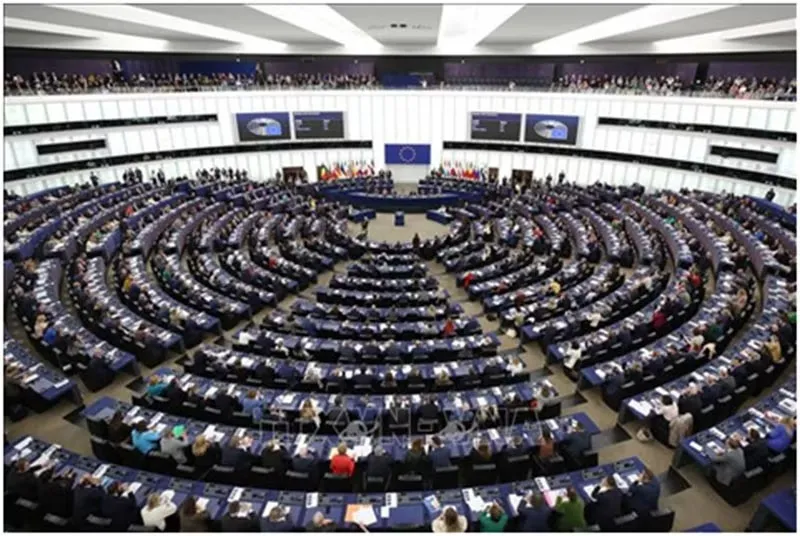
A panoramic view of the European Parliament session on June 16, 2026.
Immediately, Dai, Khoa, and other exiled reactionary groups, who were seeking support from international organizations, unanimously published articles and released celebratory videos. Nguyen Van Dai boasted that the report clearly pointed out the transnational repressive actions of four countries: China, Iran, Russia, and Vietnam. These actions included surveillance, threats, kidnapping, harassment, and other forms of coercion aimed at "silencing dissenting voices, human rights activists, refugees, and their communities living in Europe and around the world ."
From there, the media self-satisfiedly considered the European Parliament to have sent a strong message defending freedom and human rights , praising it as "a significant milestone in the struggle for democracy and human rights," "despite facing pressure from many sides, the MEPs have chosen to stand on the side of justice," and "today's decision is a beacon of hope for all those who cherish freedom!"
Adding fuel to the fire, a series of comments from subversive and disgruntled elements also endorsed the information, especially within the Brotherhood of Democracy group of Taiwan, and anti-government websites like Viet Tan and Patriotic Diary... Many comments suggested that it was time for the European Parliament and international organizations to take stronger action and pay more attention to the human rights issue in Vietnam.
Notably, in many of the clips, the perpetrators name several Party and State leaders, falsely accuse the regime of one-party rule and police rule, distort policies, and cite "transnational repression and arrests." Images of Party and State leaders are manipulated and accompanied by malicious comments to mock, slander, and create a distorted view on social media.
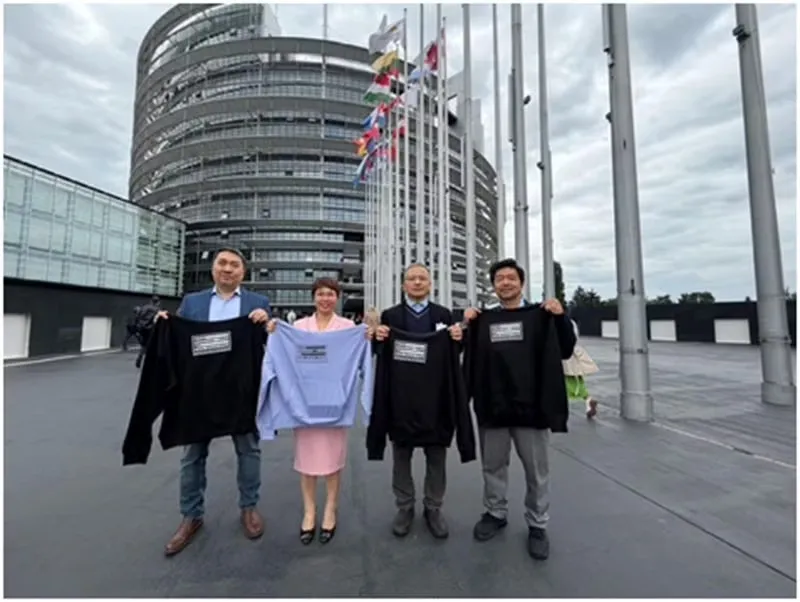
People are taking selfies in front of the European Parliament.
The European Parliament's adoption of Resolution A10-0142/2026 on Transnational Repression (TNR) on June 16, 2026, quickly became a topic of interest in international political , media, and human rights forums. Our research indicates that in some countries mentioned in the resolution, this type of document is considered biased, inaccurate, an overexpansion of human rights discourse, and potentially exploited as a tool for political pressure. Conversely, for subversive and reactionary elements in exile, it is seen as a milestone and a point of support.
The persistent lurking outside the European Parliament, spreading distorted and fabricated information, and creating a sensation on social media, followed by the shouts of "lifeline" when news of the Parliament's resolution is released, reveals the desperation of these exiled anti-government elements. Without knowing the meaning, nature, or effectiveness of the resolution, they treat it as a "drop of milk" for those who have been starving for it for so long.
Understanding European Parliament Resolutions Correctly

Le Trung Khoa has been continuously posting videos accusing "transnational oppression."
To objectively assess the significance of Resolution A10-0142/2026, it is first necessary to place it within the institutional context of the European Union. Research shows that, unlike national laws, the European Parliament is not the only body with the power to decide on foreign policy or impose international sanctions.



Within the EU's power structure, Parliament acts as the representative body of the people, participating in legislation alongside the European Council and overseeing the activities of the European Commission. Parliamentary resolutions, in most cases, are more political and policy-oriented than creating direct legal obligations. Therefore, the first thing to understand is that a resolution is not a legally binding document with enforceable force on non-EU countries.
The resolution does not automatically create sanctions, nor does it give rise to any legal obligations for Vietnam or any other country, nor does it mean that the EU has officially concluded that a country has violated international law. This document primarily reflects the political views of the European Parliament members on the concept of “transnational repression” (TNR) and proposes courses of action that the EU should consider in the future.
From a substantive standpoint, the resolution is based on numerous unreliable reports that suggest transnational repression is becoming an increasingly serious challenge to Western democracies. The report by the Committee on Foreign Relations (AFET), presented by MP Hannah Neumann, argues that many governments around the world are seeking to extend their influence over “dissidents, exiled journalists, human rights activists, or opposition groups living outside their national territories.”
According to the report, these actions could include digital surveillance, pressuring relatives in the country, abuse of international extradition mechanisms, use of social media influence campaigns, or other similar behaviors.
Notably, the resolution not only addresses a specific country but also establishes a general framework for dealing with the TNR phenomenon globally. In the discussion sections and related annexes, many countries are mentioned to varying degrees, including China, Russia, Iran, Belarus, Rwanda, Turkey, and several others. Overseas anti-government groups have exploited this issue to engage in lobbying, publish slanderous and distorted reports, and attempt to influence the views of members of Parliament.
However, it should be noted that the mention of a country in the resolution does not mean that country becomes the central focus of the entire document. In fact, much of Resolution A10-0142/2026 focuses on building an internal coordination mechanism within the EU. The Parliament calls for the establishment of a coordinating focal point on TNR at the Union level, enhanced information sharing between law enforcement agencies, improved investigative capacity, victim support, and the rectification of legal gaps in the current system. The resolution also proposes that the EU study the possibility of applying restrictive measures to individuals suspected of being involved in TNR in specific and substantiated cases.
From an international legal perspective, advocacy organizations seek to interpret the resolution as a form of “official condemnation” or “conclusion of violation” against the named countries. However, in reality, the resolution is not a judicial judgment, not the result of an independent investigation according to international procedural standards, nor a decision of an international judicial body. The conclusions in the resolution are primarily based on reports, hearings, information from “civil society” organizations, and the political assessments of participating parliamentarians.
Therefore, this document can only be used as a basis for reference in human rights dialogues between the EU and Vietnam, in discussions related to foreign policy, trade, or security cooperation. It should be noted that the adoption of the resolution does not immediately change existing international commitments between Vietnam and the EU, nor does it automatically lead to specific sanctions.
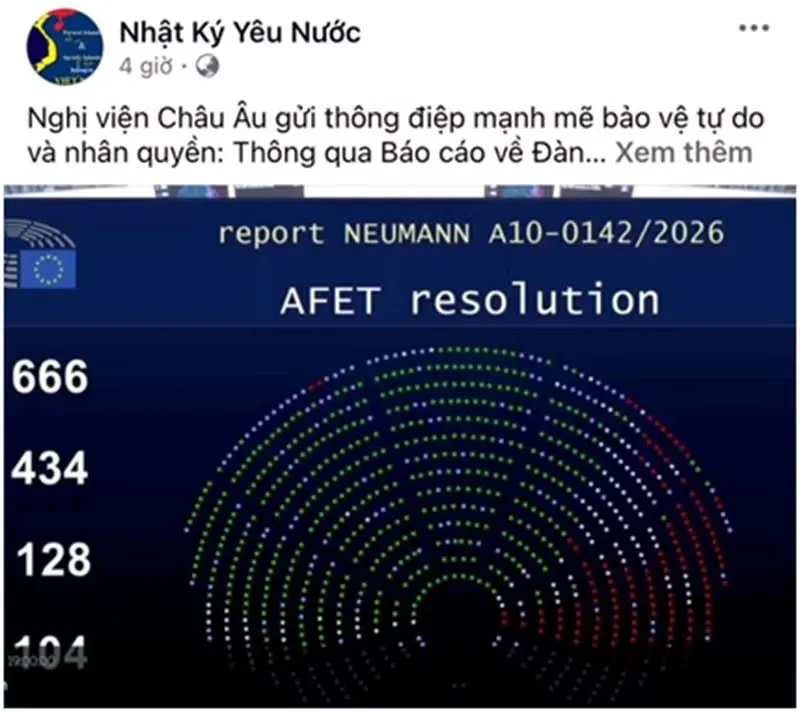
Information about the European Parliament's resolution has been widely circulated online by exile groups and organizations.
Protecting and promoting human rights is a consistent policy of Vietnam.
However, regardless of the impact, when an international organization like the European Parliament makes inaccurate assessments and judgments about human rights in its resolutions, it will negatively affect Vietnam. Regarding this issue, over the years, the Vietnamese Ministry of Foreign Affairs and relevant agencies have held working sessions, emphasizing Vietnam's commitment to the partnership and its desire to strengthen exchanges to help the European Parliament obtain complete and objective information and better understand the actual situation regarding the promotion and protection of human rights in Vietnam.
The spokesperson for the Vietnamese Ministry of Foreign Affairs has repeatedly affirmed that protecting and promoting human rights is a consistent policy of the Vietnamese State. Vietnam always considers people as the center and driving force of the reform process and national development, always striving to improve the lives and rights of its people, ensuring that no one is left behind.
In Vietnam, all people are equal before the law and have an obligation to abide by its regulations. Any violation of the law, by anyone and for any reason, must be prosecuted to ensure the strict enforcement of the law and to guarantee the full enjoyment of the rights and freedoms of every citizen in a safe, orderly, and just society. No one shall be arrested or prosecuted for legitimately exercising their human rights. Vietnam values its cooperative relationship with the European Union and is ready to engage in constructive discussions on human rights to enhance mutual understanding.
The two sides also have an annual human rights dialogue mechanism to exchange views on issues of mutual interest. Strengthening exchanges and dialogue through existing mechanisms will help the European Parliament have more objective information and a better understanding of the actual situation regarding the promotion and protection of human rights in Vietnam, thereby further promoting bilateral relations.
Leave no gaps in crime handling.



Article 6 of the 2015 Penal Code stipulates that Vietnamese citizens who commit crimes outside the territory of the Socialist Republic of Vietnam may be prosecuted in Vietnam under this Code. The handling of crimes committed abroad also requires the implementation of mutual legal assistance agreements on criminal matters between Vietnam and the host country. Furthermore, Article 491 of the Criminal Procedure Code stipulates that international cooperation in criminal proceedings is the coordination and mutual support between competent authorities of Vietnam and competent authorities of foreign countries to carry out activities serving the requirements of investigation, prosecution, trial, and execution of criminal sentences.
International cooperation in criminal proceedings includes mutual legal assistance in criminal matters, extradition, reception and transfer of persons serving prison sentences, and other international cooperation activities as stipulated in this Code, the law on mutual legal assistance, and international treaties to which Vietnam is a party.
International cooperation in criminal proceedings is conducted on the principles of respect for national independence, sovereignty, and territorial integrity; non-interference in each other's internal affairs; equality and mutual benefit; and in accordance with the Constitution and laws of Vietnam and international treaties to which Vietnam is a party. In cases where Vietnam has not signed or acceded to a relevant international treaty, international cooperation in criminal proceedings shall be conducted on the principle of reciprocity, but without violating Vietnamese law, and in accordance with international law and international customs.
Thus, in the case of Nguyen Van Dai and Le Trung Khoa, although the perpetrators committed the acts outside the territory of Vietnam, there is sufficient basis for the prosecuting authorities to pursue criminal responsibility in Vietnam according to the Penal Code. Currently, the Hanoi City People's Court has handed down a 17-year prison sentence for each defendant, and both are subject to an international arrest warrant.
Therefore, it is unacceptable to deceptively portray convicted and wanted criminals as "victims of transnational oppression," using this as leverage to pressure the European Parliament and international organizations in order to create a veneer of human rights and democracy to conceal their dangerous criminal nature.
(To be continued)
Minh Dang
Source: https://baocantho.com.vn/bai-4-khong-the-danh-trao-ban-chat-a207464.html