

The muddy rivers flow into the sea.
Standing on the banks of the Hieu River, in the section flowing through the Dong Ha market area ( Quang Tri province ), it's easy to spot small streams of water winding through drainage ditches, carrying dirt and debris from trading activities. Rows of seafood, poultry, and vegetables displayed along the river's edge create a familiar rhythm of life, but also serve as the starting point for these silent flows. There are no large drainage pipes or massive sewage streams. But when it rains, all the surface water from the market and surrounding roads overflows, carrying garbage and organic waste directly into the river, making the water murky and foul-smelling.
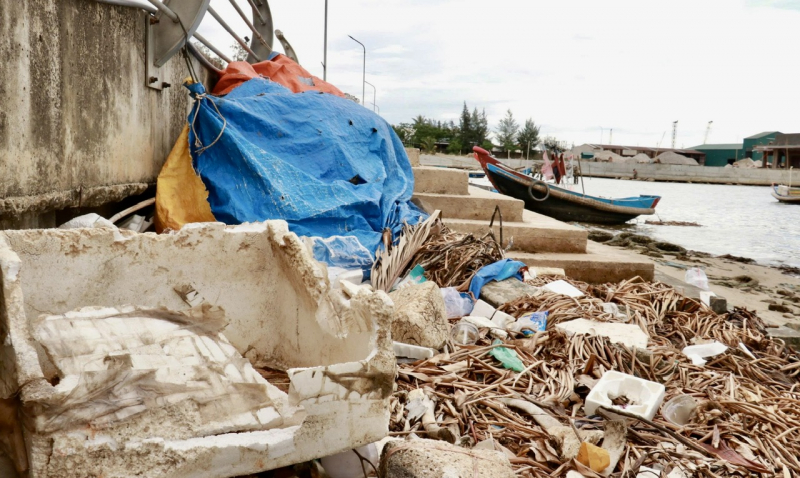
A reporter from the CAND newspaper followed the Hieu River downstream, passing through residential areas and production zones before flowing into the sea in Cua Viet commune. The further downstream, the more evident the signs of pollution became. In the villages of Xuan Ngoc, Xuan Tien, Xuan Loc, Long Ha, and Dai Loc in Cua Viet commune, the fish steaming and drying industry has existed for many years, providing livelihoods for hundreds of households. However, most production facilities are interspersed within residential areas, many close to the riverbank, leading to a series of environmental problems.
Along the small roads leading into the village, the smell of sewage permeates the air, clinging to every rooftop. Behind the processing facilities, wastewater from the fish washing process – including fish washing water, boiling water, and residue – is discharged directly into the drainage system without treatment, flowing into the river and then into the sea. For facilities located close to the riverbank, the wastewater is almost directly discharged into the river.
Ms. Le Thi Lan, a resident of Dai Loc village, said: "The fish steaming facility next to my house has been operating for many years. Every time they operate, the wastewater discharged into the ditch emits a very unpleasant odor and flows directly into the river. At peak times, they operate day and night, which is unbearable."
In Xuan Tien village, Mr. Nguyen Van Dung stated that whenever the steaming facilities operate, the wastewater discharged into the ditch turns black, then flows into the river and the sea. "Even on days when the tide is low, standing at the river mouth, you can still see the water is murky, and the smell is very unpleasant," Mr. Dung said.
Mr. Nguyen Xuan Phuong, Vice Chairman of the People's Committee of Cua Viet commune, said that the commune currently has about 47 fish steaming and drying facilities. The government has encouraged these facilities to build settling tanks to minimize pollution, but the effectiveness is still limited. To address the issue fundamentally, the commune is investing in the Cua Viet seafood processing zone, covering about 20 hectares, with a total infrastructure investment of about 80 billion VND, and an additional 20 billion VND is planned to complete the electricity and water systems. When the project is completed, the facilities will be relocated out of residential areas; the goal is to prioritize the relocation of small-scale households first in 2026.
Leaving Cua Viet, we traveled upstream along the Sa Lung River, a nearly 60km-long tributary that flows through many villages and rice paddies before merging with the Ben Hai River and then into the sea. Here, the locals don't need monitoring indicators to detect pollution; they can see it with their eyes and smell it with their noses.
“Every time it rains heavily, looking down at the river reveals two distinct colors of water. One side is a muddy red due to soil from upstream, and the other is pitch black due to untreated industrial wastewater,” said Mr. Le Vinh Thai, who lives along the river section passing through Tan Lap village, Vinh Linh commune. According to residents, the pollution in the rivers passing through the area has been ongoing. Previously, police conducted a surprise inspection of environmental protection compliance at Bac Trung Bo Joint Stock Company, located in Tan Lap village, and discovered that the company was discharging all its untreated industrial wastewater into the Bao Dai canal next to the factory, which then flows into the Sa Lung river.
In another part of Central Vietnam, at Nhat Le beach in Dong Hoi ward (Quang Tri province), the pollution problem is even more apparent.
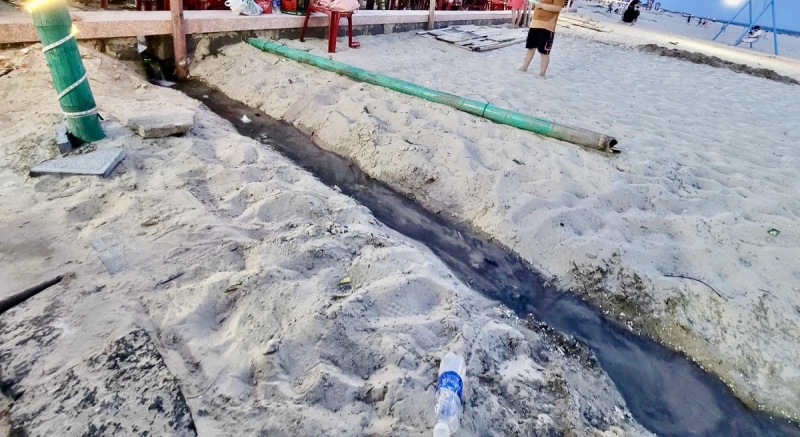
Along the seawall on Truong Phap Street, opposite the Poseido Hotel, about 700 to 800 meters from the central Nhat Le beach, a stream of black wastewater is flowing directly into the sea. The foul odor permeates the surrounding area, and can be clearly felt even from dozens of meters away.
Mr. Tran Minh Chien, owner of the Bermuda homestay in the area, said: “Since the end of 2024, when the seawall broke, wastewater started leaking out. We have tried to seal it many times, but it only worked for a few days. Recently, many guests have checked out because they couldn't stand the smell.” Not only are businesses affected, but tourists are also apprehensive. Ms. Ngo Thi Dieu Thu, a resident of Bo Trach commune, shared: “Going to the beach and smelling so foul makes it impossible to swim.” Mr. Tran Dinh Chien, a tourist from Vinh Long province, simply stated: “Looking at it, no one dares to go into the water anymore.”
According to Ms. Doan Thi Hong Phuong, Deputy Director of the Dong Hoi Public Service Management Board, the cause is that some businesses have arbitrarily connected their domestic wastewater systems to the rainwater drainage system of the seawall. When the system becomes clogged, wastewater and garbage accumulate and flow directly into the sea, causing environmental pollution and affecting the aesthetics of tourism .
Black water at the foot of the seaside city
In Da Nang – home to many beaches once hailed by international media as among the most beautiful on the planet – the pressure on the marine environment is also evident in ways not easily seen from the crowded beaches.
In the middle of summer, at the end of the Phu Loc canal where it flows into Da Nang Bay, along Thanh Binh beach in Thanh Khe ward, a thick, black stream of water seeps through the sandbars before flowing straight into the sea. The foul smell is most noticeable at low tide. Many tourists walking along the beach simply stand and watch before silently turning away.
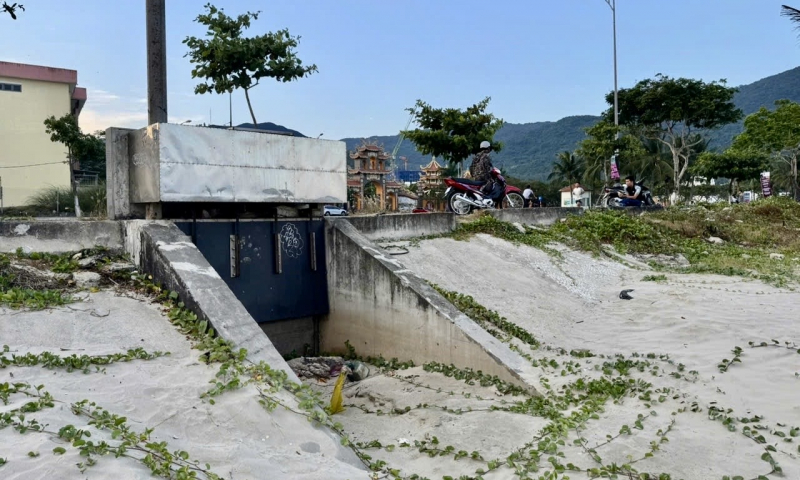
That scene was a complete contrast to the hustle and bustle of My Khe or Pham Van Dong beaches just a few kilometers away – where thousands of people crowded into the sea every summer afternoon. On one side, there was the blue sea, white sand, music, and long lines of people under the sun. On the other side, there was the dark water, foam floating on the surface, and a foul, fishy smell carried on the sea breeze.
According to observations by reporters from the People's Police Newspaper, for several days now, most of the width of the Phu Loc river mouth has been filled with sand. Water from upstream now only flows through a narrow channel between sandbars blocking the estuary. At the foot of the Phu Loc bridge on Nguyen Tat Thanh street, sand has accumulated into large mounds, in some places wider than a bridge span. The water inside the river mouth is almost stagnant, turning a dark, murky color.
Long-time residents of the Thanh Khe area say this situation has persisted for many years and is showing signs of worsening. In the late afternoon, when the heat is prolonged and the tide is low, the water almost stagnates, turning a dark black color, and a foul, fishy smell spreads far and wide with the sea breeze.
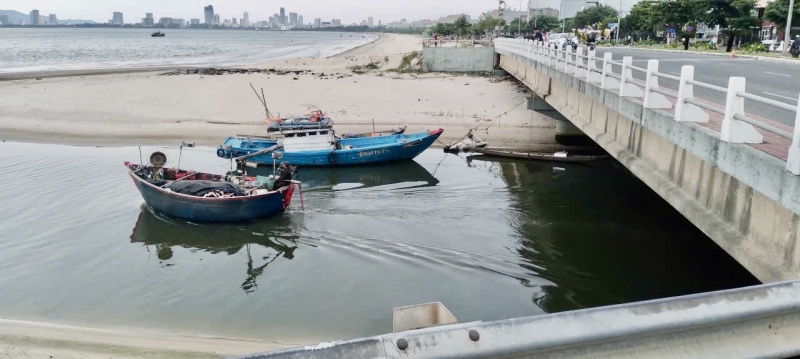
Mr. Nguyen Van Tan, a local resident, said that more than 10 years ago, the city invested in a system of stone embankments to block waves and regulate the river mouth's flow to prevent siltation and ensure drainage to the sea. The project was effective in the beginning. However, in recent years, sand has continued to accumulate heavily, significantly narrowing the waterway. "Besides environmental pollution, what residents worry about most is the risk of flooding when the rainy season comes. If the water doesn't drain quickly enough, the residential areas further inland will be very easily affected," Mr. Tan said.
According to Associate Professor Tran Van Quang, lecturer at the Faculty of Environment, Danang University of Technology, Danang University, the stagnation and accumulation of organic sediment in the Phu Loc estuary area causes the water to easily develop a foul odor during prolonged hot weather. When heavy rains occur, the sediment, organic matter, and accumulated water are washed directly into the sea. However, after only a few days, when the flow becomes again silted up and stagnant, the pollution recurs.
According to Mr. Quang, theoretically, a thorough solution requires simultaneously collecting domestic wastewater from upstream, dredging silt deposits at the river mouth to improve flow, and implementing long-term solutions to prevent siltation. However, practical implementation is not simple due to the significant infrastructure, management, and investment required.
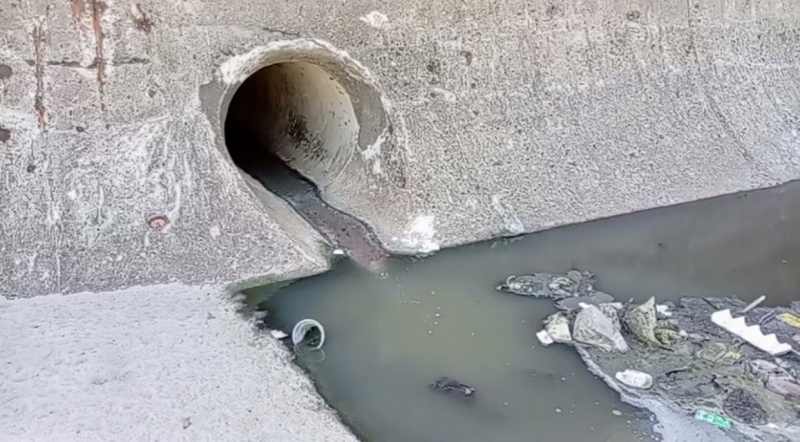
Not only in Da Nang, but in many other coastal cities along Central Vietnam, the problem of wastewater and garbage flowing into the sea through underground sewers remains a difficult challenge.
In Khanh Hoa province, the discharge of wastewater and waste into Nha Trang Bay through the stormwater drainage system has been a long-standing concern. Despite continuous efforts by local authorities and relevant agencies to address the issue, the problem persists.
Following complaints from residents, on March 12, 2026, the People's Committee of Bac Nha Trang Ward, in coordination with the Nha Trang Wastewater Treatment Plant Management Board, inspected the park area north of Tran Phu Bridge. At the site, the task force observed wastewater and garbage flowing from the stormwater drainage pipes in the Pham Van Dong, Thap Ba, and Ton That Tung areas, seeping into the beach. The wastewater emitted a foul odor, and a large amount of garbage accumulated around the discharge points, causing environmental pollution and negatively impacting urban aesthetics.
Notably, at one rainwater collection pit, inspectors discovered unauthorized connections of domestic wastewater pipes to the rainwater drainage system, causing wastewater to flow directly into the sea through the sewer lines.
According to a report by the Nha Trang Bay Management Board, wastewater and garbage from the market and riverside residential areas in the downstream Kim Bong River continue to accumulate. At the drainage culvert on the north bank of the Quan Truong River near Binh Tan Bridge, the wastewater turns black and emits a foul odor before flowing into the sea. Monitoring results from the Cai River, the Tac River estuary, and several coastal areas of Nha Trang show that many environmental parameters exceed permissible standards. Notably, the levels of mercury and phosphorus in the Vinh Luong fishing port area exceed regulations.
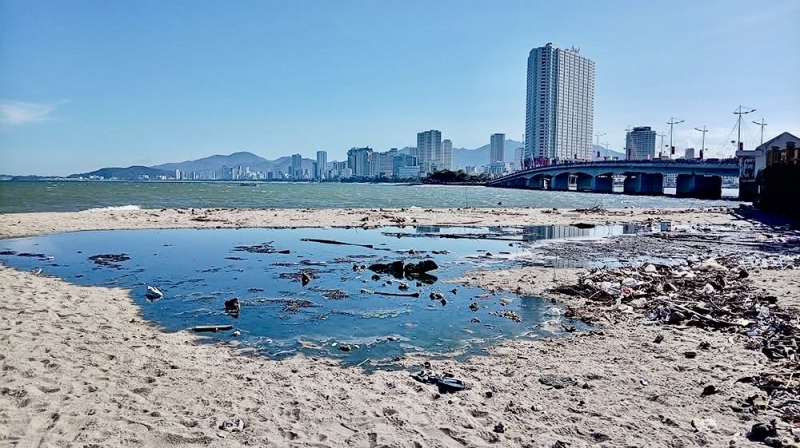
Environmental pressure is not limited to the mainland; islands in Nha Trang Bay such as Tri Nguyen and Bich Dam, home to thousands of residents, still experience significant domestic wastewater flowing directly into the sea through the rainwater drainage system.
Alarmingly, following an inspection in mid-March 2026, by the end of April 2026, the discharge of wastewater and waste into the sea continued to recur at several outlets in the area north of Tran Phu Bridge and Hon Mot Island…
Traveling through various points along Central Vietnam, from riverside markets and seafood processing villages to inland rivers and tourist beaches, one thing becomes clear: pollution doesn't originate from a single source. It's a complex web of overlapping layers – from daily life, small-scale production, industry, and tourism services. All of these flow through different channels, but ultimately converge on the sea.
Source: https://cand.com.vn/Xa-hoi/bai-i-bien-bi-buc-tu-i804727/


















































































Comment (0)