


However, amidst this change, there are still fishermen who steadfastly cling to their profession. They go out to sea year-round, fishing near the shore and in offshore areas, even during the "northern monsoon" season – the time of year when the sea is roughest and risks are highest. For them, going out to sea is not just about making a living, but also about preserving the fishing profession and the way of life that has been intertwined with the fishing village for generations.
As the morning mist still lingered, the fishermen of Trung Giang quietly went ashore, pushing their boats together through the waves, beginning a new fishing trip. As soon as the boats left the sand, they rocked precariously against the large waves of the monsoon season.
Fisherman Phan Huu Kiem (54 years old) spoke slowly, his voice mingled with the sound of the waves: "I know it's dangerous, but the rough seas are the only time of year when there are fish. If we don't go out, we won't have any income, but if we go out, we have to accept the risks." For him and many other fishermen, the days of rough seas are also when the sea is most generous, bringing in fish like the spotted grouper, sweet potato fish, and barracuda – species that only appear when the sea is rough and fetch higher prices than usual.
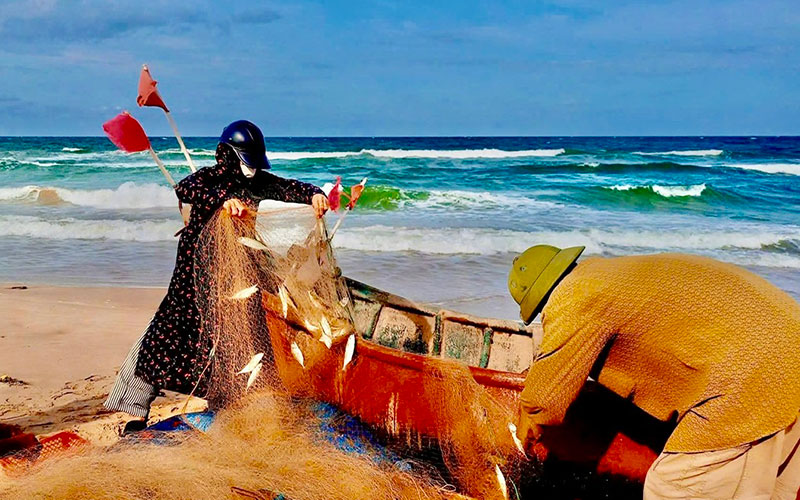
The monsoon season in Trung Giang usually begins around the tenth lunar month, when the first northeast monsoon winds arrive. The sea is no longer as calm as in the previous months; large waves rise continuously, day and night, accompanied by drizzle and a biting cold. During this season, fishermen mainly go out to sea in small boats. Their familiar fishing gear is the nylon net – a type of net that has been associated with coastal fishing in Trung Giang for generations. Each boat usually has two to three people; larger boats have three to four workers, mostly brothers and family members.
We waited until nearly noon and saw fisherman Phan Huu Kiem's small boat begin to approach the shore. As soon as the boat docked, Mrs. Binh – his wife – rushed to the water's edge. Seeing the boat's hold full of fish, a smile quickly appeared on her face. Having gone out to sea at 6 a.m., Mr. Kiem's boat had caught over 15 kg of fish this trip, mainly early-season scad and mackerel, earning between 3 and 4 million dong.
From early morning, when we arrived at Trung Giang beach, the sea was already rough. Waves offshore crashed relentlessly, white foams pounding the shore. On the beach, many people stood silently gazing out at the sea, their eyes following the small boats that had already left the shore, including the boat of fisherman Phan Huu Kiem. They were the wives, children, relatives, and neighbors of the fishermen making a living amidst the stormy seas.
Throughout the morning, whenever a boat emerged or was seen returning, the beach grew more crowded. Some were pulling in the ropes, others were preparing to support the boat's bow, and still others were waiting to help pull in the nets and unload the fish. Near noon, as Mr. Kiem's boat and several others began to approach the shore, all eyes on the beach seemed to turn in the same direction. The sea was still rough, but on shore, the waiting and sharing had become a familiar routine for the fishermen of Trung Giang.
Once the boat was pushed ashore, a safe distance from the water's edge, everyone began unloading. The nets were pulled out from the hold and spread out on the beach. Caught fish were visible in clumps, their silver sheen blending with the brown netting. As the fish were unloaded, they were sorted on the spot: scad on one side, mackerel on the other, large and small separated. After sorting, the fish were put into plastic containers and sold to traders waiting on the beach or taken home. Behind them, the waves offshore continued to ripple steadily, repeating throughout the monsoon season. Not far from fisherman Phan Huu Kiem's boat was Mr. Phan Ho Bo's, which had just been pulled ashore. The cold wind lashed fiercely, and the waves offshore were still turbulent, but Mr. Bo said the fatigue seemed to dissipate after the recent successful catches of scad. "The waves are very big, it's very cold, but we've caught a lot of fish, so everyone is in high spirits," he said.
According to local fishermen, the monsoon season is when fish congregate in the offshore and nearshore areas. Species like stingrays, scad, and barramundi are not only delicious but also command high prices. Stingrays can sometimes fetch nearly one million dong per kilogram, while scad sell for over 200,000 dong per kilogram at the beginning of the season. Seafood caught fresh on the same day is bought directly from the beach by traders, resulting in significantly higher value compared to other times of the year.
However, along with the bounty of the sea comes ever-present danger. The Trung Giang coastline is only about 3km long, but over the years, there have been numerous boat capsizing incidents during the stormy season. Smaller boats are particularly vulnerable to the towering waves. Tran Van Nam, a fisherman in Trung Giang, said that while fishing during this season yields a decent income, the risks are very high. At the beginning of October this year (lunar calendar), after half a day of fishing, his boat was returning to shore when it encountered large waves. The boat was repeatedly unable to get close to the shore. When it was about 50 meters from the shore, a sudden large wave struck, sinking the boat. Fortunately, people waiting on shore quickly threw ropes to rescue the crew, bringing them safely ashore.
According to Mr. Nam, the most dangerous part isn't fishing offshore, but rather the time spent bringing the boat out to and from shore. On stormy days, the waves near the shore can sometimes reach over 2 meters in height, surging and changing direction constantly, making them very unpredictable. Just one small mistake and the boat could be capsized. Therefore, fishermen who stay at sea during the monsoon season are usually middle-aged, experienced, and healthy enough to face the rough seas.
According to Mr. Tran Van Cuong, Head of the Economic Department of Ben Hai Commune, the entire commune currently has more than 200 medium and small-sized fishing boats operating in the mid-shore and near-shore areas. During the stormy season, many fishermen, especially in the Trung Giang coastal area, still take advantage of the opportunity to go out to sea because this is the time when specialty fish are abundant, providing high income. However, the local authorities, along with the police and border guards, always advise people to closely monitor weather developments and avoid going out to sea on days with high waves to ensure their safety.
Source: https://cand.com.vn/Xa-hoi/bam-bien-giua-mua-gio-chuong-i792139/






















![[Photo] Head of the Central Propaganda and Mass Mobilization Department visits and congratulates the Ministry of Health and the Military Traditional Medicine Institute.](https://vphoto.vietnam.vn/thumb/1200x675/vietnam/resource/IMAGE/2026/02/24/1771938483290_img-2682-3562-jpg.webp)































![[Image] National Conference on studying, understanding, and implementing Resolutions No. 79 and No. 80 of the Politburo](https://vphoto.vietnam.vn/thumb/402x226/vietnam/resource/IMAGE/2026/02/25/1771990845625_anh-man-hinh-2026-02-25-luc-10-40-34.png)

































Comment (0)