

1. Australia's unemployment rate fell to 4.1%.

Illustrative image
According to the latest data from the Australian Bureau of Statistics, the annual unemployment rate fell from 4.3% to 4.1% in December 2025, the lowest level in seven months and below the Reserve Bank of Australia's forecast (4.4%). The number of employed people reached approximately 14.7 million, an increase of over 165,000 (+1.1%) compared to the same period in 2024; the number of unemployed people was over 628,000, an increase of 25,400, equivalent to a 4.2% increase compared to the same period in 2024. The decrease in the unemployment rate is attributed to the increase in the number of young people entering the labor market.
In addition, economists predict that interest rates will not rise. However, some economists who support tighter monetary policy argue that the central bank should raise interest rates to cool down an economy operating at or near maximum capacity, an argument further strengthened by better-than-expected employment data.
2. The Australian dollar reached its highest level in 15 months.
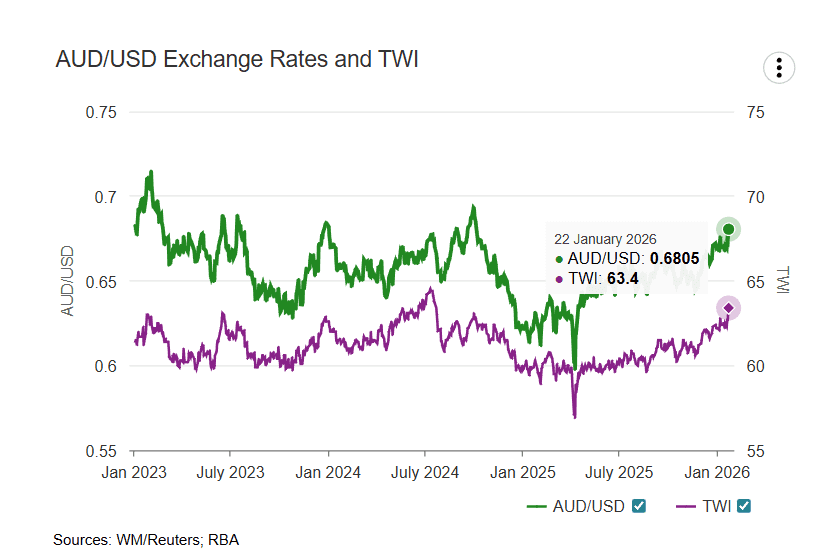
Chart showing the AUD/USD exchange rate over time.
On Thursday, January 22, 2025, the Australian dollar rose 0.4%, reaching a peak of $0.6805. This is the highest level for the Australian currency against the US dollar in the past 15 months, marking an impressive 13% increase from the 0.60 level at the beginning of 2025. The reasons for the Australian dollar's rise include: easing tensions between the US and Europe, which relieved pressure on financial markets; positive employment data indicating the stability of the Australian economy; and the depreciation of the USD against other major currencies worldwide , including the Australian dollar. Experts also predict that the AUD/USD exchange rate may continue to move towards around 0.70 in the near future. This reduces the likelihood of a short-term interest rate hike by the Reserve Bank.
3. The OECD is urging Australia to increase GST and strengthen social housing amid budget deficits.
In its recently released annual survey report on the Australian economy, the Organisation for Economic Co-operation and Development (OECD) urged the Australian government to increase the Goods and Services Tax (GST), make greater efforts to reduce greenhouse gas emissions, and set ambitious targets for social housing.
Regarding the recommendation to increase GST: The OECD is urging the Australian government to expand the scope and consider raising the GST rate above the current 10% with the aim of reducing reliance on personal income tax – which is putting significant pressure on the workforce. The projected benefit of this measure is that it will help increase the size of the Australian economy by an additional 1.6% over the next decade.

Besides increasing the GST tax, the OECD also emphasized two other important pillars: social housing and green transformation. Regarding social housing, the OECD pointed out the damage from Australia's increasingly difficult housing market, calling on the Australian federal and state governments to relax land use regulations and increase building density to alleviate supply pressure, thereby setting more ambitious targets for affordable housing.
Regarding the green transition target: the report assesses Australia as “generally on track” to achieve its 2030 emissions reduction target, but the country needs to make further efforts to reduce emissions from transport and agriculture to reach that target.
4. Australian firm Fortescue calls for continued ties with China amid iron ore tensions.
One of Australia's largest mining companies, Fortescue, argues that the relationship with China needs to be maintained and developed to benefit the Australian mining industry, while also urging Australia to purchase more equipment from China to ease tensions over iron ore prices and market structure. Fortescue's call comes as China Mineral Resources Group (CMRG) is imposing restrictions on iron ore imports from Australia, particularly from supplier BHP.

Iron ore mining in Australia
Fortescue's leader, Dino Otranto, said they are trying to build strong relationships with CMRG and other Chinese companies to ensure that iron ore trading is not affected by policies. Some reports suggest that Fortescue and Rio Tinto – one of the world's leading mining companies – have made concessions to CMRG to maintain export orders to China.
5. The Barossa gas project will ship its first LNG consignment to Japan.
After delays lasting over a year, Australian oil and gas giant Santos has announced that the first shipment of liquefied natural gas (LNG) from its A$5.6 billion Barossa project will be transported from Darwin (Northern Australia) to Sakai (Japan). The Barossa gas project, crucial to the economic future of the Northern Territory, was initially scheduled to begin operations in early 2025 but has faced legal hurdles due to lawsuits filed by residents against local authorities.

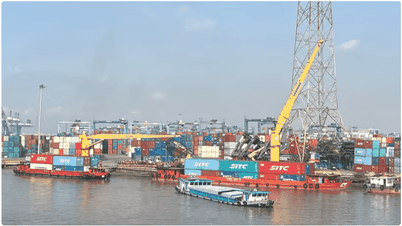
Unloading cargo at Santos port.
Although the information regarding the first export order is relatively positive, some experts also believe that Santos' gas projects will continue to face many other difficulties in the future, especially related to environmental issues and emissions.
6. The Australian Department of Agriculture reviews the Vietnam-Hai Phong Fumigation Company.

The Australian Department of Agriculture, Fisheries and Forestry has issued notification number 03-2026 dated January 8, 2026, placing Vietnam Fumigation Company – Hai Phong branch (AEI code: VN0008MB) in an "under review" status.
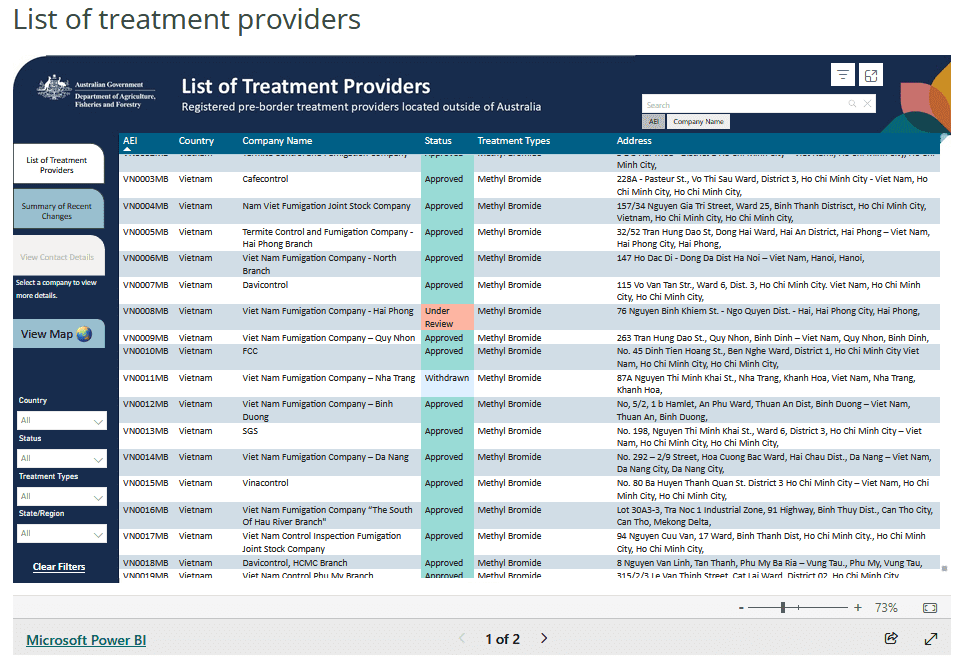
Australian Department of Agriculture, Fisheries and Forestry
Accordingly, certificates issued by Vietnam Disinfection Company - Hai Phong will no longer be accepted from the date of this announcement, including certificates issued before and after the date of the review status announcement.
The Australian Department of Agriculture may require consignments/goods handled by Vietnam Fumigation Company – Hai Phong (AEI: VN0008MB), including those in transit, to implement additional measures to manage biological risks. Consignments/goods are considered in transit when they have left Vietnam but have not yet cleared through Australian border customs. Consignments/goods (including those in transit) will be closely monitored upon arrival at Australian ports.
Source: https://moit.gov.vn/tin-tuc/ban-tin-thi-truong-uc-tu-17-1-2026-den-23-1-2026-.html









































![[Video] Sunset at Lap An Lagoon – Where the sun sets over the fishing nets](https://vphoto.vietnam.vn/thumb/1200x675/vietnam/resource/IMAGE/2026/05/31/1780192137701_beach-landscape-sea-water-nature-grass-745871-pxhere-com.jpeg)





























Comment (0)