

In the late 1980s, we compiled new textbooks that included excerpts from Khái Hưng's "Halfway Through Spring." I sought it out because, in my time, it wasn't easy to find works published before 1945. When I reached the part where Tú Lãm, in his dying wish, instructed his son to "keep a joyful heart, keep a pure soul, and put all his energy into his work," I realized the shortcomings in my own parenting .
Preserving traditional values
My whole life has been dedicated to education. At the age of eight, I followed my father to the regrouping area, and to this day, I have never left the lecture hall or my books. For a long time, whenever a child misbehaves, it seems everyone blames the school and the teachers for only teaching academics and not moral values. Is that true?
To date, almost everyone in our country has had some form of schooling. And everyone knows that each person's learning ability is different; some learn quickly, others slowly. I've noticed that if a teacher can teach 70-80% of the students in the class to grasp the core of the lesson, that's considered excellent. Where would they find the time to teach moral principles? But even if they specialize in teaching moral principles, once they leave school, the social and family environments can sometimes turn those teachings into... a joke. Why?
Through news reports and social media, we see that almost every day there are incidents in schools, many of which are quite offensive. The more we read, hear, and see, the sadder we become, because it's all so familiar. This shows that the task of preserving the nation's beautiful tradition of "respecting teachers and valuing education" has become more urgent than ever.
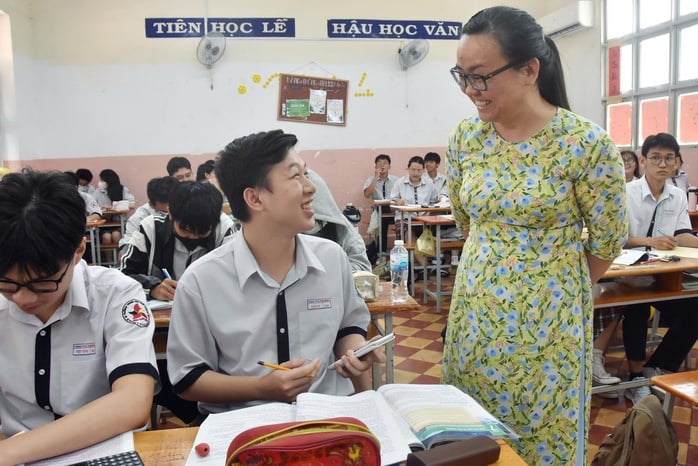
A joyful lesson between teacher and students at Ten Lơ Man High School, Ho Chi Minh City. Photo: TAN THANH
"Respecting teachers and valuing education" - what does "valuing education" mean? In my opinion, "valuing education" first and foremost means valuing the subject matter. The teacher is lecturing on the podium, while the students are daydreaming about other things – that's not "valuing education." Without "valuing education," you can't talk about "respecting teachers." Currently, some subjects aren't tested. Without exams, it's natural for students to be negligent. Students and parents find it difficult to "value education" because they don't see the "immediate benefits," only the "torture." We should reconsider this.
Families and students themselves often demand that teachers teach exceptionally well, encompassing not only professional skills but also character development. Therefore, students must also be aware that they must study hard, with character development being particularly important. Generally speaking, demands cannot be unilaterally placed on schools and teachers; parents and students must also take responsibility for self-learning and cooperate with their teachers.
It is impossible to be humane towards a select few.
Recently, the Ministry of Education and Training issued Circular No. 19/2025/TT-BGDĐT, stipulating that from October 31, 2025, all secondary schools nationwide will apply new regulations on student rewards and disciplinary actions. The disciplinary measure of expulsion has been abolished.
The three forms of disciplinary action are: a warning, criticism, and requiring a self-criticism report. For elementary school students, two forms of disciplinary action are applied: a warning and requiring an apology.
The Ministry of Education and Training's viewpoint is that rewarding and disciplining students should ensure a humane educational approach, for the progress of the students.
On the morning of October 30, 2025, at the 15th National Assembly forum, delegate Nguyen Thi Ha (from Bac Ninh province) proposed a review and assessment of the feasibility and effectiveness of implementing Circular 19 to balance humanistic and disciplinary measures, aiming to supplement disciplinary forms that are rehabilitative but still sufficiently deterrent, modifying behavior, helping students recognize their mistakes and avoid recurrence. Previously, at the 49th session of the National Assembly Standing Committee on the morning of September 23, 2025, the Chairman of the Culture and Social Affairs Committee, Nguyen Dac Vinh, also argued that applying overly lenient disciplinary measures to deviant students would have negative consequences for society.
I agree with this opinion. On October 30, 2025, the Nguoi Lao Dong newspaper published an article titled: "Shocking murder case in Dong Nai: Unexpected circumstances and lifestyle of Le Sy Tung," stating that this individual had been charged with four offenses: "Murder," "Robbery," "Destruction of property," and "Illegal possession, transportation, use, and sale of military weapons."
Le Sy Tung was a student majoring in information technology but dropped out midway through his studies. Since the 11th grade, Tung committed the crime of "theft of property" and was sentenced to 24 months in prison, suspended.
Humanism is part of human culture, but we cannot be humane to a few without being humane to the vast majority. "Causing negative consequences for society" is evident, and Le Sy Tung is just one of many recent cases.
The aspiration of the entire nation
Are the incidents mentioned above the responsibility of the school? If so, it's only a small part, because students spend less time at school than outside. In the "Analects" (chapter "Learning"), Confucius wrote: "When a child enters the home, they should be filial to their parents; when they leave, they should be respectful to their elders; when they leave, they should be cautious in speech and truthful; when they have done all this, they should befriend virtuous people; and when they have the strength left, they should study literature—that is, poetry, calligraphy, rituals, music, and the Book of Changes…".
At the 80th anniversary celebration of Vietnam's National Day, General Secretary To Lam stated: "Looking towards the future, our Party sets the goal that by 2045, the 100th anniversary of the nation's founding, Vietnam will be a powerful, prosperous, and happy nation. That is the aspiration of the entire nation, a solemn oath before history and the people." This aspiration is only possible if it is truly achievable. But to achieve a "powerful, prosperous, and happy nation," the necessary element is not just a few individuals, but the continuous efforts of every citizen. Therefore, to educate people to become "good people" to meet the demands of the nation's rise, we must begin with the family, then society, and only then the school. Current reality has confirmed this.
Back in 2012, at the Rio+20 Summit, Uruguayan President José Mujica emphasized: "Development cannot go against happiness; development must promote human happiness, love between parents, children, and friends. Life is the most important treasure we have, and when we fight, it must be for human happiness" (Nguoi Lao Dong Online, April 13, 2014). We should also take this opinion into consideration.
Source: https://nld.com.vn/ban-ve-chuyen-day-lam-nguoi-196260210204756044.htm






















































































Comment (0)