


"Military engineers" on French soil
In his work *Fighting Pen *, Dong Tung states that *Vietnam Soul* was published in France. According to the *Dong Phap Thoi Bao* (Dong Phap Times) No. 400, dated February 24, 1926, *Vietnam Soul* was published monthly in Vietnamese, French, and Chinese, with the motto: "To defend students and workers in Vietnam or France who are oppressed by tyranny. To restore freedoms in politics and the right to form trade unions; freedom of travel, freedom of speech; freedom of education ; freedom of association. To exchange ideas, hopes, and experiences with each other to help enlighten the spirit." The newspaper was distributed to Vietnam through the *Dong Phap Thoi Bao* as its agent.
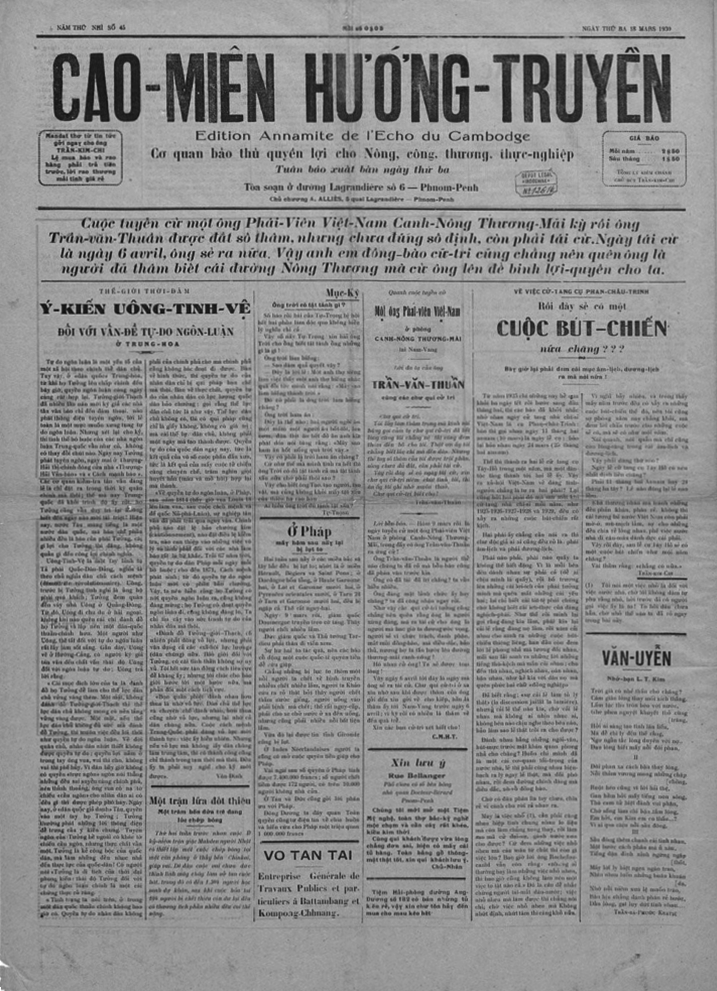
Cambodia News No. 45, issued on March 18, 1930
In France, there was also the newspaper La Tribune Indochinoise . In his memoir "41 Years in Journalism ," Ho Huu Tuong stated that Duong Van Giao, after working as an interpreter in France during World War I, studied and earned a doctorate in law, and became a lawyer at the Paris High Court: "And in 1926, together with Bui Quang Chieu, he founded La Tribune Indochinoise , the organ of the Constitutional Party in France."
Later, the Engineering Corps magazine was published in France in its first issue in 1942. According to the information in the issues of the Engineering Corps magazine, it was a newspaper of the Indochinese labor movement. The magazine's manager was Tran Ngoc Van. Sometimes the magazine wasn't published regularly, so in issue 34 of the Engineering Corps magazine , published in May 1945, there was a passage that read, "during the months when the Engineering Corps magazine didn't meet with its members." The Engineering Corps magazine was not only a source of purely Vietnamese intellectual nourishment in news, literature, and politics for the Vietnamese community in France, but also a bridge for finding relatives. Sometimes, in the Engineering Corps magazine, one could find a message seeking friends, relatives, or colleagues. Issue 33 of the Engineering Corps magazine , published in April 1945, had a "Inquiry" section in which Luong Thanh Tam asked to find a friend, and Tran Van Lieu searched for his niece, Phan Sy Tram.
Even in France, the Engineering Corps magazine occasionally published articles by famous authors from its homeland, collected and sent in by readers. Issue No. 23 of the Engineering Corps , published on March 20, 1944, featured the poem " A Deep Night " by Chế Lan Viên. The magazine provided readers with short stories, poems, and general scientific knowledge, of which "The Cause of Moonlight" in issue No. 23, published on March 20, 1944, is one example.
News about Indochina and France, especially news related to the working class, was given priority. The May 1945 issue No. 34 of the Engineering Corps newspaper covered Indochina news, including reports on inflation in housing prices, rice prices, oil prices, and vegetable prices; it also included an article on the economic situation in Indochina 1940-1944 . In addition, there were other news items, including news from Paris. Articles related to medicine, sports, and famous Vietnamese figures from the past also appeared in the newspaper.
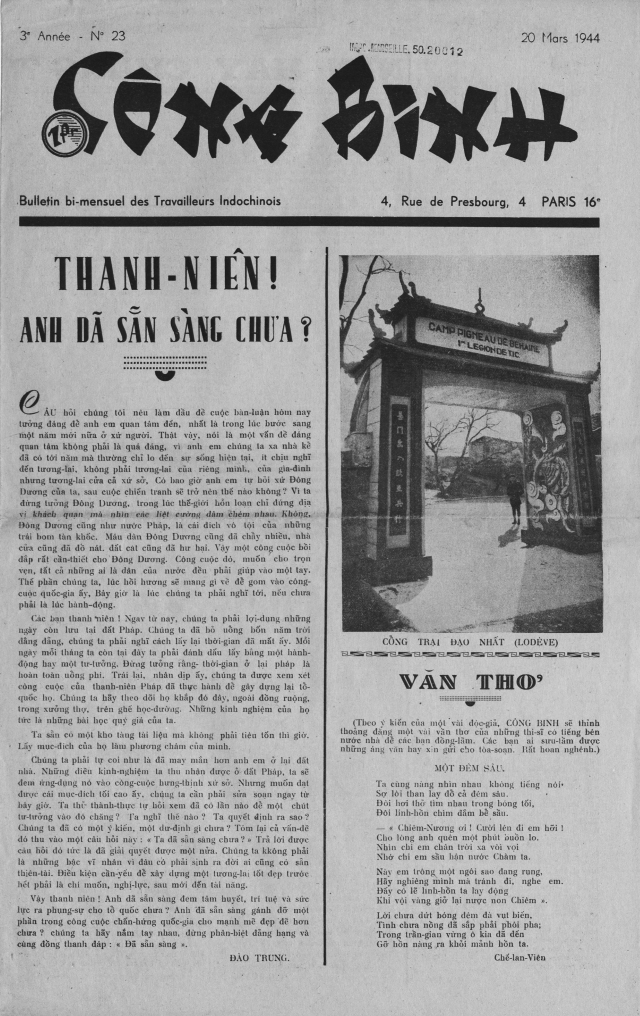
The 23rd Engineering Corps newspaper , published on March 20, 1944, featured the poem "A Deep Night " by Che Lan Vien on its front page.
DOCUMENTS OF DINH BA
Around the Asian continent
Cao Miên Hướng Truyền was a weekly newspaper founded by A. Alliès, with its headquarters at 182 Ang Duong Street, Phnom Penh. Nguyễn Văn Phúc served as the general manager, and Trần Kim Chi was the editor-in-chief. The newspaper introduced itself as "A conservative organ [understood as safeguarding] the interests of agriculture, industry, commerce, and practical industries." The newspaper discussed the national economy as well as that of Cambodia: " Is the Phnom Penh market hygienic enough?" (issue 12, July 30, 1929), "Why is our people poor and our country weak?" (issue 27, November 12, 1929).
The world news section, "Current Affairs," discussed political, military, and speech issues: "Wang Jingwei's Opinion on Freedom of Speech in China" (No. 45, March 18, 1930), "Germany: Clues to the 'Bomb' Planting" have now been uncovered" (No. 36, January 14, 1930). Feuilleton novels in Cambodia served as a literary spice, with "Love is a Web of Misfortune" by VP, "Changing Souls and Bodies " translated by Phan Phoi Dinh, and "Difficult Two Loves " by Van Phi. The "Literary Garden" section, dating back to the newspaper's inception, published poetry. Many cultural, social, and political issues of the country were discussed. For example, cultural issues were discussed in the article "Impressions and Discussion on the 'Reformed Opera' Style" (No. 49, April 15, 1930); Issue No. 13, dated August 6, 1929, discusses the political situation of the Vietnam Nationalist Party in Hanoi and the secret society in Saigon in relation to contemporary world ideology ; it also clearly speaks about several major changes that have recently occurred in Northern Vietnam (issue No. 41, February 18, 1930)...
The advertisements on the last page and some of the following pages featured goods and brands from Cambodia and Vietnam. These included Nguyen Van Vang's Hiep Loi shop selling car parts, Loc Quang photography studio in Phnom Penh (issue 7, published on June 25, 1929); Nguyen Van Que's Chi Thanh gold shop in Saigon, and Thien Hoa Duong pharmacy in Cholon (issue 36, published on January 14, 1930)… The newspaper's first issue was published on May 14, 1929, and its last issue, issue 51, published on April 29, 1930. The final issue stated the reason for the suspension was to reorganize the newspaper.
According to the book *Fighting Pen *, in China there was the newspaper *Youth *, then the *Torch* magazine of the Vietnamese Revolutionary Youth, and the *Military Man* newspaper of Vietnamese students at the Whampoa Military Academy. Siam also had Vietnamese newspapers such as *Dong Thanh*, *Than Ai*, *Dai Chung*, *Tieng Chuong *…
Source link
![[Photo] Prime Minister Pham Minh Chinh receives the Minister of Emergency Situations of the Russian Federation.](https://vphoto.vietnam.vn/thumb/1200x675/vietnam/resource/IMAGE/2026/03/05/1772712011395_ndo_br_thiet-ke-chua-co-ten-76-png.webp)
![[Photo] Rich in color and flavor, Spring Fair - Nhan Dan Newspaper Trade Union](https://vphoto.vietnam.vn/thumb/1200x675/vietnam/resource/IMAGE/2026/03/05/1772699709633_img-2781-2340-jpg.webp)























































Comment (0)